 Nana Banana
How monogamous are humans? Scientists compile ‘league table’ of pairing up.
By Helen Briggs, Environment correspondent
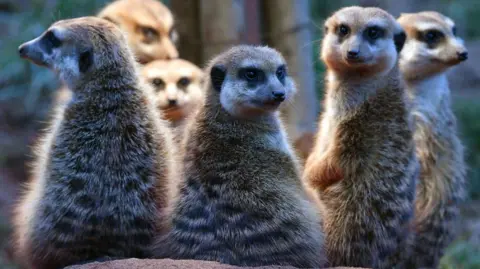
Getty. A group of six meerkats stand on their hindlegs looking back at the camera. They have grey-brown fur, pointed noses and piercing eyes. Meerkats are incredibly social animals and live in large groups known as ‘mobs’ or ‘clans’.

Humans are a bit like meerkats when it comes to pairing up, according to a groundbreaking study that meticulously examined the monogamous lifestyles of a diverse range of species. In the intricate dance of our romantic lives, we more closely resemble these remarkably social, close-knit mongooses than we do our distant primate cousins, a comprehensive "league table" of monogamy compiled by leading scientists suggests. With a monogamy rating of 66%, humans score surprisingly highly in this comparative analysis, far exceeding the pairing-up tendencies of chimpanzees and gorillas – and placing us squarely on par with the steadfast meerkats. However, it is crucial to note that we are by no means the most monogamous creature in the animal kingdom. That prestigious top spot is reserved for the Californian mouse, a species of rodent renowned for forming inseparable, lifelong bonds.
"There is a premier league of monogamy, in which humans sit comfortably, while the vast majority of other mammals take a far more promiscuous approach to mating," stated Dr. Mark Dyble from the esteemed University of Cambridge, shedding light on the unique position of humans. In the vast and varied animal world, the evolutionary strategy of pairing up offers a multitude of significant perks, which may explain why it has independently evolved in multiple species, including our own. Experts have long proposed various compelling benefits to so-called social monogamy, a mating system where individuals match up for at least a breeding season. This arrangement facilitates the crucial cooperative care of their young, ensuring their survival and development, and also provides a united front against potential rivals.
Dr. Dyble, a keen observer of animal behaviour and human evolution, undertook an in-depth examination of several human populations throughout history. His research involved meticulously calculating the proportions of full siblings – individuals who share both the same mother and father – compared with half-siblings, who share either a mother or a father, but not both. This innovative methodology was then applied to compile similar data for more than 30 species known for social monogamy, as well as a range of other mammals with different mating strategies. The findings revealed that humans boast a monogamy rating of 66% full siblings, a figure that places us comfortably ahead of meerkats (60%) but still behind the exceptionally bonded beavers (73%).
Meanwhile, our evolutionary cousins, the great apes, fall starkly at the bottom of this monogamy league table. Mountain gorillas exhibit a remarkably low monogamy rating of just 6%, while chimpanzees come in at an even more striking 4%, a figure shared alongside the highly social dolphin. At the very bottom of the ranking, displaying the most promiscuous mating behaviour observed, is Scotland’s Soay sheep, where females are known to mate with multiple males, resulting in a mere 0.6% full siblings. In stark contrast, the Californian mouse reigns supreme, achieving a perfect 100% monogamy rating, demonstrating an unparalleled commitment to pair bonding.
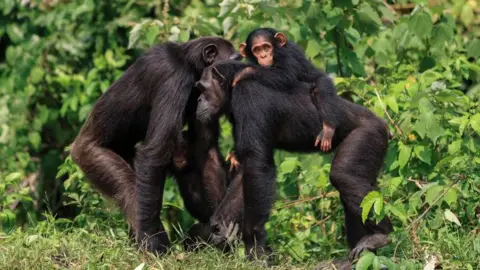
Getty. A baby chimp clings to the back of a mother chimp. She leans against the head and shoulders of another chimp against a backdrop of green foliage. Chimpanzees are highly social and form strong bonds but have very different social structures from humans.
However, while being ranked alongside species like meerkats and beavers in terms of monogamy scores might suggest a degree of social similarity, the reality is that human societies are poles apart from these animal groups. "Although the rates of full siblings we see in humans are most similar to species like meerkats or beavers, the social system that we see in humans is very different," Dr. Dyble explained in an interview with BBC News. "Most of these species live in colony-like social groups or perhaps live in solitary pairs that go around together. Humans are very different from that. We live in what we call multi-male, multi-female groups, within which we have these monogamous, or pair-bonded, units." This distinction highlights the unique complexity of human social structures, which incorporate monogamous units within broader, more diverse group dynamics.
Dr. Kit Opie at the University of Bristol, who was not directly involved in this particular study but is a recognized expert in the field, commented on the significance of the research. "I think this paper gives us a very clear understanding that across time and across space humans are monogamous," he stated, emphasizing the consistent nature of human pair-bonding behaviour. He further elaborated, "Our society is much closer to chimps and bonobos – it just happens that we’ve taken a different route when it comes to mating." This perspective underscores that while the underlying social structures of our closest primate relatives might share similarities, the evolutionary trajectory of human mating strategies has diverged significantly.
Getty. Four sheep graze on fresh green grass below a stone wall. They are dark-brown with wooly fur. Soay sheep are the most promiscuous of all the animals studied.
The new study, a significant contribution to our understanding of evolutionary biology and social behaviour, is published in the prestigious Proceedings of the Royal Society: Biological Sciences, a leading journal for groundbreaking scientific research. This comprehensive analysis offers valuable insights into the diverse strategies employed by species across the animal kingdom to ensure reproductive success and the continuation of their lineage, while also providing a fascinating comparative perspective on the unique mating patterns of our own species. The research serves as a compelling reminder of the intricate web of life and the diverse evolutionary pathways that have shaped the behaviours we observe today, from the steadfast bonds of the Californian mouse to the complex social dynamics of human societies.


 atisusanti
 Nakalama John
 George Anjay