Nana Banana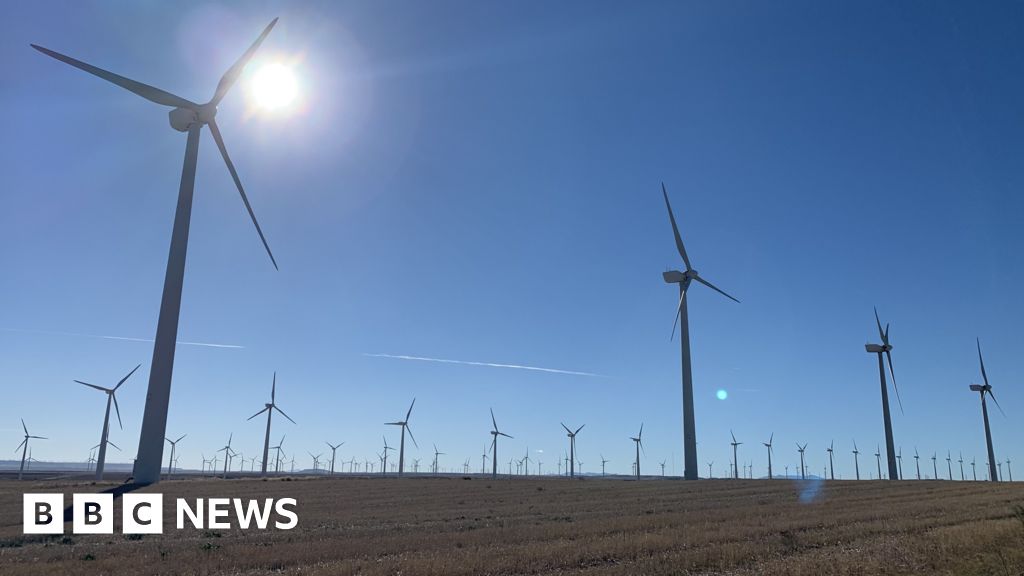
Figueruelas’s symbolic status as a beacon of green progress has recently been further cemented by the groundbreaking commencement of a massive factory nearby, poised to produce batteries for electric vehicles. This monumental undertaking is the result of a joint investment of €4 billion ($4.7 billion; £3.5 billion) by Chinese battery giant CATL and the Netherlands-based automotive conglomerate Stellantis. Yao Jing, China’s ambassador to Spain, heralded the project as "one of the biggest Chinese investments Europe has ever seen," underscoring its strategic importance on a continental scale.
For Luis Bertol Moreno, the mayor of Figueruelas, the choice of location for such a vital facility was not just logical but inevitable. "We’re in Aragón, where there’s wind all year round, there are lots of hours of sunshine, and we are surrounded by wind turbines and solar panels," he explains, highlighting the region’s natural advantages. "Those [energy sources] will be crucial in generating electricity for the new factory, and I understand that was the key reason for building it here in Figueruelas." The abundant, clean energy supply directly addresses a critical need for energy-intensive manufacturing like battery production, making the location a strategic nexus of renewable generation and future-forward industry. Mayor Moreno envisions the factory as a transformative force, not just for the local economy but as a powerful symbol of Spain’s innovative energy model.
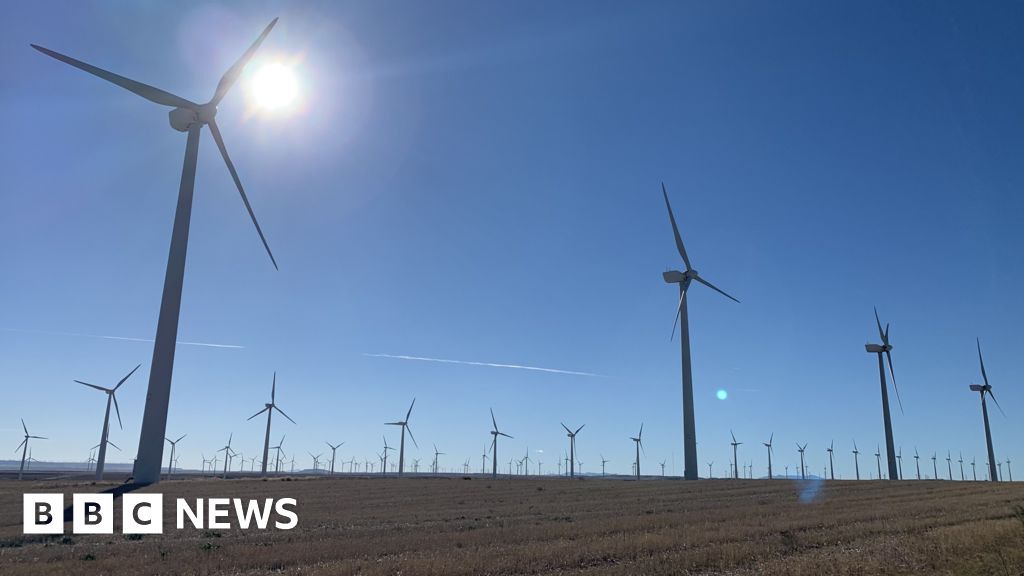
Indeed, this factory can be seen as a powerful vindication of Spain’s national energy strategy, which has steadfastly prioritized renewable sources. Just a few years ago, in 2017, renewables contributed a modest third of Spain’s total electricity production. Yet, by last year, this figure had soared dramatically, with green energy sources representing an impressive 57% of the nation’s electricity mix. This rapid acceleration places Spain at the forefront of the European green energy movement, a trajectory the government aims to continue, targeting an ambitious 81% contribution from renewables to electricity output by 2030.
Earlier this year, Prime Minister Pedro Sánchez encapsulated his government’s unwavering commitment to this vision with a memorable riposte to former US President Donald Trump’s pro-fossil fuel mantra, "Dig, baby, dig." Sánchez, a Socialist, countered with "Green, baby, green," unequivocally pointing to the multifaceted benefits of renewable energy – from environmental stewardship to economic opportunity. His statement underscored a national resolve to harness Spain’s natural assets, such as abundant sunshine and wind, to drive its energy independence and decarbonization goals.
However, despite this impressive progress and the resounding political rhetoric, Spain’s all-in commitment to renewables has recently faced an unexpected and intense period of scrutiny. This critical examination was largely triggered by a widespread power blackout on April 28, an incident that plunged homes, businesses, critical government buildings, public transport networks, and educational institutions across Spain and neighboring Portugal into darkness for several hours. The immediate inability of the government to offer a definitive explanation for the outage quickly propelled the country’s energy mix to the forefront of a fiercely debated political issue.
Alberto Núñez Feijóo, leader of the conservative opposition Partido Popular, seized upon the incident, accusing the government of "fanaticism" in its aggressive pursuit of a green agenda. He strongly suggested that an over-reliance on intermittent renewable sources might have been a contributing factor to the widespread disruption, advocating for a fundamental rethink of the national energy model. The fact that, just a week prior to the blackout, solar generation in mainland Spain had achieved a record-breaking 61.5% share of the electricity mix, further fueled these claims and added weight to the opposition’s arguments about the potential vulnerabilities of a highly renewable-dependent system. The incident provided an opportune moment for critics to question the stability and resilience of Spain’s rapid energy transition.
Despite the political storm, both the government and Red Eléctrica, the national grid operator, have vehemently denied any direct link between the widespread outage and the preponderance of renewable energy sources in Spain. Concha Sánchez, head of operations for Red Eléctrica, firmly stated, "We have operated the system with higher renewable rates [previously] with no effect on the security of the system." She concluded, "Definitely it’s not a question of the rate of renewables at that moment." Ms. Sánchez attributed the blackout to a complex combination of issues, including an "unknown event" within the system moments before the collapse, which manifested as anomalous voltage oscillations. This technical explanation, however, has done little to quell the political debate. Red Eléctrica and the government are still awaiting comprehensive reports on the incident, hoping these investigations will conclusively determine the exact cause. A cyber-attack, initially speculated by some, has been repeatedly and definitively ruled out by authorities.
In the aftermath of the April blackout, Spain’s electricity mix has indeed undergone a subtle but noticeable modification, with a greater reliance on natural gas. This shift, even if temporary or minor, reinforces the notion that the country is currently standing at a critical energy crossroads, grappling with the delicate balance between rapid decarbonization and maintaining grid stability.

Adding further complexity to this evolving energy landscape, Spain’s nuclear industry, which currently provides approximately 20% of the national electricity, has become particularly vocal since the blackout. It is actively pushing back against the government’s long-standing plans to systematically close the country’s five nuclear power plants between 2027 and 2035. This policy makes Spain something of an outlier in Europe, as many other nations, including France, the UK, Poland, and the Czech Republic, are either extending the life of existing reactors or actively pursuing a "nuclear renaissance" to bolster energy security and meet climate targets. The companies that own the Almaraz plant in south-western Spain, slated to be the first to shut down, have formally requested a three-year extension to its operational life, pushing its closure to 2030. That crucial request is currently under consideration by the authorities.
Ignacio Araluce, president of Foro Nuclear, a prominent association representing the nuclear industry in Spain, highlights the unique nature of Spain’s policy. "It’s prudent to have a mix of renewables and nuclear energy," he asserts, emphasizing that Spain is the only country in the world actively scheduling the closure of operational nuclear plants. Araluce champions nuclear energy for its unparalleled stability and its compatibility with the green energy transition, arguing it provides a consistent, baseload power supply that renewables, by their intermittent nature, cannot always guarantee.
While praising renewable sources for their ability to generate electricity from natural elements, Araluce points out their inherent limitation: they cannot operate around the clock or when weather conditions are unfavorable. "How can you produce energy in those hours when the renewables are not producing?" he asks rhetorically. His answer is unequivocal: "with a source like nuclear, that is not producing CO2, that is producing all hours of the year." This argument resonates with political opposition parties, particularly the far-right Vox, which, in criticizing what it perceived as a lack of transparency from the government regarding the April blackout, recently described nuclear power as "a crucial source of stability." The conservative opposition also largely aligns with this view, advocating for a more balanced energy portfolio that includes nuclear power. The Cofrentes nuclear power plant near Valencia, like others, represents a significant point of contention in this ongoing debate.

Concha Sánchez of Red Eléctrica acknowledges that, despite Spain’s pioneering spirit in renewable installation, there remains significant room for improvement in the country’s electricity model. She specifically points to the Iberian peninsula’s relative isolation from the broader European grid, a structural challenge compared to many of its EU neighbors. This limited interconnection means Spain has fewer external resources to draw upon for grid stability when domestic renewable output fluctuates. Furthermore, Sánchez identifies energy storage as a critical bottleneck. "While we have taken a good path when it comes to renewable installation, we cannot say the same regarding storage," she concedes. "We need to foster storage installation." This highlights the urgent need for large-scale battery storage, pumped hydro, and other flexible solutions to ensure the reliability of a grid increasingly dominated by intermittent renewables.
Adding another layer of complexity and uncertainty to Spain’s energy future is its volatile political panorama. The Socialist-led coalition government has been embroiled in a series of corruption scandals, and its parliamentary majority appears to have collapsed in recent weeks, raising the distinct possibility of a snap general election in the coming months. Such a political shift could dramatically alter the nation’s energy trajectory. Polls currently suggest a right-wing government would be the likely outcome, and such an administration would almost certainly place less emphasis on the rapid expansion of renewables. Instead, it would likely advocate for a partial return to more traditional, stable energy sources, potentially including a re-evaluation of the nuclear plant closure schedule and a greater reliance on natural gas or other conventional power generation.
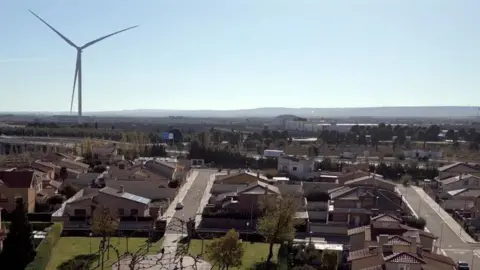
Yet, amidst these national debates and political uncertainties, Spain’s renewable transition, in many tangible ways, continues its momentum on the ground. For Figueruelas, in the heart of Aragón, this means more than just the promise of cheap, clean energy; it translates directly into significant investment and economic revitalization. The town’s current population, a modest 1,000, is projected to increase dramatically with the arrival of 2,000 Chinese workers tasked with building the new battery plant. Once operational, the facility is expected to create up to an astonishing 35,000 indirect jobs, injecting unprecedented vitality into the local economy. As local resident Manuel Martín succinctly puts it, "These kinds of investments revitalize the area, they revitalize the construction sector, hostelry. And the energy is free – it just depends on the sun and the wind." The economic benefits, in this instance, serve as a powerful argument for the green transition, even as the national commitment faces its most significant challenges yet.




 George Anjay
 Ramos Leo
 Roy Suryo
 atisusanti
 Nakalama John