
 George Anjay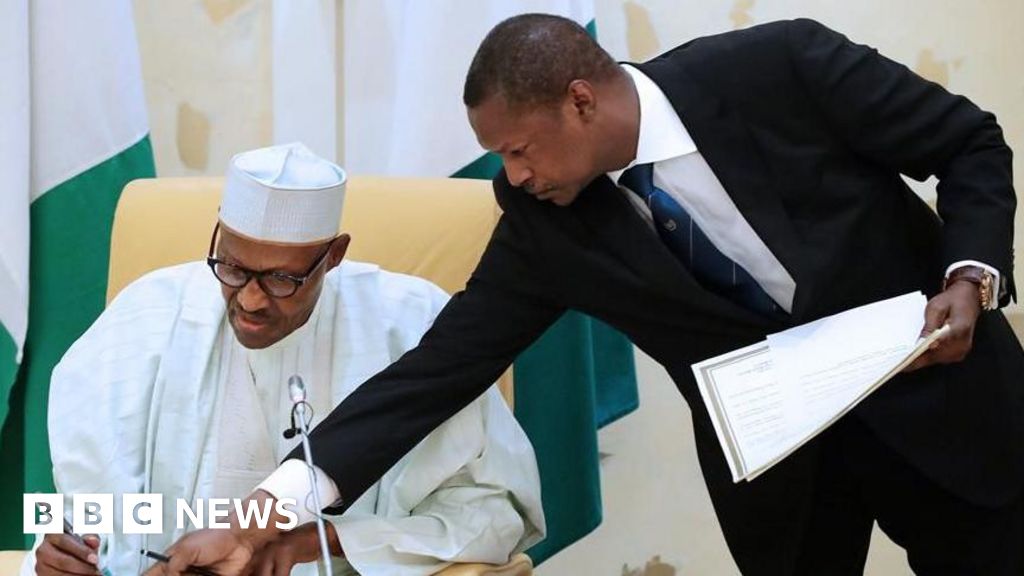
A Nigerian court has granted bail to the country’s former Attorney General and Minister of Justice, Abubakar Malami, along with his wife and son, who are facing a string of serious money laundering and abuse of office charges. The decision by Justice Emeka Nwite of the Federal High Court in Abuja marks a significant development in a case that has cast a long shadow over one of the most influential legal minds in recent Nigerian political history. Malami, a 58-year-old legal practitioner, was a central figure in the administration of former President Muhammadu Buhari, serving as the nation’s chief law officer from 2015 until the end of Buhari’s tenure in May 2023. His tenure was marked by a series of high-profile legal battles and policy decisions that often placed him at the centre of national and international scrutiny.
The charges, filed in December, encompass 16 counts of alleged money laundering and abuse of office. Malami has been in judicial custody since his arrest, a period that has seen him consistently maintain his innocence. In court, he has formally pleaded not guilty to all allegations, asserting that his arrest and subsequent detention are politically motivated. This assertion has been a recurring theme in his defence, hinting at underlying political machinations that he believes are driving the legal proceedings against him.
Malami’s legal and political trajectory has been closely intertwined with the ruling elite. He is married to Nana Hadiza, the third child of former President Muhammadu Buhari. This familial connection underscored his proximity to power during the Buhari administration. In a recent political maneuver, Malami left the ruling All Progressives Congress (APC), the party under which he served for eight years, to join the opposition African Democratic Congress (ADC). This defection is widely seen as a strategic move ahead of the 2027 general elections, positioning him within a political bloc that aims to challenge the APC’s dominance. The ADC is considered a significant contender, and Malami’s entry could potentially reshape the political landscape.
The case against Malami is not an isolated incident within the Buhari administration. He is one of several prominent ministers and officials from that era to face accusations of corruption. Another notable figure is Hadi Sirika, the former Minister of Aviation, who has also been embroiled in corruption allegations related to his tenure. These recurring accusations have fueled public discourse on governance and accountability in Nigeria, raising questions about the integrity of public service and the effectiveness of anti-corruption measures.
In his ruling on Wednesday, Justice Emeka Nwite determined that the charges brought against Malami, his wife, and son were bailable offences. This legal classification paved the way for their release on bail, albeit with stringent conditions. Each defendant has been granted bail set at 500 million naira, a substantial sum equivalent to approximately £260,000 or $350,000. This financial guarantee underscores the seriousness with which the court is treating the case, while also acknowledging the fundamental right to liberty pending the conclusion of legal proceedings.
Beyond the financial bail, the court has imposed further requirements to ensure the defendants’ appearance in subsequent hearings and to prevent any potential flight risk. They are mandated to provide two guarantors each, who must be property owners in designated areas of the nation’s capital, Abuja. This condition aims to establish a tangible link to the jurisdiction and discourage any attempts to abscond. Furthermore, the court has ordered the surrender of all their travel documents, effectively restricting their movement outside of Nigeria. This measure is a standard practice in bail conditions for high-profile cases, designed to maintain judicial oversight.
The Economic and Financial Crimes Commission (EFCC), the primary anti-corruption agency in Nigeria, is spearheading the prosecution. The EFCC alleges that Abubakar Malami, in his capacity as Attorney General, systematically used his influential office to divert substantial government funds. The commission claims that these illicitly acquired funds were subsequently channelled into the acquisition of properties across various major cities in Nigeria, with a particular focus on Abuja. The investigation reportedly involves a complex web of financial transactions and property deals, which the EFCC aims to unravel during the trial. The EFCC’s mandate is to investigate and prosecute economic and financial crimes, and the Malami case represents a significant undertaking for the agency.
The case has been adjourned until February 17, 2025, a date that signals a lengthy legal process ahead. This adjournment provides both the prosecution and the defence with ample time to prepare their respective cases, gather evidence, and present their arguments before the court. The outcome of this trial is likely to have far-reaching implications, not only for Abubakar Malami and his family but also for the broader discourse on accountability and justice within Nigeria’s political and legal spheres. The public will be closely watching the proceedings as they unfold, anticipating clarity on the allegations and the eventual verdict.
The allegations against Malami come at a time when Nigeria is grappling with persistent issues of corruption, which have been identified as a major impediment to economic development and social progress. The Buhari administration had pledged to tackle corruption head-on, and the prosecution of high-profile figures like Malami, even after leaving office, signals a continued commitment to this agenda, albeit through a new administration. The bail granted to Malami, while a step towards due process, does not absolve him of the charges, and the legal battle ahead is expected to be rigorous and closely contested. The courts will now be tasked with meticulously examining the evidence presented by both sides to determine the truth of the allegations. The case serves as a stark reminder of the ongoing efforts to uphold the rule of law and combat corruption in Nigeria, a country striving for greater transparency and accountability in its governance. The resolution of this case will undoubtedly contribute to the ongoing narrative of Nigeria’s fight against graft and its pursuit of a more just and equitable society.



 Ramos Leo
 atisusanti
 Nakalama John

 Roy Suryo