George Anjay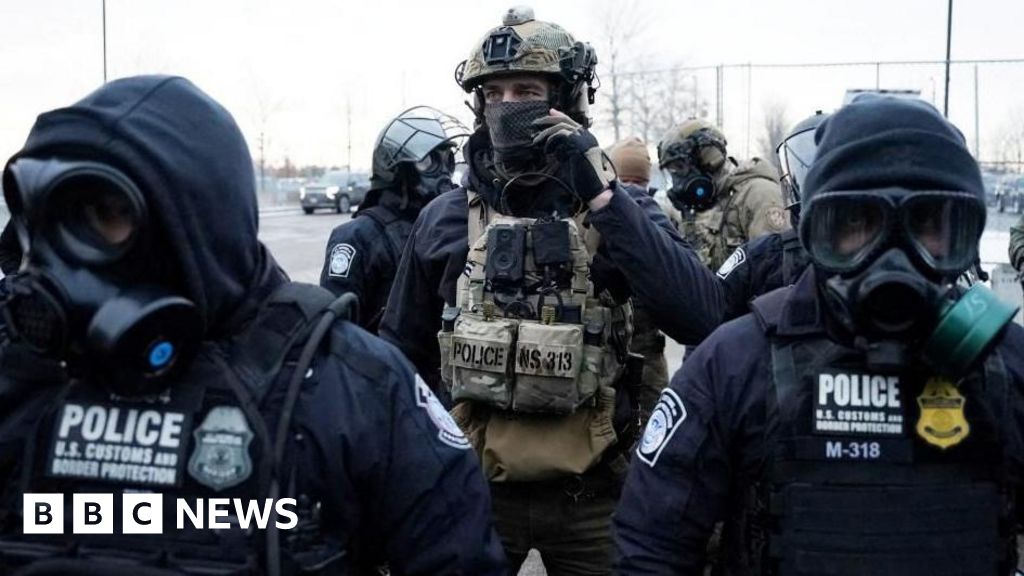
In a significant development with potential implications for civil liberties and public order, approximately 1,500 soldiers are reportedly on standby for potential deployment to Minneapolis, a US defense official disclosed to CBS News, the BBC’s American partner. These troops, currently stationed in Alaska, represent a contingency option for President Donald Trump should he decide to utilize active-duty military personnel amidst ongoing anti-Immigration and Customs Enforcement (ICE) demonstrations that have gripped the city. As of Saturday, the official emphasized that no definitive decision has been made regarding the deployment of these soldiers from their Alaskan bases.
The call for heightened military readiness in Minneapolis follows a period of escalating tensions, particularly after the fatal shooting of US citizen Renee Good earlier this month by an ICE agent. Minnesota officials have issued earnest appeals to protesters, urging them to maintain order and conduct their demonstrations peacefully. The soldiers in question are part of the esteemed 11th Airborne Division, headquartered at Fort Wainwright, underscoring the gravity of the situation and the potential scale of any military intervention.
This readiness for deployment comes in the wake of President Trump’s explicit threat last week to invoke the Insurrection Act, a rarely utilized piece of legislation that empowers the President to deploy active-duty military forces for law enforcement purposes within the United States. The Insurrection Act, a relic of a different era, has historically been invoked in instances of extreme civil unrest or to quell insurrections, and its potential activation in contemporary Minneapolis signifies a dramatic escalation of federal authority.
Adding another layer to the unfolding situation, a US federal judge has issued a critical order that significantly limits the crowd control tactics available to ICE agents when engaging with protesters in Minneapolis. Judge Katherine Menendez’s ruling specifically prohibits federal agents from arresting or deploying pepper spray against individuals participating in "peaceful and unobstructive" demonstrations, including those who are merely observing or monitoring the activities of ICE agents. This judicial intervention reflects concerns about the potential for overreach and the protection of First Amendment rights for citizens engaged in lawful protest.
In anticipation of the anti-ICE demonstrations, the state’s National Guard has already been mobilized and placed on alert by Governor Tim Walz. Furthermore, additional law enforcement personnel have been strategically deployed throughout Minneapolis, a measure aimed at maintaining public order and managing the expected influx of protesters. The current wave of protests in the city was ignited by widespread actions undertaken by ICE and has been further fueled by the tragic death of Renee Good on January 7th.
City officials have stated that Renee Good was present at the ICE activity as a legal observer, a role intended to ensure transparency and accountability. However, the Trump administration has controversially labeled her a "domestic terrorist," a characterization that has drawn widespread condemnation and further amplified the public outcry. Good’s death has resonated beyond Minneapolis, sparking protests across the nation, with many participants carrying signs bearing the poignant slogan "Justice for Renee."
The deployment of federal troops into domestic law enforcement roles is a highly sensitive and controversial issue in the United States, often raising concerns about the militarization of police and the potential for infringements on civil liberties. The Posse Comitatus Act generally prohibits the use of the Army and Air Force for domestic law enforcement, but the Insurrection Act provides a significant carve-out for presidential authority in exceptional circumstances. The debate surrounding the Insurrection Act often centers on the balance between the need to restore order and the fundamental rights of citizens to assemble and protest.
Historically, the Insurrection Act has been invoked sparingly. Most notably, President Eisenhower used it in 1957 to enforce desegregation in Little Rock, Arkansas, by sending federal troops to protect Black students enrolling in a formerly all-white high school. More recently, President George H.W. Bush considered invoking it during the Los Angeles riots in 1992, but ultimately relied on the National Guard and federalized National Guard troops to restore order. The potential invocation by President Trump signals a willingness to employ the most forceful federal tools available, a move that has been met with apprehension by civil rights organizations and some lawmakers.
The specific context of the Minneapolis protests, which are ostensibly directed at ICE actions and are amplified by the death of a civilian legal observer, adds a complex layer to the potential deployment. Critics of ICE have long raised concerns about the agency’s practices, particularly in communities with significant immigrant populations. The notion of federal agents operating with broad authority, potentially backed by the U.S. military, in response to protests against those very agencies, creates a situation ripe for legal and ethical challenges.
The federal judge’s order limiting ICE tactics is a significant judicial check on executive power and highlights the ongoing legal battles over the boundaries of protest and law enforcement. By defining what constitutes "peaceful and unobstructive" protest and restricting the use of force against such demonstrations, Judge Menendez’s ruling seeks to safeguard the rights of protesters while acknowledging the need for law enforcement to maintain order. This ruling could have far-reaching implications for how federal agencies conduct themselves during future demonstrations.
The presence of the 11th Airborne Division, a unit known for its combat readiness and Arctic warfare capabilities, being placed on standby for deployment to an urban environment like Minneapolis raises questions about the suitability and proportionality of such a force. While these soldiers are highly trained, their deployment for domestic law enforcement purposes is an unusual and potentially alarming prospect for many Americans. The visual of heavily armed soldiers on the streets of an American city, even if on standby, can have a chilling effect on public discourse and assembly.
The role of the National Guard, which has already been mobilized, presents a different dynamic. National Guard units are typically state-controlled and are often seen as a more integrated component of domestic security responses. However, when federalized or placed on alert for potential federal deployment, they can also operate under federal command, blurring the lines between state and federal authority. Governor Walz’s decision to mobilize the National Guard indicates a recognition of the potential for unrest and a desire to maintain state-level control over security measures.
The death of Renee Good and the subsequent protests underscore a broader national conversation about immigration enforcement, police accountability, and the rights of citizens to observe and protest government actions. The administration’s labeling of Good as a "domestic terrorist" has been widely criticized as an attempt to discredit the movement and suppress dissent. This strong rhetoric from the executive branch, coupled with the potential for military deployment, creates a charged atmosphere where the boundaries of acceptable protest and government response are being severely tested.
The situation in Minneapolis is thus a complex confluence of factors: ongoing protests against a federal agency, the tragic death of a civilian, the threat of invoking an extreme federal law, judicial intervention to protect protesters’ rights, and the potential deployment of active-duty military personnel. The coming days will likely reveal whether President Trump opts to deploy the soldiers on standby, a decision that would undoubtedly have significant repercussions for Minneapolis and set a precedent for future responses to civil unrest in the United States. The world is watching as this critical juncture in American civil liberties and federal authority unfolds.

 Ramos Leo
 Nakalama John