
 Nana Banana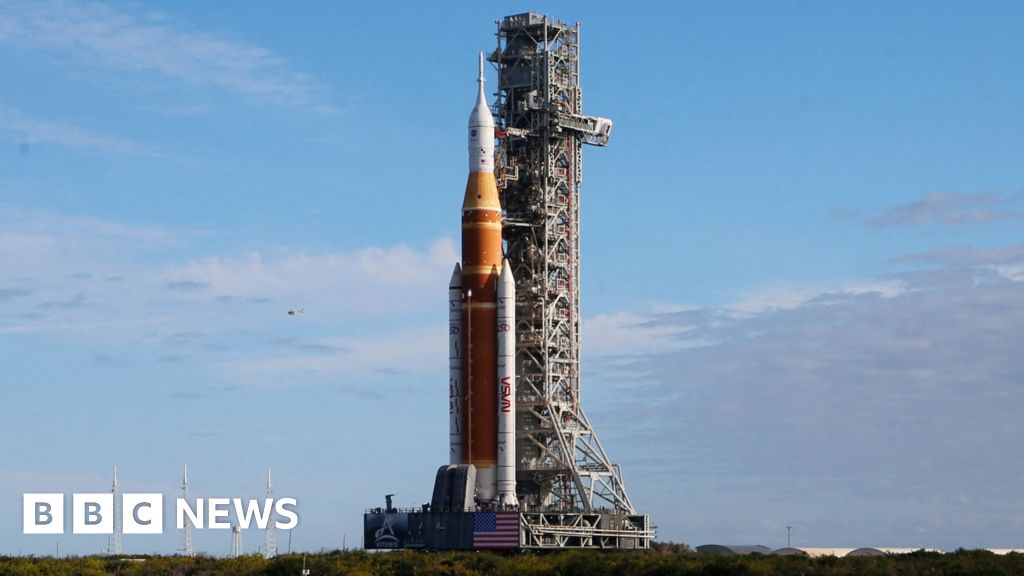
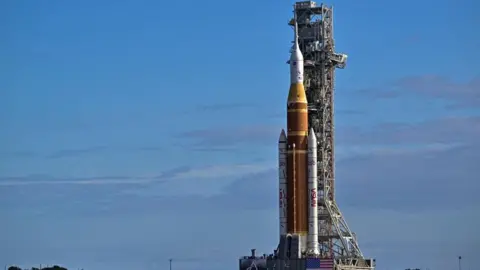
The monumental 98-meter-tall SLS, crowned with the Orion spacecraft, embarked on its methodical 6.5-kilometer (4-mile) trek from the iconic Vehicle Assembly Building (VAB). This intricate process, which saw the fully stacked rocket moved vertically, spanned nearly 12 hours, commencing at 07:04 local time (12:04 GMT) and concluding at 18:41 local time (23:42 GMT) at the historic launch complex. The VAB, one of the largest buildings in the world by volume, has been the assembly point for every Saturn V rocket of the Apollo era and now serves as the birthplace of the SLS, marking a continuation of a legacy of human spaceflight.
The arduous journey was facilitated by an engineering marvel known as the crawler-transporter. This behemoth, weighing an astounding 2,700 metric tons and standing as tall as a two-story building, moved the integrated stack at a glacial top speed of just 1.3 kilometers per hour (0.82 mph). The spectacle, a testament to intricate logistics and precision engineering, was captured live, offering a rare glimpse into the painstaking efforts required for deep-space missions. Its deliberate pace is essential to ensure the stability and integrity of the delicate rocket and spacecraft during transit.

With the SLS now firmly positioned on Launch Pad 39B, the focus shifts to a series of exhaustive final tests, checks, and a comprehensive "wet dress rehearsal." This crucial rehearsal involves fully loading the rocket’s tanks with propellant, practicing the entire countdown sequence, and simulating launch day procedures without actually igniting the engines. This meticulous dry run is indispensable for verifying the readiness of all ground systems, the rocket’s hardware, and the integrated software, ensuring every component is in perfect working order before the actual launch. These steps are vital to guarantee the safety and success of the upcoming 10-day mission, which will see four astronauts journey around the Moon.
Nasa has outlined an ambitious launch window, with the earliest possible blast-off date slated for February 6th. However, the complexities of spaceflight, including orbital mechanics, weather conditions, and the need for absolute readiness, mean that additional launch windows have been identified later in February, as well as in March and April, providing crucial flexibility for the mission planners.
The four intrepid astronauts assigned to the Artemis II mission – Nasa’s Reid Wiseman (mission commander), Victor Glover (pilot), Christina Koch (mission specialist), and Canadian Space Agency’s Jeremy Hansen (mission specialist) – were present at the Kennedy Space Center to witness their future ride to the Moon being rolled out. This diverse crew represents a significant step forward for human spaceflight, including the first woman (Koch), the first person of color (Glover), and the first Canadian (Hansen) to venture on a lunar mission. Their presence underscored the profound human element at the heart of this technological endeavor.
In just a few weeks, these four individuals will be strapped into the Orion spacecraft atop the SLS, poised to make history. This mission marks the first time humans will journey to the vicinity of the Moon since the Apollo 17 mission in December 1972, which saw Eugene Cernan and Harrison Schmitt land on the lunar surface. Artemis II, while not a landing mission, will take its crew further into space than any human has traveled before, pushing the boundaries of human endurance and technological capability.
The primary objective of Artemis II is to validate the Orion spacecraft’s life support systems, test its performance in the deep space environment with a crew aboard, and confirm the operational capabilities needed for future lunar landings. It serves as a crucial shakedown cruise, laying the essential groundwork for the subsequent Artemis III mission, which aims to land astronauts, including the first woman and first person of color, on the Moon’s South Pole. While Artemis III is currently targeted for "no earlier than" 2027, experts widely anticipate it could realistically occur in 2028 or beyond, given the challenges of developing new lunar landers and spacesuits.
Reflecting on the monumental event, astronaut Christina Koch expressed her profound excitement: "Astronauts are the calmest people on launch day. And I think… it feels that way because we’re just so ready to fulfill the mission that we came here to do, that we’ve trained to do." Jeremy Hansen echoed this sentiment, emphasizing the broader impact: "The Moon is something that I’ve taken for granted. I’ve looked at it my whole life, but then you just glance at it and glance away. But now I’ve been staring at it a lot more, and I think others will be joining us and staring at the Moon a lot more as there will be humans flying around the far side and that is just good for humanity." Their words highlight not only their professional dedication but also the deep sense of wonder and inspiration that such missions ignite globally.

The Artemis II mission profile involves a complex trajectory. The initial two days post-launch will be spent in a high Earth orbit, where the crew will conduct critical checkout procedures for the Orion spacecraft. "We’re going to be going into an orbit almost right away that is 40,000 miles out – like a fifth of the way of the Moon," Koch elaborated to BBC News. "We will have the Earth out the window as a single ball, something none of us have seen in that perspective. And then we’re going to travel a quarter of a million miles away… we’re going to do a lot of science and operations along the way." This extended Earth orbit will allow for thorough testing of Orion’s systems before committing to the translunar injection burn.
Once on its translunar trajectory, the crew will perform a lunar flyby, circling the Moon and venturing around its far side, a region unseen by human eyes for over half a century. During this phase, the astronauts will have a dedicated three hours for lunar observation, meticulously gazing at and imaging the lunar surface, studying its geology, and gathering crucial data. This reconnaissance will be invaluable for planning and preparing for future landings, particularly at the Moon’s scientifically rich south pole, believed to harbor significant reserves of water ice in permanently shadowed craters.
A vital international collaboration underpins the Artemis II mission: the European Service Module (ESM). This cylindrical component, which sits directly behind the crew capsule of the Orion spacecraft, is the European Space Agency’s (ESA) indispensable contribution to the mission, built by Airbus in Bremen, Germany. Sian Cleaver, a spacecraft engineer at Airbus, underscored its critical role: "The European Service Module is so important – we basically can’t get to the Moon without it."

The ESM provides the essential propulsion for Orion to reach and return from the Moon, housing the main engine and a series of smaller thrusters for maneuvering. Furthermore, its large solar arrays generate all the electrical power needed for the spacecraft, ensuring continuous operation throughout the mission. Cleaver further explained its life-support functions: "We’ve also got these big tanks full of oxygen and nitrogen, which are mixed to make air, and also water, so that we can provide everything that the astronauts need in the crew module to keep them alive on their journey." This intricate piece of engineering is a testament to global partnership in space exploration, with European technology enabling American astronauts to return to the Moon.
Inside Airbus’s state-of-the-art cleanroom facilities, teams are already diligently working on building subsequent ESMs for future Artemis missions. Each module is a product of thousands of engineering hours in design and approximately 18 months of meticulous assembly. The demand for perfection is absolute. "We’ve got to get those astronauts to the Moon and then back again, completely safely," Cleaver affirmed, highlighting the paramount importance of reliability and safety ingrained in every stage of the design and manufacturing process.
As the rocket now stands on Launch Pad 39B, the Artemis team is engaged in an intense, round-the-clock effort to prepare it for its historic lift-off. The Artemis program has faced several years of delays, a common challenge in complex, cutting-edge space endeavors, leading to understandable pressure on Nasa to expedite the mission. However, the agency remains steadfast in its commitment to prioritize safety above all else. John Honeycutt, chair of the Artemis mission management team, reiterated this core principle: "I’ve got one job, and it’s the safe return of Reid and Victor and Christina and Jeremy. We’re going to fly when we’re ready… crew safety is going to be our number one priority." This unwavering focus on astronaut safety underscores the inherent risks and monumental stakes of sending humans into deep space, ensuring that while the world watches with anticipation, no shortcuts are taken in the journey back to the Moon.




 George Anjay

 Ramos Leo
 Nakalama John