Nana Banana
This delayed embrace of human companionship, in true feline style, sets cats apart from other domesticated animals like dogs, whose ties with humans stretch back tens of thousands of years. The shift from the independent, solitary existence of a wildcat to the pampered, purring companion we know today was a gradual process, driven by mutual benefit rather than direct human intervention in the initial stages. Professor Greger Larson of the University of Oxford, a lead researcher in the study, highlighted the surprising recency of this profound connection. "They are ubiquitous, we make TV programmes about them, and they dominate the internet," he noted, underscoring the stark contrast between their modern cultural prominence and the relatively short span of their domestication history. "That relationship we have with cats now only gets started about 3.5 or 4,000 years ago, rather than 10,000 years ago."

The lineage of all modern domestic cats (Felis catus) traces back to a single ancestor: the African wildcat (Felis lybica lybica). For years, the precise details of how, where, and when these agile hunters shed their wildness to develop intimate bonds with humans remained largely a scientific enigma. To unravel this mystery, an international team of researchers embarked on an ambitious project, meticulously analyzing ancient DNA extracted from cat bones discovered at archaeological sites spanning across Europe, North Africa, and Anatolia. By precisely dating these bones and comparing their genetic makeup with the diverse gene pool of contemporary domestic cats, scientists were able to construct a much clearer evolutionary timeline.
The findings decisively contradict the long-held hypothesis that cat domestication began in the Levant, coinciding with the dawn of agriculture when human settlements first started storing grain, inadvertently attracting rodents and, consequently, wildcats. Instead, the new evidence suggests a different narrative, one that unfolded millennia later and predominantly in ancient Egypt. This makes the domestication of cats an "Egyptian phenomenon," as Professor Larson describes it. This geographical shift aligns perfectly with historical and cultural records, where the land of the pharaohs is renowned for its profound reverence for felines. Ancient Egyptians not only immortalized cats in their art and hieroglyphs but also deified them, most famously through the goddess Bastet, who was often depicted with the head of a lioness or domestic cat. The practice of mummifying cats further underscores their revered status and deep integration into Egyptian society.

Once this unique bond was forged in Egypt, cats began their remarkable journey across the globe. Their utility as natural pest controllers, particularly aboard ships laden with grain, facilitated their rapid dispersal. These "ship cats" were invaluable in protecting food supplies from rodents, making them highly prized companions for seafarers and traders. This efficient mode of transport meant that cats reached Europe considerably later than previously estimated, only arriving around 2,000 years ago, largely accompanying the Roman Empire’s expansion. From Europe, they continued their eastward migration, traversing the ancient Silk Road into China and beyond. Today, domestic cats have colonized nearly every corner of the world, with the notable exception of the frigid continent of Antarctica, a testament to their adaptability and the enduring human desire for their companionship.
In an intriguing subplot to the domestication story, the scientists uncovered evidence of an entirely separate, temporary relationship between humans and another species of wild cat in China. Long before domestic cats arrived from the west, the indigenous leopard cat (Prionailurus bengalensis) coexisted with human communities in China for approximately 3,500 years. These small, elegantly spotted wildcats were found in human settlements, suggesting a unique, albeit different, form of interaction.
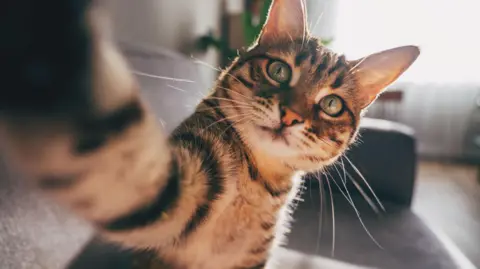
Professor Shu-Jin Luo of Peking University in Beijing explained this relationship as primarily "commensal." In a commensal relationship, one species benefits while the other is largely unaffected or even benefits indirectly. "Leopard cats benefited from living near people, while humans were largely unaffected or even welcomed them as natural rodent controllers," she stated. The abundance of rodents drawn to human grain stores provided an easy food source for the leopard cats. However, unlike their African wildcat cousins, the leopard cats never underwent full domestication. There is no evidence of genetic changes indicative of selective breeding or a deep, dependent bond with humans. They maintained their wild instincts and continue to thrive as wild animals across Asia.
Curiously, despite never being domesticated, leopard cats have re-entered the human sphere in a modern context. In the 1980s, they were intentionally crossbred with domestic cats to create a striking new hybrid breed known as the Bengal cat. These beautiful felines possess the exotic appearance of their wild ancestors combined with the affectionate temperament of domestic cats, making them highly sought after pets today. This fascinating juxtaposition highlights the complex and multifaceted ways in which humans and felines have interacted throughout history.

The groundbreaking research providing these insights into feline domestication was published across two prestigious scientific journals, Science and Cell Genomics, affirming the rigorous methodology and significant implications of these findings for our understanding of one of humanity’s most cherished animal companions. The journey of the cat, from elusive wild hunter in ancient North Africa to the internet sensation and beloved family member of today, is a testament to an evolutionary partnership that, it turns out, began much later, and perhaps more independently, than we ever imagined.




 Ramos Leo
 Nakalama John
 George Anjay