Nana Banana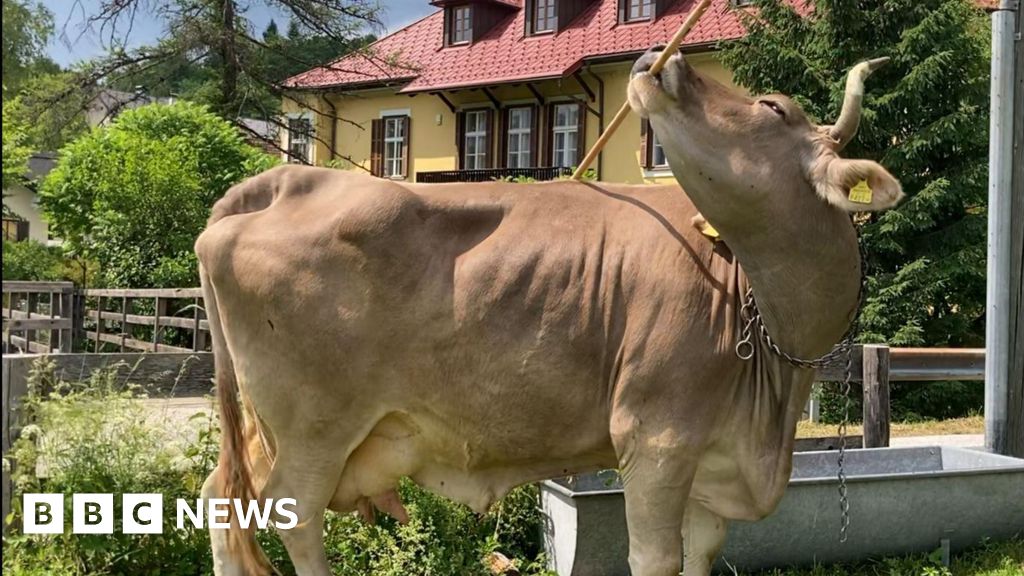
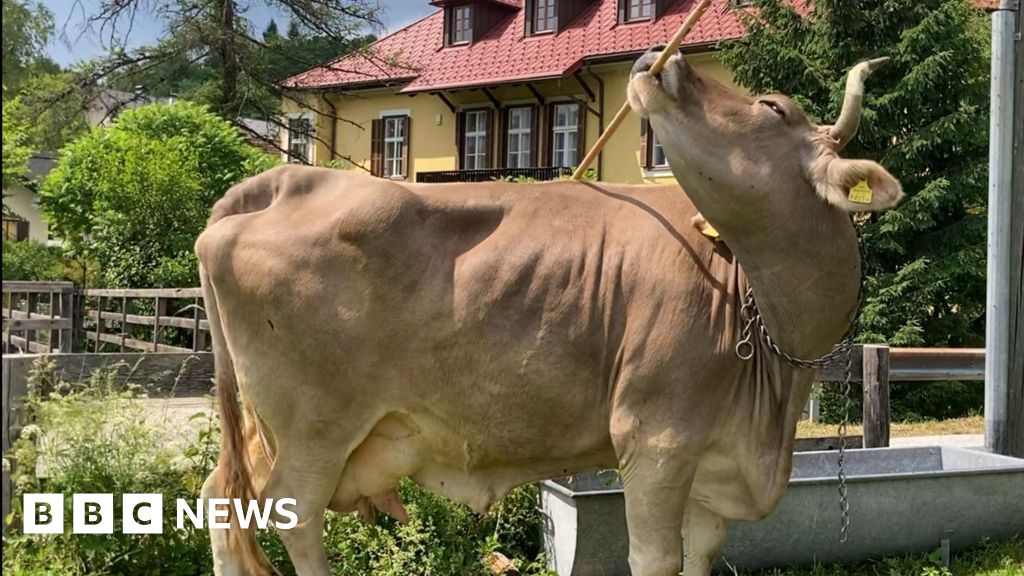
Veronika, a striking Swiss Brown cow residing in a tranquil mountain village nestled within the picturesque Austrian countryside, has spent an impressive span of years refining her unique ability to employ various implements for personal grooming. Her chosen tools include an assortment of sticks, garden rakes, and even robust deck brushes, which she manipulates with remarkable dexterity to alleviate itches and maintain her coat. This extraordinary behavior, initially observed by her owner, Witgar Wiegele, and later brought to the attention of animal intelligence specialists, has ignited a fervent discussion within the fields of ethology and comparative cognition.
The journey of Veronika’s story from a local curiosity to a global scientific marvel began with Wiegele’s casual observations of his prized cow. For years, he watched Veronika instinctively pick up discarded objects around the farm and skillfully apply them to her flanks or back, areas often difficult for a cow to reach independently. What might have been dismissed as mere instinctual rubbing against objects quickly escalated in complexity, as Veronika began to exhibit a clear preference for certain items and an increasingly refined technique. Wiegele, recognizing the unusual nature of her actions, eventually shared his observations, which ultimately reached the ears of Dr. Antonio Osuna-Mascaro and his team at the University of Veterinary Medicine in Vienna, specialists renowned for their work in animal cognition.
Upon closer examination, the researchers were astonished by the nuance of Veronika’s technique. Not only did she select appropriate tools for the task of scratching, but she also demonstrated an advanced understanding of their properties. Crucially, their observations confirmed that Veronika was adept at utilizing both ends of a single object for distinct purposes. For instance, a rake might be used with its tines to vigorously scratch a particularly persistent itch, while its handle could be employed for a more gentle rub on a sensitive area. This nuanced application of a "multipurpose tool" is a hallmark of advanced cognitive function, a behavior that, until now, has been consistently and complexly reported almost exclusively in higher primates, particularly chimpanzees.
Dr. Osuna-Mascaro articulated the profound surprise felt by his team: "We were not expecting cows to be able to use tools, and we were not expecting a cow to use a tool as a multipurpose tool. Until now this has only been consistently reported in chimpanzees." This statement underscores the monumental shift in perspective Veronika’s actions demand. Tool use in the animal kingdom is a widely studied phenomenon, ranging from sea otters using rocks to crack shells to various bird species employing twigs to extract insects. However, the deliberate selection, manipulation, and adaptive application of multiple parts of a single tool for different, specific tasks places Veronika in an elite category, suggesting a level of planning, problem-solving, and environmental awareness rarely attributed to livestock.
The implications of Veronika’s ingenuity extend far beyond a single, clever cow. Her case compels scientists to fundamentally re-evaluate the cognitive capabilities of all bovine species. For decades, cattle have largely been viewed through the lens of their utility in agriculture, with their intellectual capacity often underestimated or simply unexamined. This discovery now opens avenues for extensive research into the cognitive landscapes of cows, potentially revealing complex social structures, communication methods, and problem-solving skills that have, until now, remained hidden in plain sight. It suggests that the perceived intelligence gap between humans and many other species might be far narrower than conventionally assumed, especially for animals we interact with daily but rarely give credit for complex thought.
Furthermore, Veronika’s story sheds light on the potential for similar, unrecognized abilities in other cows. The researchers speculate that countless other bovines across the globe might possess comparable cognitive talents that have simply gone unnoticed by human observers. Often, animals in agricultural settings are not afforded the opportunity or the environment conducive to demonstrating such behaviors, nor are they typically subject to the kind of detailed, open-minded observation that led to Veronika’s discovery. This calls for a broader, more empathetic approach to animal husbandry and scientific inquiry, encouraging farmers and researchers alike to look beyond conventional expectations and appreciate the rich inner lives of the creatures around them.
Witgar Wiegele, Veronika’s owner, views her unexpected talents not merely as a scientific curiosity but as a powerful symbol. He hopes that Veronika’s story will serve as a poignant reminder and an inspiration for people to foster a deeper appreciation for the natural world and all its inhabitants. His philosophy, succinctly captured in his words, "Save the nature, then you protect yourself. Nature diversity is the key to survive on this planet," resonates deeply with the implications of Veronika’s intelligence. Her ability to innovate and adapt using her environment highlights the intrinsic value of every species and the intricate web of life. It emphasizes that nature’s wonders are not confined to exotic, wild animals but can be found even in the most familiar of creatures, if only we take the time to observe and understand them.
The ripple effect of Veronika’s discovery is expected to stimulate new research protocols and ethical considerations in animal welfare. If cows possess such advanced cognitive abilities, it necessitates a re-evaluation of their living conditions, their mental stimulation, and our overall interaction with them. Future studies might explore the conditions under which tool use emerges in cattle, whether it can be taught, or if it is a spontaneous innovation linked to individual intelligence and environmental opportunity. Researchers may also investigate genetic predispositions or specific brain structures that enable such complex behaviors in cattle.
In conclusion, Veronika the Swiss Brown cow has not just astonished scientists; she has opened a new frontier in understanding animal intelligence. Her skillful and purposeful use of tools, particularly as a multipurpose implement, fundamentally challenges preconceived notions about bovine cognition and places her in an exclusive club of animals demonstrating advanced problem-solving. Her story is a compelling testament to the unexplored depths of the animal mind, urging humanity to look closer, listen more intently, and ultimately, appreciate the profound intelligence that thrives in the most unexpected corners of the natural world.


 George Anjay
 Ramos Leo
 Nakalama John