
 Roy Suryo
Amber health alerts have been issued by the UK Health Security Agency (UKHSA) for the North East and North West of England, signalling a heightened risk due to current low temperatures. Concurrently, less severe yellow cold health alerts are in effect across the remainder of England, encompassing the East Midlands, West Midlands, South East, South West, East of England, Yorkshire and the Humber, and London. These alerts, which are scheduled to remain active until 12:00 GMT on Monday, January 5th, serve as crucial warnings to the public about potential health risks posed by prolonged periods of cold weather.
The sophisticated weather health alert system is a collaborative effort between the UK Health Security Agency (UKHSA) and the Met Office, designed to proactively address the health impacts of extreme weather conditions. This system operates on a seasonal basis, with cold health alerts issued annually from November 1st to March 30th, and their counterparts, heat health alerts, published during the warmer months, from June 1st to September 30th. Beyond merely informing the general public, the alerts are meticulously disseminated to key stakeholders, including NHS England, governmental bodies, and healthcare professionals, providing them with vital guidance to prepare for and respond to adverse weather events. The alerts are systematically categorised based on their severity, ensuring a nuanced understanding of the potential risks. This comprehensive system was specifically developed with the overarching goal of mitigating illness and reducing mortality rates during periods of extreme hot and cold weather, thereby safeguarding public health.
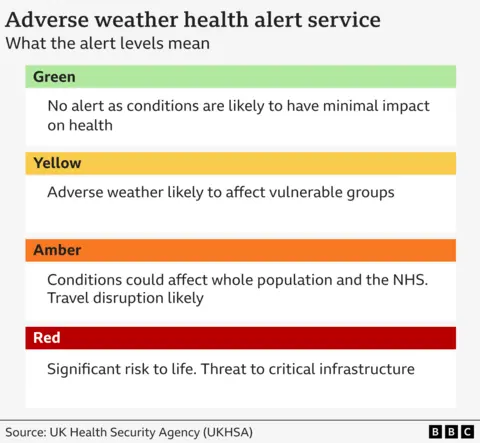
The determination of the alert level is a data-driven process, relying on precise forecasts and temperature data provided by the Met Office. The system encompasses four distinct levels of severity, ranging from the least concerning "Green" to the most critical "Red."
The "Green" level signifies the normal operational state, where the primary focus is on providing general advice and recommendations on how individuals and communities can prepare and respond effectively should temperatures begin to deviate significantly, either rising or falling. This proactive approach aims to build resilience within the population.
"Yellow" alerts are activated during periods of hot or cold weather that are predicted to have a discernible impact, but are primarily anticipated to affect those individuals who are particularly vulnerable. This includes, but is not limited to, the elderly, young children, and individuals with pre-existing chronic health conditions. The aim is to encourage these groups to take appropriate precautions.
"Amber" alerts are issued when the prevailing weather conditions escalate to a point where they could potentially pose a risk to the wider population. At this level, the National Health Service (NHS) may experience a notable increase in demand, with a potential rise in calls to GPs and emergency ambulance services. Furthermore, amber alerts often indicate a likelihood of travel disruption, affecting transportation networks and potentially impeding access to essential services.
The "Red" alert represents the most severe classification within the system. This level is reserved for situations where the extreme weather conditions are deemed to present a significant and immediate risk to life, not only for vulnerable populations but also for the general healthy population. Red alerts also signify a potential threat to critical national infrastructure. This could manifest as widespread power outages, significant disruptions to road and rail networks, and other failures that could have a profound impact on societal functioning.
The impact of cold weather on the human body is a well-documented phenomenon, contributing to a range of health challenges. During the winter months, viruses that cause common colds, flu, and sore throats tend to spread more readily. Furthermore, cold temperatures can exacerbate respiratory conditions, making individuals more susceptible to infections like pneumonia, which is characterized by inflammation in the lungs due to an infection. Cases of norovirus, commonly known as the winter vomiting bug, also tend to see an increase during this period.
Professor Damian Bailey, an expert from the University of South Wales, has shed further light on the physiological effects of cold exposure. In a program for BBC Radio 4’s "Inside Health," presenter James Gallagher participated in an experiment where he spent 30 minutes in a room where the air temperature was progressively lowered from 21°C to 10°C. The results of this controlled experiment revealed significant physiological changes. During the exposure, blood flow to Gallagher’s brain decreased, his blood pressure and heart rate both elevated, and the temperature of his extremities – including his arms, legs, and head – dropped considerably. Moreover, his cognitive function was demonstrably affected, as he took a significantly longer time to complete a series of puzzles.
Professor Bailey highlights that 18°C is a critical threshold for the human body. Below this temperature, the body must expend considerable energy and resources to maintain its core temperature, a process that can place significant strain on the cardiovascular system. This increased physiological stress is a primary reason why heart attacks and strokes are observed to be more prevalent during the colder winter months.
In circumstances where it is not feasible to maintain indoor room temperatures at or above 18°C, Professor Bailey offers practical advice for mitigating the adverse effects of cold. He recommends adopting simple yet effective measures such as wearing warm clothing, including gloves, thick socks, and a woolly hat, to trap body heat. Adjusting dietary habits to include a higher proportion of carbohydrate-rich foods can provide the body with more energy to generate heat. Additionally, increasing physical activity and moving around more frequently can also help to generate internal body heat and improve circulation. By understanding the mechanisms by which cold weather affects the body and by implementing these preventative strategies, individuals can better protect themselves from the health risks associated with low temperatures. The existence and understanding of the cold health alert system are vital tools in this ongoing effort to safeguard public well-being during the winter season.



 Ramos Leo
 atisusanti
 Nakalama John
 Nana Banana