Nana Banana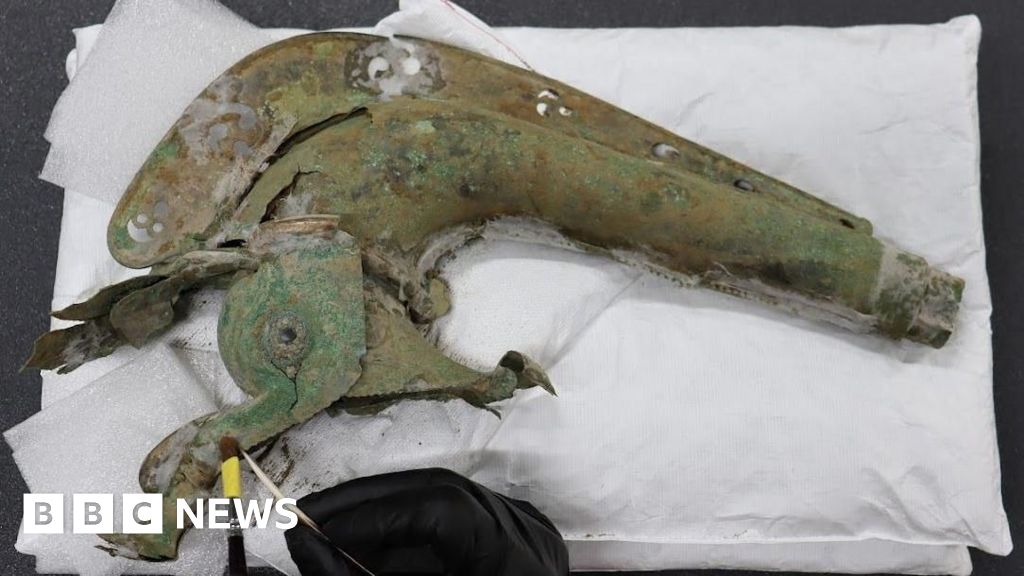
Archaeologists have hailed a recent discovery near Thetford, Norfolk, as "a discovery of a lifetime," after unearthing an unprecedented hoard containing two of the rarest and most significant Iron Age objects ever found in Europe: a remarkably complete carnyx, or battle trumpet, and the first-ever boar’s head flag standard discovered in Britain. This extraordinary find, dating to a pivotal period between 50 BC and AD 50, promises to redefine our understanding of Iron Age warfare, ritual, and artistry in ancient Britain.
The groundbreaking excavation was conducted last year by a team from Pre-Construct Archaeology on a building site just a few miles from Thetford. What began as a routine archaeological assessment quickly transformed into an electrifying quest when dig leader Peter Crawley experienced a profound "gut feeling" about the site. "It felt like one of those special sites that you do get every so often," he recounted, a premonition that proved astonishingly accurate. His intuition led the team to uncover a tightly packed hoard that had lain undisturbed for two millennia, preserving its precious contents in the sandy Norfolk soil.
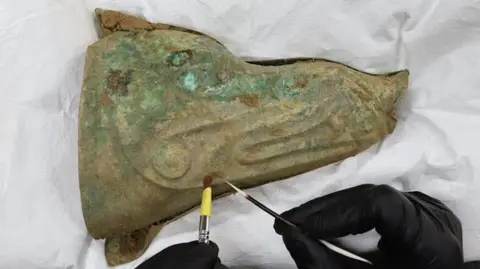
At the heart of this treasure trove lay the most complete carnyx ever recovered in Europe. Carnyces were towering, bronze wind instruments, typically measuring over two metres long, designed to be held vertically with a bell-shaped mouth fashioned into the head of an animal, often a boar or a serpent. This particular carnyx features a striking animal head, complete with a gaping mouth and an intricate crest, and, as conservator Jonathan Carr noted, "a wonderful little eye, which is a remarkable survivor and you can’t help but be impressed and charmed by it." Its intricate design suggests sophisticated craftsmanship, hinting at a society with advanced metallurgical skills and a rich symbolic culture.
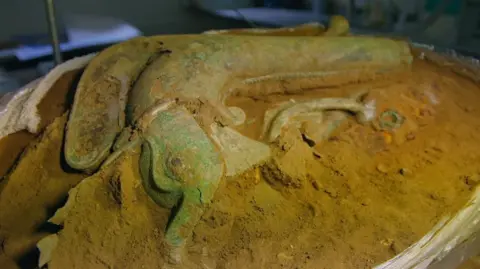
Senior project officer Gary Trimble, speaking on BBC Two’s Digging for Britain, underscored the immense rarity of the carnyx. "Carnyces are extraordinarily rare," he stated, explaining that only a handful of fragments have been found across Britain and continental Europe. Prior to this, Britain had only yielded two other partial carnyx finds: the Deskford Carnyx in Scotland and a fragment from the Ulceby hoard in Lincolnshire. The Thetford carnyx, however, stands apart as the most complete example, with its pipe, mouthpiece, and bell all uniquely intact. This completeness offers an unparalleled opportunity for researchers to study its construction, acoustics, and cultural significance.
These formidable instruments played a crucial role in Celtic warfare, serving multiple functions. Their primary purpose was psychological warfare, producing a loud, jarring, and arguably terrifying sound intended to intimidate enemies and strike fear into their hearts before battle. Beyond mere noise, carnyces were also vital for communication on the battlefield, enabling commanders to issue commands and rally their warriors amidst the chaos. They likely held deep ritualistic significance, perhaps used in ceremonies or as symbols of tribal identity and power. The Romans themselves were fascinated by carnyces, frequently depicting them as exotic war trophies on monuments like Trajan’s Column, testament to their potent imagery and impact.
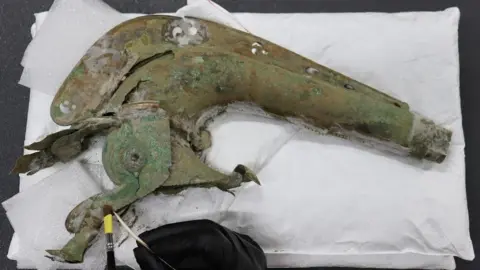
Adding to the breathtaking nature of the find was the discovery of the first-ever boar’s head flag standard found in Britain. Crafted from delicate sheets of bronze, this standard would have been mounted atop a pole and carried aloft during battle, much like a modern regimental flag. Its presence underscores the sophistication of Iron Age military organisation and the importance of visual symbols in inspiring troops and defining allegiance. Dr. Fraser Hunter, Iron Age and Roman curator at National Museums Scotland, highlighted the profound symbolism of the boar: "They were very fierce animals to face in the hunt, so the symbolism of the boar is a lot about the strength of it – a very appropriate adversary in battle." For Celtic tribes, the boar embodied ferocity, courage, and untamed power, qualities highly valued in warriors. To carry such a standard into conflict would have been a powerful statement of tribal identity and martial prowess.
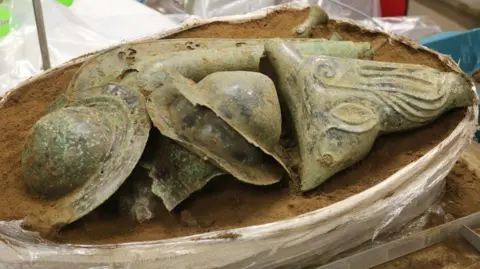
The hoard, carefully dated to the period just before and during the early stages of the Roman conquest of Britain, also included five shield bosses and an enigmatic iron object whose purpose remains unknown. The presence of multiple shield bosses suggests that these artifacts were not merely isolated items but part of a collective, possibly belonging to a group of high-status warriors or even an entire unit. This assemblage prompts intriguing questions about why such valuable and symbolic objects were buried together. Was it a votive offering to the gods, a ritualistic burial marking a significant event, or perhaps hidden for safekeeping in anticipation of conflict, such as the impending Roman invasion or local skirmishes?
The area around Thetford holds deep historical significance, being within the traditional territory of the Iceni tribe, renowned for their fierce resistance against the Romans, famously led by Queen Boudica in her uprising in AD 60-61. The dating of the hoard places it squarely within the era of increasing Roman presence and the subsequent tension that would erupt into revolt. These objects, therefore, offer a tangible link to the martial culture of the Iceni and other East Anglian tribes during a critical juncture in British history. "We have our fair share of hoards in Norfolk, but this is so, so different – it is really, really special," Gary Trimble added, emphasizing its unique connection to the region’s storied past.
The archaeological process itself was a testament to meticulous care and interdisciplinary collaboration. Once the hoard was identified, it was not immediately excavated piece by piece. Instead, the entire block of soil containing the fragile artifacts was carefully lifted from the ground, a technique known as "block lifting." This method is crucial for preserving delicate and heavily corroded items, as it allows for their extraction in a controlled laboratory environment, maintaining their precise spatial relationships.
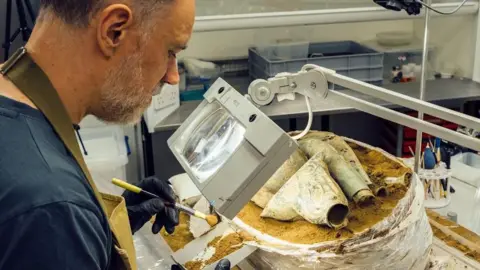
Back in the lab, the soil block underwent extensive scanning, including X-rays and CT scans, to map the exact location and condition of each artifact before conservation work could begin. Conservator Jonathan Carr faced an immense challenge: the objects, particularly the carnyx and boar standard, were made "from extremely thin sheets of metal which have become extremely brittle after 2,000 years in the ground." His painstaking work involved delicately removing the surrounding soil, consolidating the fragile metal, and piecing together fragments, all while aware of the risks involved. The successful conservation effort has brought these ancient masterpieces back from the brink of decay, allowing their stories to be told.
The significance of these finds extends beyond their archaeological rarity. Dr. Fraser Hunter noted that the full research and conservation of these incredibly fragile remains "will reshape our view of sound and music in the Iron Age," offering unprecedented insights into the auditory landscape of ancient Britain and the role of musical instruments in warfare and ceremony. Similarly, the boar standard provides a unique window into Celtic military insignia and the powerful animal symbolism central to their worldview.
This monumental discovery has brought together a consortium of experts and institutions. Historic England is coordinating the research and conservation efforts in collaboration with Pre-Construct Archaeology, Norfolk Museums Service, and the National Museum of Scotland. The find has been reported to the coroner, and an inquest will be held to officially determine if it constitutes "treasure" under UK law, a process that will decide its long-term future and eventual ownership. The hope is that these remarkable artifacts will ultimately find a permanent home where they can be researched, conserved, and displayed for the public.
Dr. Tim Pestell, senior curator of archaeology for Norfolk Museums Service, expressed profound excitement: "This find is a powerful reminder of Norfolk’s Iron Age past which, through the story of Boudica and the Iceni people, still retains its capacity to fascinate the British public." He stressed that "The Norfolk Carnyx Hoard will provide archaeologists with an unparalleled opportunity to investigate a number of rare objects and ultimately, to tell the story of how these came to be buried in the county 2,000 years ago." Claudia Kenyatta CBE and Emma Squire CBE, co-CEOs of Historic England, echoed this sentiment, calling it a "remarkable discovery" and expressing their eagerness "to uncovering and sharing the story of the Norfolk community that owned and used these items."
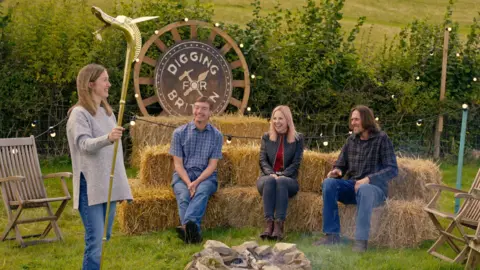
The public will have a unique chance to learn about this incredible find when its story is featured on BBC Two’s Digging for Britain, presented by Professor Alice Roberts, on 14 January at 21:00 GMT, or available for streaming on BBC iPlayer. This program will bring to life the excitement of the discovery, the challenges of conservation, and the profound historical implications of unearthing such extraordinary relics from Britain’s Iron Age past. The Thetford Carnyx and Boar Standard Hoard stands as a powerful testament to the rich and complex history of the Iceni and their ancestors, offering a resonant voice from an era long silent.



 George Anjay
 Ramos Leo
 Nakalama John