Nakalama John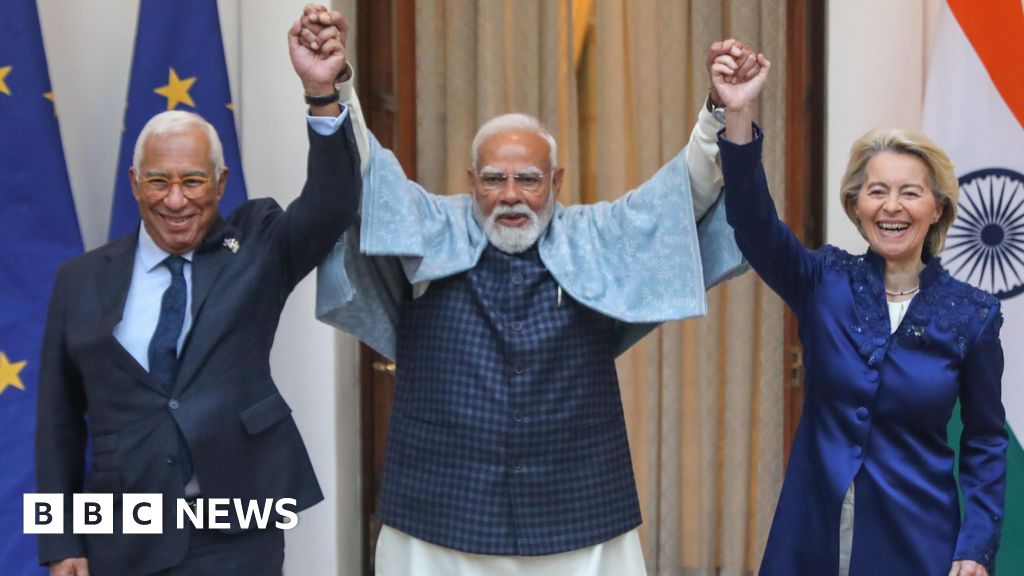
The European Union and India have formally announced a landmark Free Trade Agreement (FTA), culminating nearly two decades of complex and often challenging negotiations. This pivotal accord comes as both economic giants seek to deepen their strategic ties and diversify global trade relationships, particularly in an era marked by heightened protectionism and trade tensions with the United States. The agreement, hailed as a significant step towards bolstering economic resilience and fostering closer cooperation, represents a powerful counter-narrative to the prevailing sentiment of trade wars and tariff escalations.
European Commission President Ursula von der Leyen, meeting with Indian Prime Minister Narendra Modi in Delhi, encapsulated the magnitude of the achievement, declaring on X, "We have concluded the mother of all deals." Prime Minister Modi, reciprocating the sentiment, described the pact as "historic," underscoring its long-term implications for India’s economic trajectory and global standing. The announcement signals a new chapter in the relationship between the 27-member European bloc and the world’s most populous nation, collectively representing approximately 25% of global gross domestic product (GDP) and a vast market of two billion consumers.
At its core, the FTA is designed to significantly reduce tariffs and expand market access for goods and services across both jurisdictions. This expansive agreement is expected to stimulate trade flows, foster investment, and enhance supply chain integration, thereby creating a more robust and interconnected global economy. Von der Leyen, alongside European Council President Antónió Costa, held a bilateral summit with Modi in Delhi, where the comprehensive nature of the deal was highlighted.
The European Commission detailed that the agreement would lead to the elimination of tariffs on a substantial majority of exports in key sectors, including chemicals, machinery, and electrical equipment, as well as high-value aircraft and spacecraft. These tariff reductions are planned to be phased in, allowing industries on both sides to adapt. A particularly significant aspect of the deal addresses the highly protected Indian automotive market. Duties on motor vehicles, which currently stand at an formidable 110%, are set to be drastically cut to 10% for a quota of 250,000 vehicles. This provision is expected to offer a crucial entry point for European car manufacturers into India’s rapidly expanding market, while simultaneously providing a structured framework for India’s domestic industry to remain competitive.
For European products entering India, the FTA is anticipated to lower costs considerably across various categories, including cars, advanced machinery, and certain agricultural food items, once import duties are reduced or eliminated. However, negotiations prudently excluded sensitive agricultural sectors such as dairy and sugar, acknowledging the need to protect domestic producers and food security concerns in both regions. This nuanced approach reflects the intricate balance required to forge a comprehensive trade deal while safeguarding national interests.
Brussels emphasized that beyond tariff reductions, the agreement would actively support investment flows, improve European companies’ access to the dynamic Indian market, and deepen supply-chain integration, offering resilience against future global disruptions. Prime Minister Modi articulated the benefits for India, stating, "This is a historic agreement. It will make access to European markets easier for India’s farmers and small businesses. It will also boost manufacturing and services sectors. It will boost innovative partnerships." This statement highlights India’s ambition to leverage the FTA for broader economic development, empowering its vast agricultural sector and burgeoning small and medium enterprises (SMEs), while also attracting advanced manufacturing and service industries.
The timing of this agreement is particularly noteworthy, unfolding against a backdrop of complex economic and geopolitical pressures, most notably from the United States under former President Donald Trump. Delhi has been grappling with 50% tariffs imposed by the Trump administration in previous years, an action that complicated ongoing bilateral trade talks between India and the US, which continue to drag on. Similarly, the EU experienced its own share of trade tensions with the US, including Trump’s threat to escalate a trade war with European allies over a perceived slight related to Greenland, a threat from which he later backed down. These experiences underscore a shared vulnerability to unilateral protectionist measures and have evidently spurred both India and the EU to forge stronger, more reliable trade alliances.
The broader geopolitical context was explicitly acknowledged by leaders. On Tuesday, Ursula von der Leyen reiterated the strategic depth of the pact, writing, "We have created a free trade zone of two billion people, with both sides set to benefit. This is only the beginning. We will grow our strategic relationship to be even stronger." A day prior, Antónió Costa, without directly naming the US, conveyed a clear message about the deal’s global significance: the trade agreement would send an "important political message to the world that India and the EU believe more in trade agreements than in tariffs" at a time when protectionism is on the rise and "some countries have decided to increase tariffs." This statement firmly positions the India-EU FTA as a testament to multilateralism and open trade in an increasingly fragmented global economy.
The arrival of von der Leyen and Costa in Delhi over the weekend, where they served as chief guests at India’s vibrant Republic Day celebrations on Monday, further symbolized the deepening ties. This high diplomatic honour underscored the mutual respect and strategic importance both sides attach to their relationship. The visible bonhomie and shared smiles during photo opportunities with Prime Minister Modi on Tuesday reflected a strong personal rapport among the leaders, which often underpins successful international agreements.
While the announcement marks a significant milestone, the formal signing of the FTA is expected to take place later this year, pending crucial approvals from the European Parliament and the European Council. This procedural step ensures democratic oversight and broad consensus within the EU before the agreement can fully enter into force.
Beyond the immediate economic benefits, the India-EU partnership is also advancing on parallel tracks, focusing on critical areas such as security and defence co-operation, and climate action. On Tuesday, India’s Defence Minister Rajnath Singh held discussions with European Commission Vice-President Kaja Kallas, exploring avenues for integrating supply chains to build trusted defence ecosystems and develop future-ready capabilities. The Reuters news agency reported that both sides are actively working on a draft security and defence partnership that encompasses vital areas like maritime security, cyber threats, and structured defence dialogue. This comprehensive approach signifies a strategic alignment that extends beyond purely economic considerations, addressing shared challenges in a complex global security landscape.
Highlighting the sheer economic scale of the partnership, Prime Minister Modi, while inaugurating the India Energy Week conference on Tuesday, stated, "This is a perfect example of a partnership between two major economies of the world… This agreement represents 25% of the global GDP and one-third of global trade." Indeed, the EU stands as India’s largest trading partner in goods, with bilateral merchandise trade reaching a substantial $136 billion (£99.4 billion) in the fiscal year 2024-25, a figure that has nearly doubled over the past decade. This robust trade relationship forms a strong foundation upon which the FTA is expected to build, driving further growth and economic integration.
The journey to this agreement has been protracted, with initial talks for a comprehensive trade deal between India and the EU commencing as early as 2007. However, these discussions stalled in 2013 due to persistent roadblocks concerning market access and regulatory demands, particularly around issues such as intellectual property rights, data protection, and specific non-tariff barriers. After nearly a decade, discussions were formally restarted in July 2022, spurred by a renewed geopolitical imperative to diversify trade partners and enhance supply chain resilience in the wake of global disruptions. The main sticking points in the renewed negotiations remained access to India’s automobile market, sensitive agricultural goods, and increasingly, the complex issue of carbon-linked tariffs, reflecting evolving global environmental standards. Officials from both sides worked tirelessly, especially in the final days leading up to the EU leaders’ visit, to finalize outstanding chapters of the agreement, demonstrating a strong political will to secure the deal. Analysts will now meticulously examine the fine print of the final agreement to understand the precise concessions and commitments made on these previously contentious issues.
The imperative to secure alternative markets for exporters has been a driving force for both Delhi and Brussels. In recent months, India has been particularly active on the trade front, signing significant agreements with the United Kingdom, Oman, and New Zealand. Furthermore, a 2024 pact with the four-nation European Free Trade Association (EFTA) bloc, comprising Switzerland, Norway, Iceland, and Liechtenstein, has recently come into effect. Concurrently, the EU has also been expanding its trade network, successfully concluding a trade deal with the South American trade bloc Mercosur earlier this month, after an equally lengthy 25-year negotiation process. These parallel developments underscore a global trend among major economic powers to fortify their trade relationships and adapt to a rapidly evolving international trade landscape, where bilateral and regional agreements are increasingly seen as vital tools for economic stability and growth.

 Ramos Leo
 George Anjay