
 Ramos Leo
The primary driver behind these unprecedented postponements is an extensive shake-up of local government structures across England. This ambitious reorganisation aims to abolish the long-standing two-tier system, prevalent in many parts of the country, which involves separate district and county councils, each responsible for different services. In its place, new ‘unitary’ councils will be established. These unitary authorities are designed to be single bodies responsible for delivering all council services within their designated area, from waste collection and planning to education and social care. The government’s rationale is that this consolidation will streamline governance, reduce administrative duplication, and create clearer lines of accountability for residents.
Minister Reed underscored the financial implications of proceeding with elections for councils destined for abolition or significant restructuring. He argued that holding elections for these transitional bodies would incur "tens of millions of pounds" in wasted taxpayer money. He painted a picture of inefficiency under the current two-tier system, citing examples where citizens effectively pay for "two sets of councillors, two sets of chief executives, and two sets of financial directors." This, he asserted, leads to confusion and unnecessary bureaucracy, exemplified by the scenario where "one council collects your rubbish but another gets rid of it." The delays, therefore, are presented as a pragmatic financial measure to prevent expenditure on elections that would yield short-term mandates for councillors in rapidly changing administrative landscapes.
Beyond the financial argument, capacity concerns among local authorities also played a significant role in the decision. The government noted that many councils expressed anxieties about their ability to simultaneously manage the complex administrative processes of local government reorganisation and effectively run the scheduled May polls. The logistical challenges of merging departments, harmonising policies, managing staff transitions, and migrating data during a period of significant upheaval were deemed substantial enough to warrant a delay in electoral proceedings. Postponing elections is intended to allow councils to fully dedicate their resources to the smooth transition to the new unitary structures, ensuring continuity and quality of public services during this transformative period.
Originally, 136 local elections were scheduled to take place across England this May. Of these, 63 were identified as being eligible to request a postponement due to the ongoing or impending local government reorganisation. With 29 applications now approved and one still pending, the government maintains that the "vast majority" of local elections will still proceed as planned. In his statement to the Commons, Steve Reed clarified that he had meticulously reviewed over 350 representations concerning the elections. He reiterated that legislation would be brought forward to formalise the postponement for the confirmed 29 councils, and promised to report back on the final decision regarding the remaining application. He also stressed that councils not providing sufficient evidence that holding elections would hinder reorganisation would proceed with their ballots.
The decision has, predictably, sparked a wave of criticism from opposition parties, who argue that the delays undermine democratic principles and potentially disenfranchise millions of voters. Liberal Democrat leader Ed Davey was particularly vocal, accusing the Labour government of "running scared of the electorate" and "denying millions of people a voice at May’s local elections." Davey called for a fundamental change in the law, advocating for parliamentary scrutiny and a vote on any future proposals to delay elections, thereby ensuring greater accountability for such significant democratic decisions.
Adding to the chorus of disapproval, James Cleverly, Reed’s Conservative shadow counterpart, launched a scathing attack on the Labour administration. He asserted that elections form the bedrock of democracy, and accused Labour of a political trajectory that "moving seamlessly from arrogance to incompetence and now cowardice" in their approach to local governance. The implication was that the Labour party was avoiding electoral contests where they feared potential losses, rather than genuinely acting in the public interest.
Perhaps the most pointed criticism came from Reform UK MP Robert Jenrick, a former Communities Secretary who recently defected from the Conservatives. Jenrick claimed that delaying local council elections for a second consecutive year was "almost certainly illegal." This assertion carries weight given Jenrick’s own history; in his previous ministerial role, he himself approved the delay of local elections in areas undergoing reorganisation, specifically in Cumbria, Somerset, and North Yorkshire in 2021. Reed swiftly countered Jenrick’s accusation, highlighting this past precedent. He accused Jenrick of failing "to act on eliminating waste" during his tenure by not addressing the inefficiencies of the two-tier system, and strategically quoted Jenrick’s own statement from 2021: "Elections in such circumstances risk confusing voters and would be hard to justify where members could be elected to serve shortened terms." This tit-for-tat exchange exposed the complexities and historical precedents surrounding such decisions, irrespective of the party in power.
The legal challenge mounted by Reform UK against the decision underscores the seriousness with which some view the postponements. A hearing is scheduled for February 19th. When questioned about these legal proceedings, Minister Reed maintained that it would be "entirely inappropriate" for him to comment, adhering to standard parliamentary protocol regarding ongoing legal matters.
Further compounding the controversy, the Electoral Commission, the independent body responsible for overseeing elections in the UK, has expressed significant reservations. The Commission warned that delays to council elections in England risk "damaging public confidence" in the democratic process. Crucially, it stated that it did not consider "capacity constraints are a legitimate reason for delaying long-planned elections." This independent assessment challenges one of the core justifications provided by the government, suggesting that adequate planning should have mitigated such capacity issues. The Commission’s stance highlights a fundamental tension between administrative efficiency and democratic regularity.
The implications for local democracy and individual councillors are also considerable. For some councils slated for election this year, the prospect of being absorbed into new unitary authorities in 2027 or 2028 means that elected councillors would serve significantly shortened terms, potentially as little as one year. This raises questions about the efficacy and public interest in holding such brief electoral cycles. Conversely, in other areas affected by the delays, incumbent councillors could find their terms extended, potentially serving for up to seven years without facing re-election, a duration that critics argue undermines accountability and voter choice.
An analysis of the councils requesting delays reveals a mixed political landscape. While the majority of the councils seeking postponements are Labour-led, a notable number are Conservative-led (three) and one is Liberal Democrat-led. Furthermore, some of the requesting councils are governed by coalitions of multiple parties or independent councillors. This indicates that the desire for postponement is not solely a partisan issue but reflects a broader concern across local government regarding the practicalities and costs associated with the reorganisation.
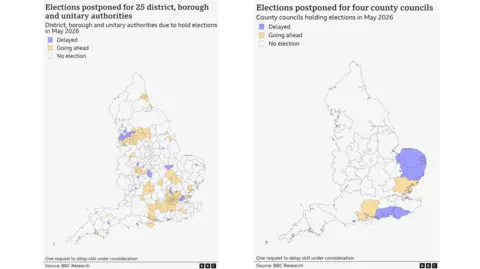
The government’s decision to delay these elections, while framed as a practical and cost-effective measure to facilitate a necessary local government overhaul, has clearly touched a nerve in the political arena. The balance between administrative efficiency, financial prudence, and the fundamental tenets of democratic accountability will continue to be a focal point of debate as the reorganisation progresses and the postponed elections loom on the horizon. The outcome of the legal challenge and the public reaction to these extended terms for some councillors will undoubtedly shape future discussions around local electoral cycles and government reform in England.
Sign up for our Politics Essential newsletter to read top political analysis, gain insight from across the UK and stay up to speed with the big moments. It’ll be delivered straight to your inbox every weekday.


 George Anjay
 Nakalama John
 atisusanti