Nana Banana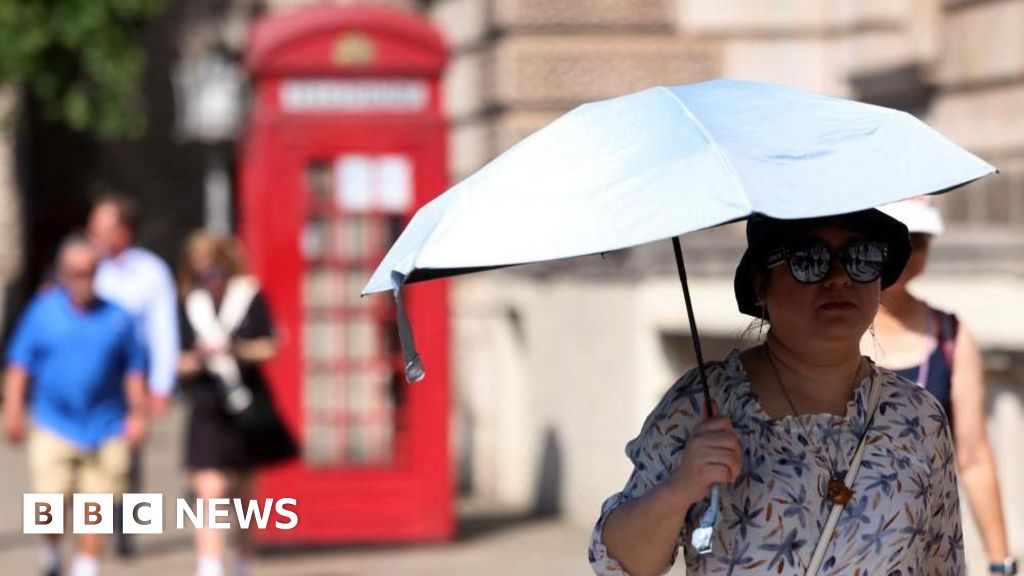
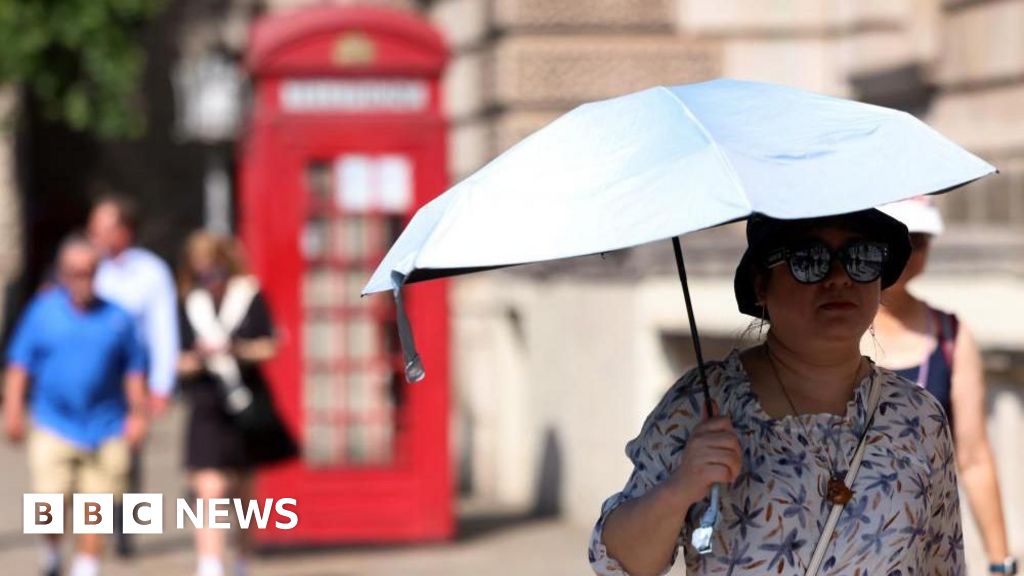
Mark Poynting, a climate researcher, highlights the gravity of these findings as the UK grapples with the tangible effects of a warming planet. The image of a woman seeking shade under an umbrella on a London street serves as a visual metaphor for a country increasingly adapting to unprecedented heat. Professor Rachel Kyte, the UK’s special representative for climate, minced no words in her assessment, declaring that rising temperatures in the UK are rapidly becoming "the new normal." She issued a forceful call for immediate and substantial action to prepare for the inevitable impacts of climate change, emphasizing that the time for proactive resilience building is now.
"This is our future, encapsulated in data," Professor Kyte told the BBC, stressing the scientific certainty behind the projections. "Now the question is ‘how are we going to prepare ourselves and build our resilience to this?’" Her statement encapsulates the critical juncture at which the UK finds itself, moving from observing climate change to actively living with its consequences. The year 2025’s projected record is not an isolated anomaly but the latest data point in a clear and concerning trajectory.
The scientific consensus is unequivocal: the primary driver of this warming trend is anthropogenic, or human-caused, climate change. The accumulation of greenhouse gases, primarily carbon dioxide, emitted over the past two to three decades from industrial activities, transportation, and energy production, is now manifesting in tangible and severe climatic shifts. These gases trap heat in the Earth’s atmosphere, leading to a gradual but persistent increase in global and regional temperatures. "The pollution [carbon dioxide] we’ve put in for the last 20-30 years is now what is driving this warmth, and so not curbing emissions well enough means we’re going to continue to see these kinds of impacts," Prof Kyte elaborated.
Throughout 2025, the UK experienced a pronounced lack of rainfall coupled with persistent warmth, leaving large swathes of the country vulnerable to severe droughts and devastating wildfires through the spring and summer months. This combination of dry conditions and elevated temperatures creates a dangerous feedback loop, exacerbating environmental stress and threatening ecosystems, agriculture, and public health.
Professor Kyte stressed the urgent need for the UK to become "resilient" to the inevitability of higher temperatures through strategic investments in both natural solutions and robust infrastructure. This includes measures such as expanding urban green spaces to combat heat islands, developing sustainable water management systems, designing buildings to withstand extreme heat, and protecting vital ecosystems that provide natural buffers against climate impacts. "If we don’t invest in our adaptation now, it’s going to cost us way more," she warned, highlighting the significant economic burden that inaction will place on future generations and the national economy.
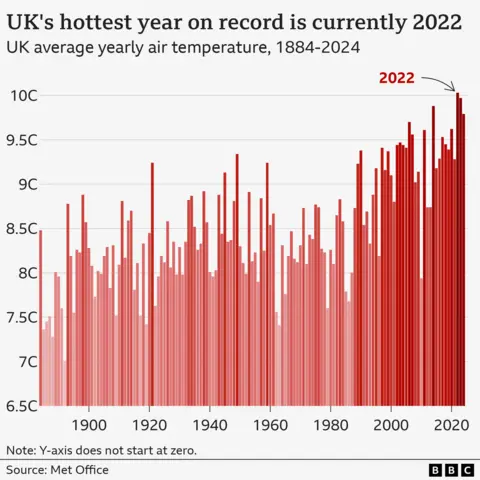
The historical context of these temperature records paints a sobering picture. By the end of 2025, an astonishing ten warmest years on record for the UK will all have occurred within the last two decades, a period for which observational records extend back to the late 1800s. This rapid succession of record-breaking years provides compelling evidence of an accelerating warming trend that is unprecedented in recorded history.
Amy Doherty, a climate scientist at the Met Office, reinforced this perspective. "Anthropogenic [human-caused] climate change is causing the warming in the UK as it’s causing the warming across the world," she stated. She further cautioned that "what we have seen in the past 40 years, and what we’re going to continue to see, is more records broken, more extremely hot years […] so what was normal 10 years ago, 20 years ago, will become [relatively] cool in the future." This concept of a shifting baseline fundamentally alters our understanding of what constitutes "normal" weather, requiring a complete recalibration of societal expectations and preparedness strategies.
The Met Office’s projection for 2025 is based on observed temperatures up to December 21st, combined with the assumption that the remaining days of the year will be approximately 2C below the long-term December average, with slightly cooler conditions anticipated over the Christmas period. While this methodology means the Met Office cannot declare with absolute certainty that 2025 will be the hottest year, it is deemed the most likely outcome given the overwhelming data. Should this prediction hold, it would mark the sixth time this century that the UK has set a new annual temperature record, following 2002, 2003, 2006, 2014, and 2022, showcasing an alarming increase in the frequency of these milestones.
Mike Kendon, another distinguished climate scientist at the Met Office, underscored the historical significance: "The changes we are seeing are unprecedented in observational records back to the 19th Century." These changes are not just about peak temperatures but also about sustained heat. The expected new record for 2025 has been built on persistent and above-average temperatures throughout the spring and summer. Both spring and summer were recorded as the UK’s warmest ever, with each month from March to August registering more than 2C above the long-term average between 1961 and 1990.
While temperatures peaked at 35.8C – a figure below the more extreme highs of over 40C seen in July 2022 – the defining characteristic of 2025 was the repeated occurrence of hot spells. Four separate, albeit relatively short-lived, heatwaves were officially declared across much of the country. These sustained periods of elevated temperatures prompted the UK Health Security Agency to issue multiple heat-health alerts throughout the summer, warning of increased risks, particularly for elderly and vulnerable individuals. Mike Kendon emphasized on the Today programme that longer spells of hotter days and nights pose a significant threat to public health and place considerable strain on healthcare services. Furthermore, he highlighted the severe impact on the agriculture sector, influencing not only crop yields but also dictating which crops farmers are able to cultivate successfully in the UK, potentially threatening food security.
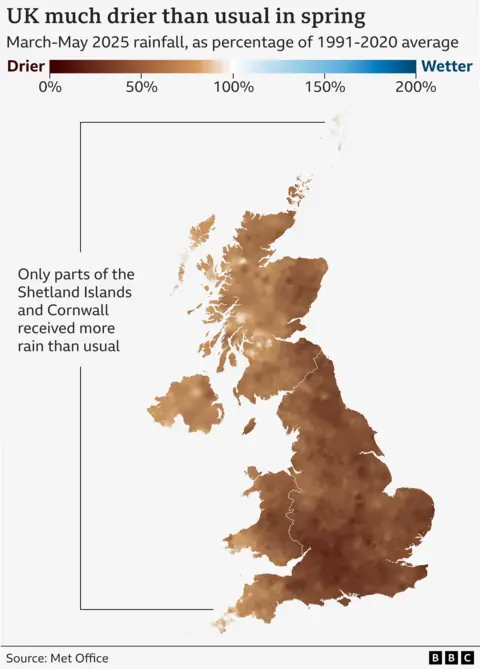
Beyond the heat, spring and summer 2025 were also marked by exceptionally low rainfall. Spring was particularly dry, ranking as the UK’s sixth driest since 1836. This severe lack of precipitation, combined with the warm weather that rapidly dried out soils, pushed large parts of the country towards drought conditions. Official droughts were subsequently declared across several regions in England and Wales by the Environment Agency and Natural Resources Wales, respectively. Parts of eastern Scotland also entered a state of "significant water scarcity," as reported by the Scottish Environment Protection Agency, indicating widespread water stress across the nation.
While recent rainfall has provided some relief and eased the situation across many areas, bringing most regions out of official drought status, water levels in some places remain stubbornly below average. Jess Neumann, an associate professor of hydrology at the University of Reading, cautioned that "there’s a huge deficit to be made up, and there’s a huge implication, not just for people who are farming the land [and] growing food, but our rivers, our aquifers, our availability of drinking water." She further noted that the repeated and unpredictable swings between periods of drought and intense flooding are making it exceedingly difficult for communities to adapt effectively to increasing weather extremes, creating a "whiplash" effect that challenges infrastructure and resource management.
The prolonged dry and warm weather created ideal conditions for wildfires, leading to an unprecedented year for fire incidents. By late April, the area of the UK burned by wildfires had already reached a new annual record, according to data from the Global Wildfires Information System, which dates back to 2012. More than 47,100 hectares (471 sq km or 182 sq miles) have now been scorched throughout 2025, decisively smashing the previous high of 28,100 hectares recorded in 2019. Andy Cole, Chief Fire Officer at Dorset & Wiltshire Fire and Rescue Service, reported that firefighters in his region alone responded to over 1,000 wildfires this year – an "unprecedented" number. He told the Today programme, "I’ve been doing this for over 20 years and we’ve seen a marked increase in the number of fires we’re having to deal with in the open," underscoring the growing strain on emergency services.
As the UK continues to heat up, primarily driven by humanity’s relentless greenhouse gas emissions, scientists expect the nation to experience an even greater frequency and intensity of weather extremes. Dr. Doherty articulated this future: "The conditions that people are going to experience are going to continue to change as they have in the last few years [with] more wildfires, more droughts, more heatwaves." However, the impacts are not limited to heat and aridity. She added, "But also it’s going to get wetter in the winter half-year, so from October to March […] the rain that does fall will fall more intensely, and in heavier rain showers, causing that kind of flooding that we’ve been seeing this year as well." This forecast suggests a future where the UK experiences a dual threat: scorching, dry summers and increasingly wet, flood-prone winters.
The UK’s experience with extreme heat this year is part of a broader global phenomenon. The world as a whole is currently on course for its second or third warmest year ever recorded, according to the European Copernicus climate service, highlighting the universal nature of this climate crisis. However, the international consensus and collective will to tackle climate change are facing significant challenges. The US and several other leading producers of fossil fuels have signaled intentions to row back on their net-zero commitments, a move that could severely undermine global efforts to mitigate warming and accelerate the planet’s trajectory towards more dangerous climate thresholds. The stakes, both nationally and globally, have never been higher.
Additional reporting by Justin Rowlatt, Kate Stephens and Zahra Fatima

 George Anjay
 Ramos Leo
 Nakalama John