
 atisusanti
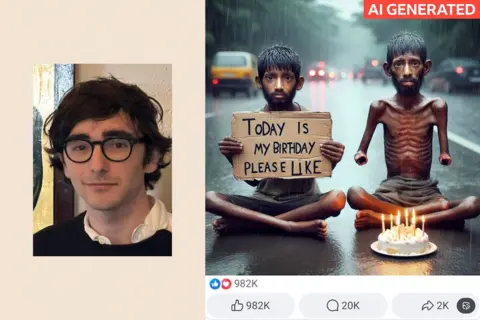
Théodore remembers the AI slop that tipped him over the edge. The image, which went viral on Facebook with nearly a million likes, depicted two emaciated, impoverished South Asian children with inexplicable beards, one missing hands and a foot, holding a birthday sign in a downpour on a busy road, complete with a cake. The absurdity, coupled with the clear AI artifacts, baffled the 20-year-old Parisian student. "It boggled my mind," he stated. "The absurd AI made images were all over Facebook and getting [a] huge amount of traction without any scrutiny at all – it was insane to me."
This frustration spurred Théodore to create an X (formerly Twitter) account, "Insane AI Slop," dedicated to calling out and satirizing AI-generated content that deceived users. His initiative quickly gained traction, flooding his inbox with submissions from others who had encountered similar "AI slop." Common themes emerged: religion, military scenarios, and heartwarming portrayals of impoverished children. "Kids in the third world doing impressive stuff is always popular – like a poor kid in Africa making an insane statue out of trash," Théodore observed. "I think people find it wholesome so the creators think, ‘Great, let’s make more of this stuff up.’" His account rapidly amassed over 133,000 followers.
The relentless influx of AI slop—defined as fake, unconvincing, and quickly produced videos and pictures—appears unstoppable. While tech companies are beginning to address certain forms of AI slop, many social media feeds remain saturated with it. This phenomenon has profoundly altered the social media landscape in just a few years, raising questions about its societal impact and whether billions of users truly care.
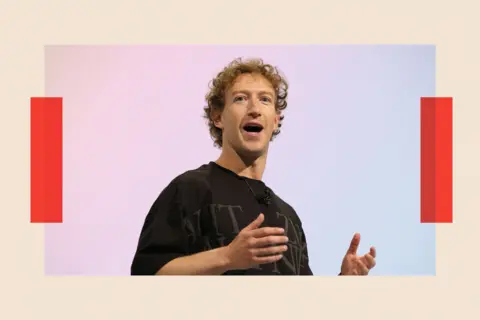
Social media has entered what Meta CEO Mark Zuckerberg termed its "third phase," now centered around artificial intelligence. He explained that the initial phase was dominated by content from friends and family, followed by creator content. Now, with AI simplifying content creation and remixing, a "huge corpus of content" is being added. Meta, the parent company of Facebook, Instagram, and Threads, not only permits AI-generated content but actively promotes its creation through image and video generators and advanced filters. Meta pointed to their January earnings call when asked for comment, where Zuckerberg emphasized the company’s increased focus on AI and made no mention of a crackdown on slop. He anticipates an "explosion of new media formats that are more immersive and interactive, and only possible because of advances in AI."
Similarly, YouTube CEO Neal Mohan highlighted that in December alone, over a million YouTube channels utilized the platform’s AI tools. He believes AI will be a "boon to the creatives who are ready to lean in," likening its impact to the synthesizer, Photoshop, and CGI. Mohan also acknowledged concerns about "low-quality content, aka AI slop" and stated that his team is developing systems to identify and remove "low quality, repetitive content." However, he refrained from making subjective judgments on content, noting how previously niche formats like ASMR and live game streaming have become mainstream.
Research from AI company Kapwing indicates that 20% of content presented to a new YouTube account is now "low-quality AI video," particularly in short-form content. YouTube Shorts featured in 104 out of the first 500 clips shown to a newly created account by Kapwing researchers. The creator economy, driven by engagement and views, appears to be a significant factor. Channels like India’s Bandar Apna Dost, with 2.07 billion views, reportedly earn an estimated $4 million annually from AI-generated content.
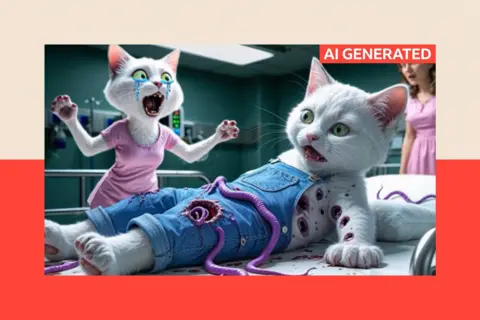
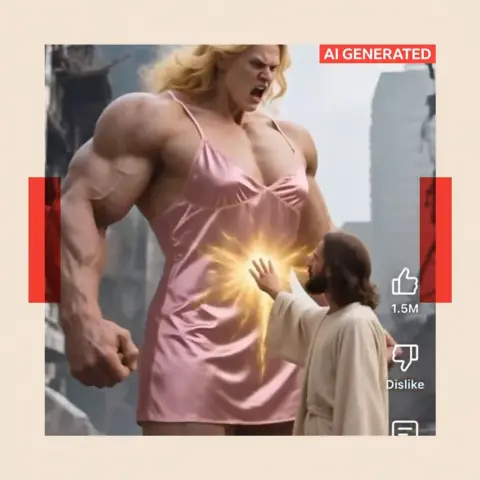
Despite the economic incentives, a backlash is brewing. Comment sections on viral AI videos are frequently filled with user criticism. Théodore, the Parisian student, has been a driving force behind this pushback. He alerted YouTube moderators to what he perceived as disturbing and potentially harmful AI cartoons, some seemingly targeted at children. Examples included titles like "Mum cat saves kitten from deadly belly parasites" and a clip depicting a woman transforming into a monster after ingesting a parasite, only to be healed by Jesus. YouTube removed the channels for violating community guidelines, stating they are "focused on connecting our users with high-quality content, regardless of how it was made," and are working to "reduce the spread of low quality AI content."
Even platforms like Pinterest, known for lifestyle inspiration, have been affected. Frustrated users led to the introduction of an AI-generated content opt-out system, though its effectiveness remains questionable, relying on AI detection or user disclosure.
The backlash against AI slop is increasingly visible across social media platforms like TikTok, Threads, Instagram, and X. Comments decrying the content often garner more likes than the original posts, as seen in a video of a snowboarder rescuing a wolf, where a comment expressing fatigue with "AI s**t" received 2,400 likes compared to the video’s 932. However, this engagement, regardless of sentiment, ultimately benefits the platforms by keeping users scrolling. The critical question remains: does the authenticity of social media content truly matter to users?
Emily Thorson, an associate professor at Syracuse University specializing in politics, misinformation, and misperceptions, suggests the impact depends on user intent. For those seeking entertainment, AI slop might be acceptable if it’s engaging. However, for users seeking information or community connection, AI-generated content can be more problematic. The perception of AI slop also hinges on its presentation. Content clearly intended as a joke is often received as such, but AI slop created to deceive can provoke anger.
A realistic AI-generated natural history video of a leopard hunt exemplified this ambiguity. Some viewers were fooled, while others questioned its authenticity, with one commenter pleading for proof of origin to disprove AI. Alessandro Galeazzi, a researcher at the University of Padova, notes that verifying AI content requires mental effort, and he fears users will eventually cease checking. He warns that the "flood of nonsense, low-quality content generated using AI might further reduce people’s attention span." Galeazzi distinguishes between deceptive AI content and more whimsical AI slop, like fish with shoes, but argues that even the latter contributes to "brain rot"—the degradation of intellectual abilities due to constant social media exposure—by promoting the quick consumption of content known to be unreal, and likely meaningless or uninteresting.
Beyond the "slop," AI-generated content can have more severe implications. Elon Musk’s companies faced scrutiny after the Grok chatbot was used to digitally undress women and children on X. Following the US attack on Venezuela, fake videos circulated depicting civilians thanking the US, potentially shaping public opinion about the raid’s reception. This is particularly concerning as many rely on social media as their sole news source.
Dr. Manny Ahmed, CEO of OpenOrigins, an AI detection firm, emphasizes the need for infrastructure that allows genuine content creators to prove their work’s origin, as visual inspection alone is no longer sufficient. He advocates for systems that "allow real content to publicly prove its origin" rather than solely relying on AI detection. This task is complicated by many social media companies, including Meta and X, having reduced their moderation teams and shifted responsibility to users for labeling misleading content.
The prospect of a "slop-free" social media platform challenging incumbents seems unlikely, given the increasing difficulty in detecting AI and the subjective nature of defining "slop." However, the rise of apps like BeReal, which prioritizes authenticity, suggests that a demand for genuine content could foster new platforms, potentially influencing existing ones to adopt similar principles.
For Théodore, the battle against AI slop feels lost, with its continued presence online seemingly inevitable. Despite ongoing submissions from his followers, he posts less frequently, having largely resigned himself to the evolving online landscape. "Unlike a lot of my followers, I’m not dogmatically against AI," he states. "I’m against the pollution online of AI slop that’s made for quick entertainment and views."




 George Anjay
 Ramos Leo
 Nakalama John