Nana Banana
In a tale as ancient and enigmatic as the feline spirit itself, cats, true to their famously independent nature, took their own sweet time in forging the deep bonds of companionship with humanity. For centuries, the prevailing scientific understanding placed the origins of cat domestication roughly 10,000 years ago, coinciding with the dawn of agriculture in the fertile crescent region of the Middle East, often referred to as the Levant. This theory suggested that as humans settled down and began cultivating crops, the resulting grain stores attracted rodents, which in turn drew wildcats, leading to a gradual mutualistic relationship. However, new scientific evidence has dramatically shifted this timeline and geographical origin, revealing that the transition from a solitary wild hunter to the purring, pampered house pet we know today occurred much more recently – and in a completely different part of the world.
A groundbreaking study, meticulously analyzing ancient cat bones unearthed from numerous archaeological sites across diverse regions, now suggests that the intimate relationship between Felis catus and Homo sapiens began a mere few thousand years ago, firmly placing its origins in northern Africa, rather than the Levant. This revelation challenges long-held assumptions and offers a fresh perspective on one of humanity’s most cherished animal companions. As Professor Greger Larson of the University of Oxford aptly puts it, "They are ubiquitous, we make TV programmes about them, and they dominate the internet. That relationship we have with cats now only gets started about 3.5 or 4,000 years ago, rather than 10,000 years ago." This later domestication date highlights the relatively recent development of the intense, often comical, and undeniably profound bond we share with our feline friends, a bond that feels timeless in its contemporary prevalence.

All domestic cats across the globe, from the sleek Siamese to the fluffy Maine Coon, share a common ancestor: the African wildcat (Felis lybica). These fascinating wild felines, slightly larger and more robust than their domestic descendants, are characterized by their sandy-grey to yellowish-brown coats, often with subtle tabby markings, allowing them to blend seamlessly into their arid and semi-arid natural habitats. They are solitary hunters, primarily nocturnal, preying on small rodents, birds, and insects. The question of how, where, and precisely when these skilled wild predators shed their wildness to embrace a life alongside humans has long been a captivating mystery for scientists, prompting extensive genetic and archaeological investigations.
To unravel this complex evolutionary puzzle, researchers embarked on an ambitious project involving the analysis of DNA extracted from cat bones discovered at archaeological excavations spanning Europe, North Africa, and Anatolia. The process was painstaking: first, the bones were carefully dated using radiocarbon methods to establish their age. Then, sophisticated genetic techniques were employed to extract and sequence ancient DNA from these remains. This ancient genetic blueprint was subsequently compared with the diverse gene pool of modern domestic cats, allowing scientists to trace lineages, identify genetic bottlenecks, and pinpoint the geographical epicenters of divergence and spread. This comprehensive genetic mapping provided the critical data needed to reconstruct the domestication narrative with unprecedented accuracy.
The compelling new evidence unequivocally points away from the agricultural revolution in the Levant as the initial spark for cat domestication. Instead, it strongly suggests that the process unfolded several millennia later, with northern Africa emerging as the primary locus. "Instead of happening in that area where people are first settling down with agriculture, it looks like it is much more of an Egyptian phenomenon," explains Prof. Larson. This finding resonates profoundly with our existing knowledge of ancient Egypt, a civilization renowned for its profound reverence for cats.

The arid climate and fertile Nile Delta of ancient Egypt provided an ideal environment for the initial convergence of humans and wildcats. As early agricultural societies flourished along the Nile, vast quantities of grain were stored in granaries. These abundant food sources inevitably attracted a burgeoning population of rodents, creating a perfect hunting ground for the local African wildcats. These opportunistic felines, driven by instinct and hunger, would have naturally ventured closer to human settlements to exploit this readily available prey. Humans, in turn, would have quickly recognized the immense value of these natural pest controllers. A cat patrolling a granary meant less spoilage, healthier communities, and a more secure food supply. This pragmatic relationship of mutual benefit – cats gaining easy access to food, humans gaining protection from vermin – laid the groundwork for a deeper connection.
Over time, this utilitarian partnership evolved. Ancient Egyptians began to appreciate cats not just for their hunting prowess but also for their grace, beauty, and enigmatic charm. Cats transitioned from mere pest control agents to cherished members of households, imbued with symbolic and even divine significance. They were immortalized in exquisite art, adorning murals, sculptures, and hieroglyphs. The goddess Bastet, depicted with the head of a lioness or a domestic cat, became a prominent deity associated with protection, fertility, and the home, reflecting the high esteem in which cats were held. Perhaps the most striking testament to their elevated status was the practice of mummification; thousands of cat mummies have been discovered in Egyptian tombs, some interred with their human companions, indicating a belief in their continued presence in the afterlife. This rich cultural context of admiration and integration undoubtedly fostered the selective breeding and taming that eventually led to full domestication, differentiating these cats from their wild cousins.
Once firmly integrated into human society, cats began their global odyssey, primarily facilitated by maritime trade. They were highly prized as "ship cats," essential crew members on ancient vessels. Their unparalleled ability to control rats and mice on board ships was crucial for preventing damage to cargo, preserving food stores, and curbing the spread of diseases carried by rodents, such as the plague. This role as effective pest controllers on long voyages inadvertently made them agents of global dispersal. Cats traveled across seas and continents, reaching new lands far from their North African homeland.
The journey of domestic cats into Europe, for instance, occurred significantly later than previously believed, arriving around 2,000 years ago. Their primary vectors were the Romans, who adopted cats from Egypt and carried them throughout their vast empire. Roman legionaries and traders brought cats to various provinces, including Britain, where they helped protect military camps and civilian settlements from rodents. From Europe, their spread continued eastward along the ancient Silk Road, a network of trade routes connecting the East and West. This allowed Felis catus to eventually reach distant lands like China, where they encountered other human-feline dynamics. Today, the enduring legacy of these ancient migrations is evident in the fact that domestic cats are found in virtually every corner of the world, thriving in diverse environments on every continent except the inhospitable reaches of Antarctica.
Adding another fascinating twist to the narrative of feline-human interaction, the scientists made a remarkable discovery concerning a rival wildcat lineage that briefly coexisted with humans in ancient China, long before the arrival of domestic cats from Africa. These distinct kitties were leopard cats (Prionailurus bengalensis), small, lithe wild felines characterized by their striking leopard-like spots and found widely across Asia. For approximately 3,500 years, these indigenous leopard cats inhabited human settlements in China, engaging in a unique relationship.
Professor Shu-Jin Luo of Peking University in Beijing describes this early human-leopard cat dynamic as essentially "commensal." In a commensal relationship, two species live alongside each other, with one benefiting while the other is largely unaffected or even benefits indirectly. In this context, leopard cats undeniably benefited from living near people, finding abundant prey in the rodent populations drawn to human grain stores and refuse. Humans, on the other hand, were largely unaffected by their presence or, more likely, welcomed them as effective and natural rodent controllers. Evidence from archaeological sites, including the skull of a leopard cat found in a Han-dynasty tomb in Xinzheng City, Henan Province, China, suggests a close proximity, though not necessarily full domestication. These leopard cats never underwent the profound genetic and behavioral changes associated with domestication that their African wildcat counterparts did. They retained their inherent wildness, and their association with humans eventually faded as the more thoroughly domesticated Felis catus arrived and spread throughout China, proving to be more adaptable to life within human households.

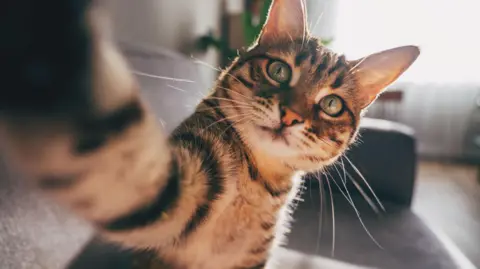
Curiously, the genetic legacy of the leopard cat has re-emerged in a modern context. In a new twist of feline genetics, these small wildcats have recently been crossbred with domestic cats to produce the distinctive Bengal cat. Recognized as a new breed in the 1980s, Bengal cats are celebrated for their exotic, wild appearance, boasting strikingly patterned coats reminiscent of their leopard cat ancestors, combined with the temperament of a domestic pet. This modern hybridization underscores the ongoing fascination humans have with wild feline aesthetics, even as the primary line of domestic cats continues its ancient journey of companionship.
The revised timeline and geographical origins of cat domestication offer a more nuanced understanding of our shared history with these captivating creatures. It paints a picture not of an immediate adoption at the dawn of civilization, but of a more gradual, perhaps more deliberate, evolution of companionship, initially rooted in mutual benefit in ancient Egypt. From the granaries of the Nile to the holds of ancient ships, and eventually into homes across the globe, the cat’s journey to becoming our cherished companion is a testament to its unique adaptability and enduring appeal, a story that continues to unfold even today.




 George Anjay

 Ramos Leo
 Nakalama John