George Anjay
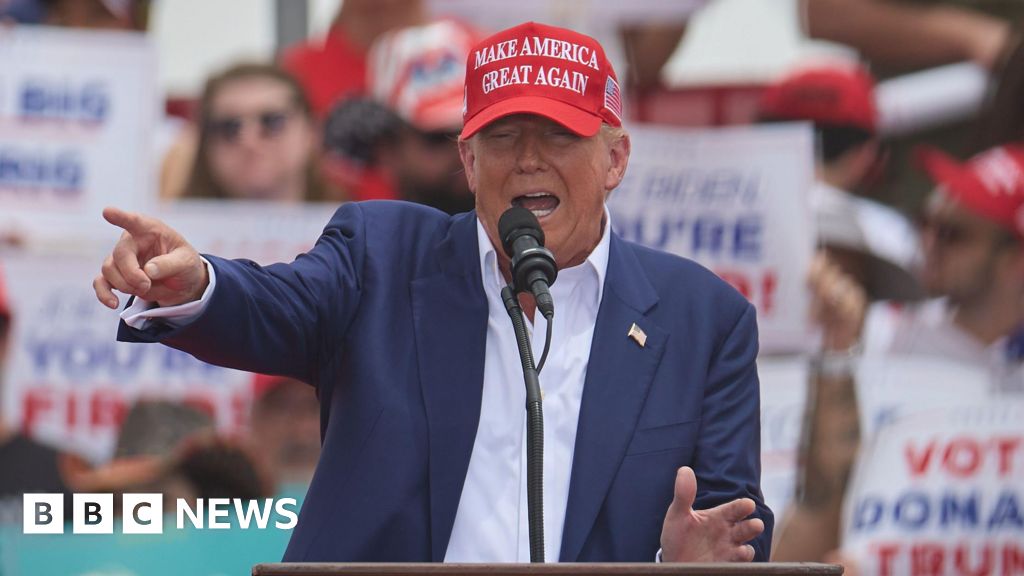
As Donald Trump prepares to address the nation in his State of the Union address, his administration is expected to highlight key policy achievements from his first year back in the White House. However, a significant and comprehensive policy blueprint that some believe has heavily influenced his agenda, Project 2025, is unlikely to be mentioned. This extensive 900-page document, published by the Heritage Foundation think tank, was conceived as a detailed roadmap for a potential second Trump term, outlining an ultra-conservative vision for governance. Despite Trump’s public distancing from the project during the 2024 election campaign, publicly stating he had "no idea who is behind it" and disagreeing with some of its "ridiculous and abysmal" proposals, many of its tenets have demonstrably begun to materialize under his presidency. Liberal groups closely monitoring the administration’s actions suggest that approximately half of Project 2025’s ambitious agenda has already been implemented, spanning critical areas such as a severe crackdown on immigration and a renewed strategic focus on Venezuela, alongside significant efforts to reshape the federal workforce.
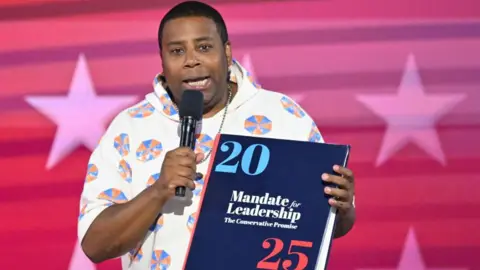
Washington’s policy landscape is replete with think tanks producing policy proposals for incoming administrations. Project 2025, released in April 2023, predated the certainty of the Republican nominee but laid out a clear vision. Its core component, the "Mandate for Leadership" document, advocated for a radical transformation of government through the expansion of presidential authority, substantial reductions in the federal workforce, and the implementation of a staunchly conservative social agenda. Experts observe that the document did more than simply list policy ideas; it meticulously detailed the legal and administrative mechanisms required to achieve these objectives. Eugene Kiley, who provided an in-depth analysis of Project 2025 for Factcheck.org, described it as a "very detailed blueprint," noting its explicit instructions on how to dismiss government employees and how to exert control over traditionally independent agencies.
These detailed methodologies have been evident in the early actions of Trump’s second term. The establishment of the Department of Government Efficiency (Doge) marked an aggressive push to curtail federal staff, while the consolidation of the United States Agency for International Development under the State Department also reflected a strategic reorientation. The Heritage Foundation, in a statement to the BBC, emphasized that "all policy and personnel decisions are up to President Trump and his team," while downplaying any direct role in shaping administration policy. White House spokesman Davis Ingle, in response to inquiries about Project 2025, stated, "In just a year, President Trump has made America the hottest country in the world by securing the border, signing the largest middle class tax cuts in history, and bringing in trillions of dollars in investments."
The extent to which Project 2025 has been enacted is a subject of ongoing analysis. A report by the Center for Progressive Reform, a left-leaning think tank, indicated that the White House has "already initiated or completed" 53% of the policies outlined in the document. A separate tracker, employing a different analytical framework, arrived at a similar figure of approximately 51%. Key proposals from Project 2025 that have been implemented since Trump’s return to office include a comprehensive overhaul of immigration policy. The document’s immigration section advocated for the deployment of military troops to secure the nation’s borders, the elimination of sanctuary zones, widespread workplace raids targeting undocumented immigrants, and a significant expansion of detention facilities for those awaiting deportation. These measures have all been actively pursued by the Trump administration.
Trump’s foreign policy also bears the imprint of Project 2025. A chapter dedicated to foreign affairs, which includes a specific focus on Venezuela, stops short of explicitly calling for the removal of President Nicolás Maduro, a policy the Trump administration pursued earlier in his first term. However, the text states, "To contain Venezuela’s Communism and aid international partners, the next Administration must take important steps to put Venezuela’s Communist abusers on notice while making strides to help the Venezuelan people." The document further identifies Colombia, Guyana, and Ecuador as South American nations facing "either increasingly regional security threats… or are vulnerable to hostile extra-continental powers" such as China and Russia. The authors argued, "The US has an opportunity to lead these democratic neighbors to fight against the external pressure of threats from abroad and address local regional security concerns." This aligns with the 2025 US National Security Strategy, which designates China as a primary adversary and, in its section on the Western Hemisphere, posits a clear choice for nations: "whether they want to live in an American-led world of sovereign countries and free economies or in a parallel one in which they are influenced by countries on the other side of the world."
A notable number of individuals who contributed to Project 2025 now hold significant positions within the Trump administration. These include CIA Director John Ratcliffe, Federal Communications Commission head Brendan Carr, former "border tsar" Tom Homan, Securities and Exchange Commission chair Paul Atkins, and trade adviser Peter Navarro, a vocal proponent of Trump’s tariffs. Russell Vought, who authored a chapter on bureaucratic reform for Project 2025 and oversees the vast federal budget, has played a crucial role in implementing the president’s agenda. His influence was even acknowledged by Trump, who shared an AI-generated video portraying Vought as a cost-cutting "grim reaper" during a congressional debate over government spending.
Looking ahead, Project 2025 continues to be viewed as a foundational document within conservative circles. Paul Dans, who directed Project 2025 before resigning to support Trump’s election campaign, described the plan as "conservative gospel right now." He observed, "Any outsider looking at this can easily see how much of this first year was set out by Project 2025. If it wasn’t for President Trump this would just be a report on a shelf." Dans, who previously served in the US Office of Personnel Management during Trump’s first administration, expressed his satisfaction with the number of policies from the document that have been adopted. He stated, "The real measuring stick of this whole thing is going to be how we keep implementing it." Acknowledging the proximity of midterm elections and the remaining years of Trump’s second term, Dans cautioned, "The hourglass is slowly running out, and time is being wasted."
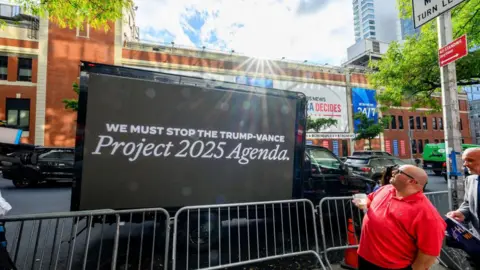
While approximately half of Project 2025’s proposals have been implemented, a significant portion remains to be addressed. Dans asserted that the policies outlined in Project 2025 resonate strongly with the president’s base, adding, "I think it was one of the great electoral miscalculations in history [by the Democratic Party] to demonise Project 2025 rather than just tell the people what their vision was for the next four years." The potential for future administrations to leverage the expanded executive powers, partly shaped by Project 2025, for a contrasting agenda remains a possibility. Kiley commented, "This can come back and bite [Republicans] someday. It’s inevitable. There will be liberals in the White House and conservatives in the White House, it will swing back and forth."
Dans, however, remains optimistic about the continued influence of Project 2025 on the future of the Trump movement. He believes, "It really is the barometer of whether Maga lives another day or whether this whole thing sinks back into a storyline where the establishment wins out." For progressives currently out of federal power, the path forward may involve creating a similarly comprehensive policy document, but with a focus on left-leaning priorities, as suggested by James Goodwin of the Center for Progressive Reform. He noted, "To the extent that there is a silver lining… we’re presented with this unique opportunity to rebuild things. We have an opportunity to articulate a vision for how to do things better and build consensus around it."


 Ramos Leo
 Roy Suryo
 atisusanti
 Nakalama John