 George Anjay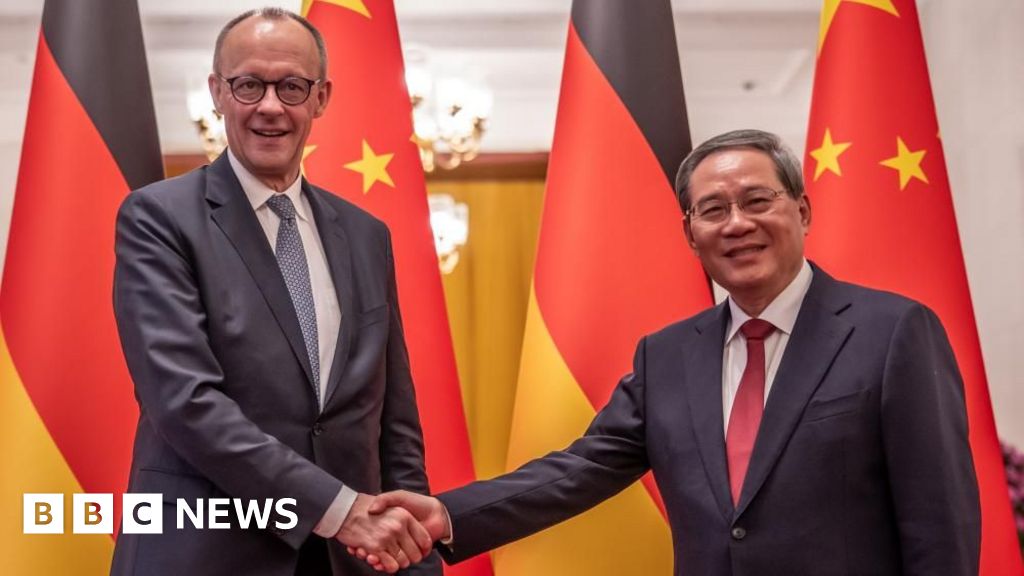
German Chancellor Friedrich Merz has issued a stark warning regarding the significant and widening trade imbalance between Germany and China, emphasizing that the current situation is "not healthy" for either nation. During his inaugural official visit to Beijing, Merz highlighted that German imports from China significantly outpaced its exports, a trend that has quadrupled in just five years and is now reaching a critical juncture for the European Union’s largest economy. This concern over economic parity overshadowed other key discussion points, including Merz’s plea for Beijing to leverage its influence with Moscow to bring an end to the ongoing war in Ukraine.
The stark reality of the trade deficit is underscored by recent federal statistics. In the past year, Germany imported goods valued at €170.6 billion (approximately £148.8 billion or $200.9 billion) from China, marking an 8.8% increase year-on-year. Conversely, German exports to China experienced a notable decline of 9.7%, falling to €81.3 billion. This dramatic imbalance, according to Juergen Matthes, head of International Economic Policy at the German Economic Institute (IW), is "eroding the core of German industry, especially in the car, machinery, and chemicals sectors." Matthes attributes this disparity primarily to what he describes as "massive" Chinese state subsidies and a deliberate undervaluation of its currency. He posits that the competitive advantage enjoyed by Chinese products cannot solely be attributed to innovation and efficiency.
Beijing, however, has consistently maintained that its subsidy policies are transparent and adhere to international trade rules. Regarding allegations of currency manipulation, China has asserted its commitment to a managed floating exchange rate system, responsive to market forces but subject to necessary intervention. This persistent trade gap, now affecting the entire EU, is being increasingly referred to as the latest "China shock." Economic analysts from the Brussels-based think tank Bruegel suggest that the COVID-19 pandemic and Russia’s full-scale invasion of Ukraine contributed to rising production costs within Europe. Simultaneously, China has entered a prolonged deflationary period, fueled by overinvestment in its manufacturing sector, leading to the current overcapacity in production.
This economic phenomenon compels European leaders to strategize on mitigating the impact of competitively priced Chinese goods, a challenge compounded by the residual effects of former US President Donald Trump’s tariff policies. Noah Barkin, a senior fellow at the German Marshall Fund and senior advisor at the Rhodium Group, observes that "no one in Europe wants a two-front trade war with the world’s two superpowers." Despite this, Barkin notes that Europe does possess leverage, stating, "China needs somewhere to sell its goods. It has a real problem with over-capacity." Nevertheless, the influx of these goods is generating significant anxiety within Germany, traditionally the economic powerhouse of Europe, which has been experiencing economic headwinds for several years.
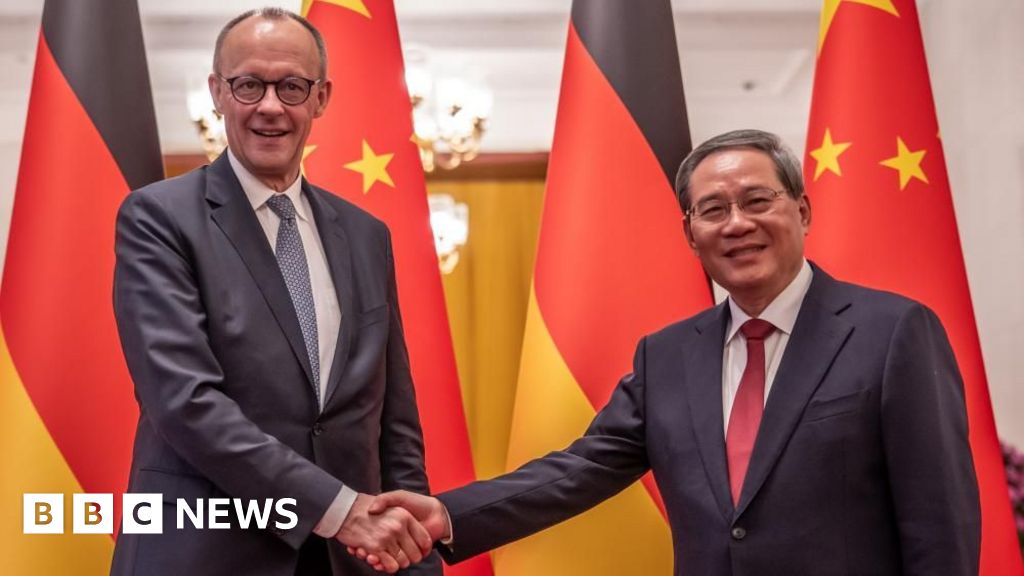
A notable area of concern is Germany’s once-dominant automotive industry, which is currently shedding jobs amidst a challenging transition to electric vehicles, a sector where China has established a leading position. Business organizations in Germany have urged Chancellor Merz to deliver a clear message during his initial visit to China as head of government. The Federation of German Industries has called for addressing issues such as "distortions" in competition and export controls on critical rare earth elements. On a more positive note, Chancellor Merz did announce that China is expected to purchase up to 120 aircraft from the European aviation giant Airbus.
However, Merz’s inherent free-trade and trans-Atlanticist leanings appear to be at odds with the current global economic landscape. Barkin observes that "France is behind a protectionist agenda while Germany is more skeptical." The European Union has initiated numerous anti-dumping investigations against China and is exploring measures to bolster domestic production and reduce foreign dependencies. Barkin points out that "where the Commission struggles is classic trade defence tools like tariffs," noting that the EU lacks the flexibility in tariff application that the United States possesses.
For Berlin, this complex situation represents another strategic setback for its long-standing policy of "change through trade," a philosophy previously applied to nations like China and Russia. Former Chancellor Angela Merkel frequently faced accusations of prioritizing deepening economic ties with Beijing over human rights concerns. The deep economic ties and resultant dependencies forged over years are not easily dismantled.
Speaking to reporters, Merz acknowledged that the relationship with China presents both opportunities and risks. "We want to further strengthen our partnership… However, we will of course also protect our interests," he stated, having previously cautioned that attempting to decouple from China would be a misstep. The Chancellor’s visit underscores a delicate balancing act for Germany, seeking to maintain economic engagement while safeguarding its industrial base and national interests in an increasingly competitive and complex global market. The trade imbalance, coupled with broader geopolitical tensions and China’s growing economic prowess, presents a formidable challenge for Merz and the European Union as they navigate their future relationship with Beijing. The discussions in Beijing signal a potential shift in Germany’s approach, moving from a purely engagement-focused strategy to one that more forcefully advocates for its economic sovereignty and fair competition. The implications of these talks will undoubtedly shape the future of Sino-German and, by extension, Sino-European economic relations for years to come.




 atisusanti
 Nakalama John