
 Nana Banana
Despite a temporary reprieve from the relentless upward climb of global temperatures, 2025 marked a crucial year in climate monitoring, demonstrating both the persistent threat of human-induced warming and the complex interplay of natural weather phenomena. New data released by the European Copernicus climate service and the UK’s Met Office confirms that while global temperatures in 2025 did not quite reach the unprecedented heights of 2024, thanks primarily to the cooling influence of the natural La Niña weather pattern in the Pacific Ocean, the planet remains firmly entrenched in a period of escalating heat.
This slight dip, however, offers little comfort to climate scientists, who warn that it is merely a momentary fluctuation in a much larger, alarming trend. The last three years – 2023, 2024, and 2025 – collectively stand as the warmest ever recorded in human history, pushing the planet precariously closer to breaching critical international climate targets. The underlying driver of this long-term warming is unequivocally humanity’s unabated carbon emissions, which continue to accumulate greenhouse gases in the atmosphere, trapping heat and fundamentally altering Earth’s climate system.

"If we go twenty years into the future and we look back at this period of the mid-2020s, we will see these years as relatively cool," stated Dr. Samantha Burgess, deputy director of Copernicus, underscoring the grim projection that current temperatures, despite their record-breaking nature, are merely a precursor to even hotter decades to come. This stark reality means that unless global carbon emissions are drastically and swiftly reduced, further temperature records are not just likely, but inevitable, bringing with them a worsening cascade of extreme weather events across the globe.
According to the combined data from Copernicus and the Met Office, the global average temperature in 2025 stood more than 1.4°C above "pre-industrial" levels. This baseline typically refers to the period of the late 1800s, before widespread industrialization led to the burning of massive quantities of fossil fuels and the subsequent release of greenhouse gases into the atmosphere. While precise figures might vary slightly between major climate groups due to minor differences in how the pre-industrial temperature is calculated, there is no scientific debate about the world’s undeniable and accelerating long-term warming trend.
Prof. Rowan Sutton, director of the Met Office Hadley Centre, articulated the fundamental scientific understanding: "We understand very well that if we continue to pump greenhouse gases into the atmosphere, the concentrations of those gases increase in the atmosphere, and the planet responds by warming." This direct cause-and-effect relationship forms the bedrock of climate science and explains the current trajectory.

Even though 2025 wasn’t the single hottest year on record worldwide, it was still a year marked by a relentless barrage of extreme weather events, many of which bear the clear fingerprints of global warming. The devastating California fires of January 2025, for instance, raged across the landscape, leaving a trail of destruction. Firefighters, silhouetted against hazy, sun-drenched skies, battled the infernos with water cannons, as seen in imagery from Altadena. These fires quickly escalated into one of the most expensive weather-related disasters in US history, highlighting how rising temperatures and prolonged droughts create tinderbox conditions, amplifying the intensity and spread of wildfires.
The international community, in the landmark 2015 Paris Agreement, committed to limiting global warming to well below 2°C above pre-industrial levels, with an ambitious goal of pursuing efforts to limit it to 1.5°C. These targets were established to avoid the most catastrophic and irreversible consequences of climate change. However, the current pace of warming suggests these goals are rapidly slipping out of reach. "Looking at the most recent data, it looks like we’ll exceed that 1.5-degree level of long-term warming by the end of this decade," warned Dr. Burgess, indicating that the world is heading towards a future with more severe impacts than originally envisioned.
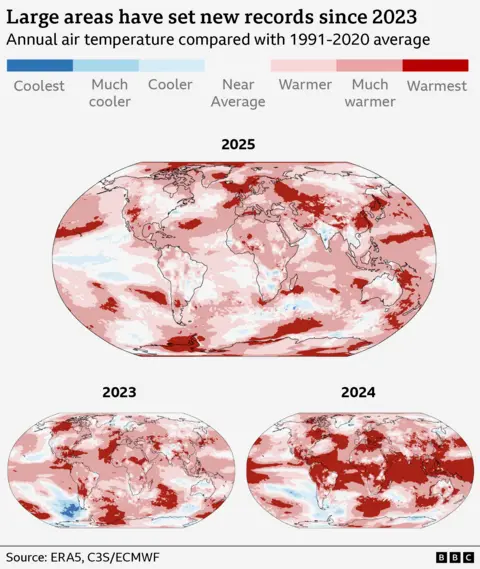
The planet’s temperature anomalies are vividly illustrated by global maps. Reds indicate areas significantly warmer than average, while blues represent cooler regions. In 2023, 2024, and 2025, these maps consistently show vast swathes of the globe bathed in shades of red, with only isolated pockets of blue, underscoring the pervasive nature of the warming trend. These visual representations reinforce the data that the last three years have been remarkably warm, with 2024 registering slightly above 1.5°C warming and 2023 and 2025 just below, according to Copernicus.
While human activities are the primary driver of long-term warming, natural climatic oscillations also play a significant role in year-to-year variability. Phenomena like El Niño and La Niña, which involve temperature fluctuations in the Pacific Ocean, have a profound impact on global weather patterns. El Niño years typically bring warmer global average temperatures, while La Niña years tend to be cooler. The return of La Niña conditions is credited with suppressing global warmth in 2025, preventing it from surpassing 2024’s record. However, the fact that temperatures remained so exceptionally high even in a La Niña year "is a little worrying," according to Dr. Zeke Hausfather, a climate scientist at Berkeley Earth in the US. This suggests the underlying anthropogenic warming signal is now so strong that even natural cooling mechanisms struggle to significantly dampen the overall heat.
The impacts of this warming were not confined to wildfires. The 2025 hurricane season brought its own share of devastation. Hurricane Melissa, for example, unleashed mass flooding in Haiti and wreaked havoc across other parts of the Caribbean. Images from Petit Goave, Haiti, show residents cleaning up debris in front of their flooded homes. Scientists explain that global warming intensifies such storms, leading to stronger winds, heavier rainfall, and more destructive storm surges, thereby increasing the vulnerability of coastal communities and small island nations.
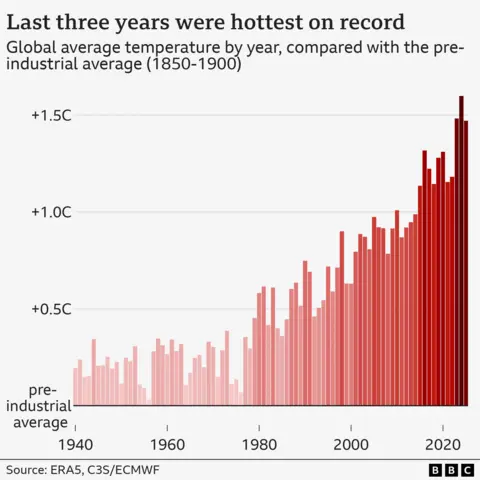
A comprehensive analysis of global average annual temperatures between 1940 and 2025 reveals a clear and accelerating trend. A bar chart illustrating this data shows a consistent rise in temperature, with the bars growing taller and deepening in red hues, particularly in recent decades. The most striking feature of this chart is the pronounced increase in the last three years, which stand significantly above previous records, underscoring the rapid escalation of global warming.

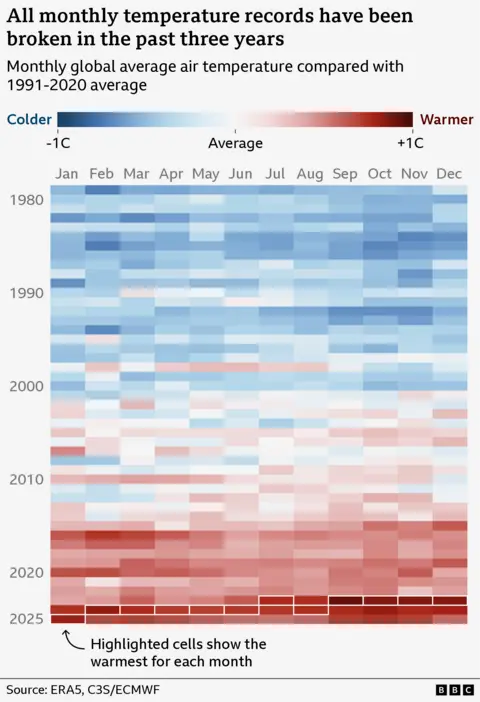
Indeed, the period from 2023 to 2025 has seen an unprecedented streak of record-breaking warmth. Copernicus data illustrates this vividly, showing that for every single month of the year, a new temperature record has been set within these three years. A detailed chart, mapping each month for each year since 1979, highlights this phenomenon. While the top of the chart (earlier years) shows more blue (cooler months), the bottom (recent years) is dominated by red (warmer months), with highlighted blocks indicating the warmest month on record occurring consistently within the last three years. This widespread and persistent warmth across all seasons points to a fundamental shift in the Earth’s climate.
Scientists are actively investigating potential factors contributing to this rapid warming, which has, in some respects, exceeded long-term expectations. Theories include changes in cloud cover and the impact of tiny atmospheric particles known as aerosols. Aerosols, which can be natural (like volcanic ash) or anthropogenic (from industrial pollution), typically reflect some of the Sun’s energy back into space, exerting a cooling effect. It appears that recent changes in aerosol concentrations or their interaction with clouds might be allowing more solar energy to reach the Earth’s surface, exacerbating warming.
"We are seeing rapid warming at the upper end of our longer-term expectations," acknowledged Prof. Sutton. However, he cautioned that it is "not yet clear" whether the exceptional warmth of the last three years has significant implications for the longer-term climate models, emphasizing the need for more comprehensive data and further research before drawing firm conclusions about these emerging factors.
Despite the sobering data and the increasing urgency, scientists maintain that the future impacts of climate change are not a foregone conclusion. "We can strongly affect what happens," Sutton asserted, highlighting two crucial pathways for action. The first is "mitigating climate change" – drastically cutting greenhouse gas emissions to stabilize global warming at the lowest possible level. The second is "adapting" – implementing measures to make societies and ecosystems more resilient to the ongoing and unavoidable changes that are already locked into the climate system.
The message from the scientific community is clear: while 2025 offered a fleeting, natural dip in global temperatures, it served as a stark reminder that the planet is on a trajectory towards ever-increasing heat records and intensifying extreme weather. The window for effective action to avert the most catastrophic outcomes is rapidly closing, making global commitment to emission reductions and robust adaptation strategies more critical than ever.
Additional reporting by Jess Carr
Join our Future Earth newsletter to get the world’s biggest climate news in your inbox every week.




 Ramos Leo
 Nakalama John

 atisusanti

 George Anjay