Nana Banana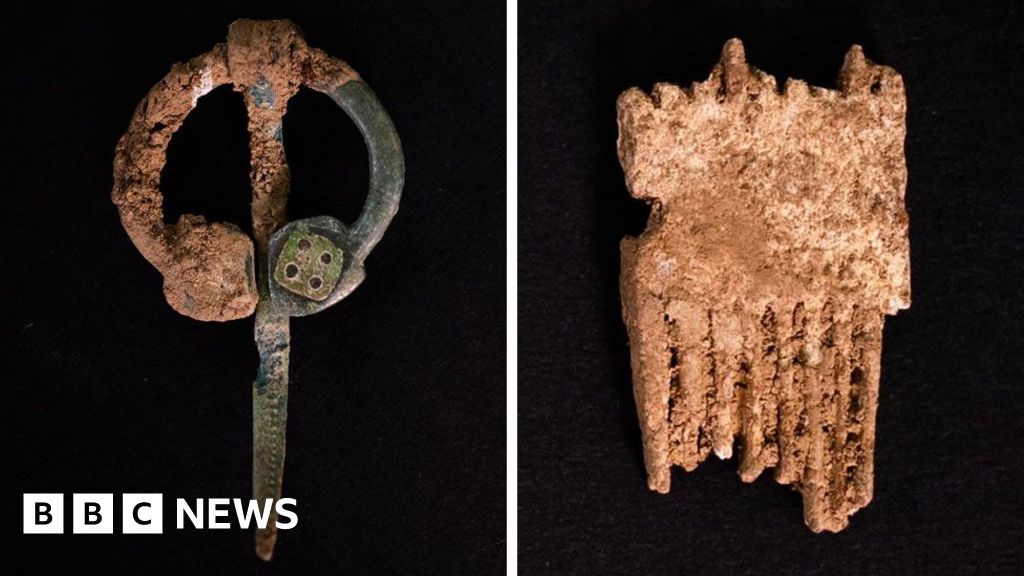
Intriguing new discoveries at a medieval cemetery in Wales have brought archaeologists significantly closer to unraveling the long-standing mystery surrounding the lives and deaths of the women buried there. For the past four years, a dedicated team has been meticulously excavating the site, situated in the historic grounds of Fonmon Castle, mere moments from the bustling Cardiff airport runway. Their recent findings, including the outline of what appears to be a small, significant building and an array of domestic and decorative artifacts, such as exquisite colored glass beads, are providing crucial insights into this enigmatic community from the 6th or 7th Century.
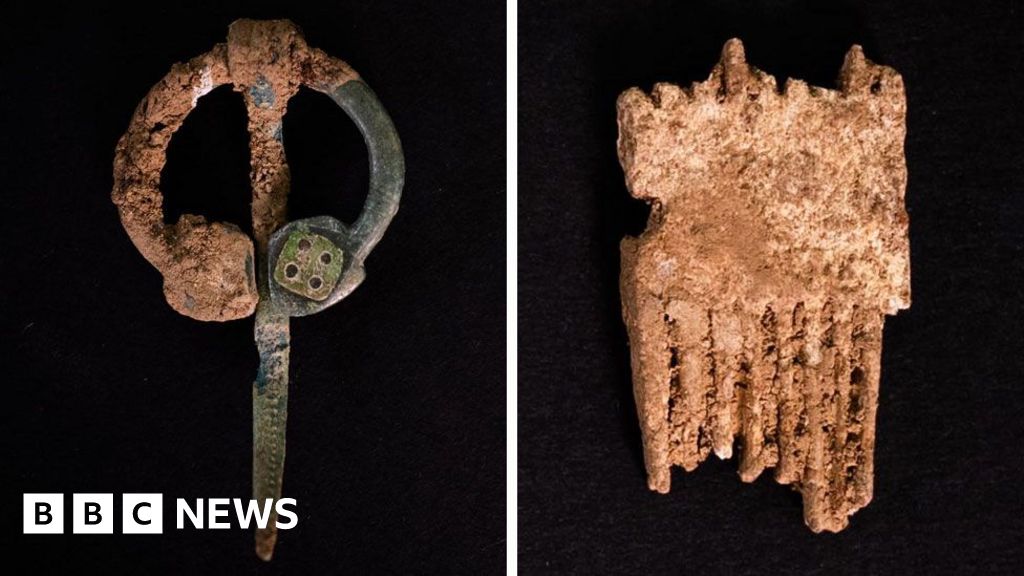
To date, 58 human skeletons have been carefully uncovered at the site. What initially baffled researchers was the overwhelming demographic: nearly all of these remains belonged to women. This striking gender imbalance immediately suggested a unique social structure, diverging from typical family or village burial grounds of the period. The new evidence now strongly reinforces the burgeoning theory that this burial ground was an integral part of an early female religious community, a rare and invaluable window into a poorly understood era of Welsh history.
The 1,500-year-old skeletons, remarkably intact and well-preserved within their shallow graves cut into the limestone bedrock, offer a poignant glimpse into the physical realities of early medieval life. While analysis of their bones and teeth reveals that these women endured physically demanding lives, often marked by hardship, the objects found interred with or near them tell a contrasting tale of unexpected wealth and personal luxury. This duality has been a central puzzle for the archaeological team, led by Dr. Andy Seaman from Cardiff University.

The most compelling new clue has emerged in the form of structural remnants: the discernible outline of what Dr. Seaman suggests could be a small building. "It’s producing fragments of building stone, so it might be structural," he explains, indicating that the building was more than a simple wooden dwelling. "We might be thinking of a small shrine or a chapel." This potential religious structure is centrally located within the cemetery, and critically, the graves are clustered densely around it. This spatial arrangement strongly suggests that proximity to this feature was highly desired, indicating its profound spiritual or communal significance to the deceased and their surviving community.
Cardiff University archaeologist Tudur Davies further elaborates on this phenomenon, noting the unusual practice of multiple burials in a single spot. "It’s a highly desired location for people to be buried in," he observes. "Sometimes two, three, four individuals have been buried on the same spot, again and again. There doesn’t appear to be as much of a taboo over putting bodies in the same place and just moving those still there to one side." This intense clustering around the central building underscores its importance, perhaps as a focal point for veneration, prayer, or communal identity. The evidence strongly points towards a site that served as both a place of worship and a final resting place for its dedicated members. "I do think that we have a site which may be an early religious community," Dr. Seaman concludes, a hypothesis that gains significant weight with each new find.

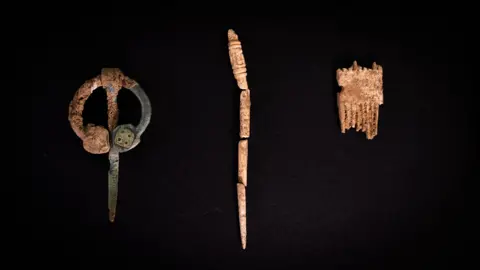
The artifacts recovered from the site are providing rich details about the lives and possibly the status of these women. In Cardiff University’s lab, conservator Nicola Emmerson is meticulously working to remove centuries of dirt from an ornate copper brooch. Her careful cleaning has begun to reveal its intricate details. "We’d have to do some more analysis, but it’s probably bronze," she states, noting the likely composition. "Also we think it was possibly gilded, which would be a coating of gold over the top." The ends of this impressive piece of medieval "bling," as it has been dubbed, were adorned with vibrant green enamel. "This would have been a very decorative brooch. I think it’s a very special find for the site," Emmerson emphasizes, highlighting its rarity and the skill involved in its creation. Such an item suggests that at least some members of this community possessed or had access to valuable, finely crafted personal adornments, hinting at a level of material culture beyond simple subsistence.
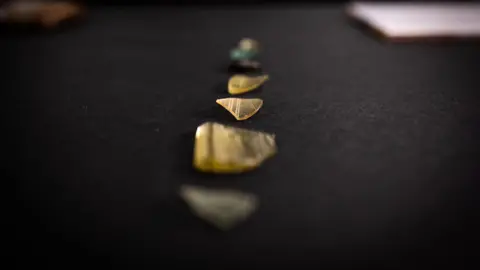
Alongside the brooch, the team has unearthed other exquisite personal items. A pin made from bone features a detailed, intricate pattern, showcasing skilled craftsmanship. A comb, painstakingly carved from antler, further speaks to a community that valued personal grooming and the creation of beautiful, functional objects. Perhaps most striking are the minuscule, multicoloured glass beads. Measuring a mere 3mm across, each one is a miniature marvel of ancient artistry. These delicate beads were likely stitched onto clothing, adding vibrant decoration, or incorporated into pieces of jewellery, further underscoring a preference for adornment and aesthetics. The presence of such finely made objects suggests a degree of economic stability and cultural sophistication within this isolated community.
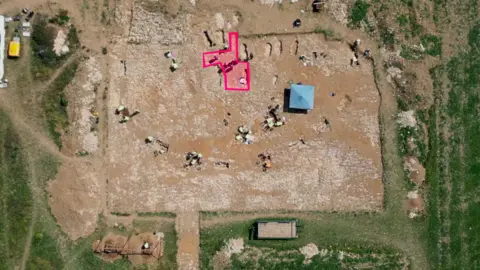
Beyond personal effects, the excavation has also yielded a significant collection of domestic items, painting a picture of daily life within the settlement. "We have a quern stone for grinding flour for bread," Dr. Andy Seaman points out. "We’ve got pottery and glass for eating and drinking." These everyday objects are crucial because they firmly establish the site as more than just a cemetery. "It’s clearly not just a place for the dead. There’s a living community here as well," Dr. Seaman asserts. This evidence supports the idea that the community was self-sufficient, engaging in essential activities like food preparation and communal meals. He postulates that this community was likely enclosed, living in close proximity to the cemetery, deliberately separated from the broader secular society of the time. This spatial and social isolation would have reinforced their communal identity and religious devotion.
The emerging picture of a largely female, enclosed religious community from the 6th or 7th century is incredibly significant. This period in Wales represents a "formative period of history," as Dr. Seaman describes it, one about which very little is known regarding the structure and function of early Christian sites. While later monastic institutions are well-documented, the earliest phases of Christianity in Britain, particularly in the Celtic west, remain shrouded in mystery. This site offers a unique opportunity to understand how early church sites "functioned, what they looked like, how they were organised." It could shed light on the nature of early Welsh or "Celtic" Christianity, which often had distinct characteristics compared to its Roman counterparts, including a strong emphasis on asceticism, hermitic traditions, and the potential for influential female leaders or communities.
Despite the significant progress, several intriguing questions persist, keeping the medieval puzzle from being fully solved. The discovery of the remains of a few men and children among the predominantly female burials raises new lines of inquiry. Who were these individuals? Were they family members, perhaps male converts, or individuals who served the community in some capacity? The precise relationship between these scattered male and juvenile remains and the larger female population remains an open question for future research.
Perhaps the most unsettling mystery involves two women whose burials stand in stark contrast to the careful interments of their peers. These two individuals were found "tossed in a ditch," with one notably discovered with her hands and feet tied. This brutal treatment sharply deviates from the reverent burials seen throughout the rest of the cemetery. What had they done to deserve such a fate? Were they outcasts, criminals, victims of a punitive justice system within the community, or perhaps even victims of external violence? Their unusual burial raises complex questions about social control, transgression, and the darker aspects of life within this early medieval settlement. These anomalies highlight that even within a seemingly pious community, there could be harsh realities and profound differences in how individuals were treated in death.
The pieces of this medieval puzzle are steadily coming together, offering an unprecedented glimpse into early Christianity in Wales. Dr. Seaman and his team are immensely enthusiastic about the potential of this site. "It’s a period where the history is not yet written," he reflects. "We don’t really understand early church sites… how they functioned, what they looked like, how they were organised. We know that very well from later periods, but in this very formative period of history, it’s not very well understood. So it’s a really exciting opportunity." The ongoing excavations promise to continue enriching our understanding of a pivotal but obscure era. The archaeologists eagerly anticipate resuming their work later this year, with further excavations planned for 2026, hoping to unearth more clues that will definitively solve the mystery of these remarkable medieval women.


 George Anjay

 Ramos Leo
 Nakalama John