
 Nana Banana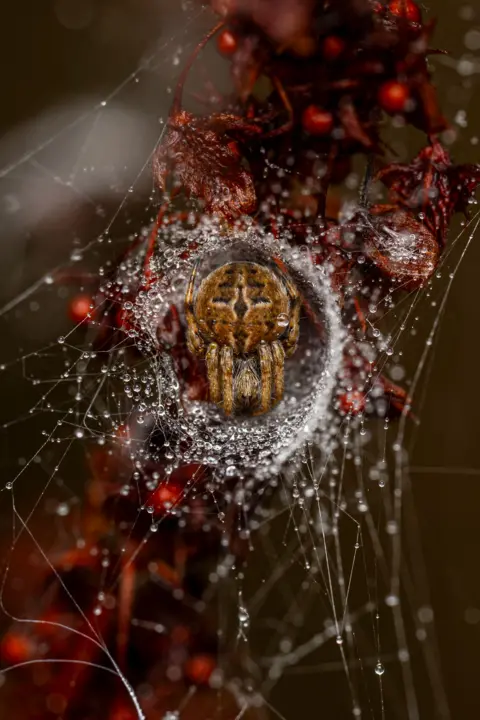
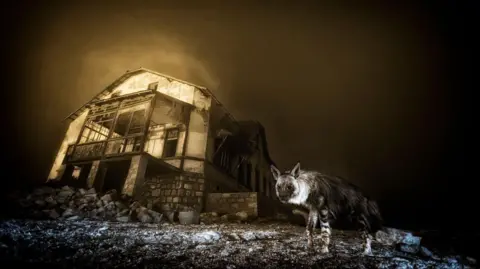
Wim van den Heever, Grand Prize Winner
A solitary brown hyena stands as a poignant figure against the desolate backdrop of Kolmanskop, Namibia, an abandoned diamond mining settlement reclaimed by the shifting sands of the Namib Desert. This evocative image, captured by wildlife photographer Wim van den Heever, has earned him the prestigious title of Wildlife Photographer of the Year 2025. The photograph portrays the hyena amidst crumbling structures, bathed in the dusty, ethereal light of the desert, creating a powerful juxtaposition between the remnants of human ambition and the enduring resilience of nature. Van den Heever’s dedication to this shot is remarkable; he spent a decade tracking the elusive brown hyena, the rarest of all hyena species, which is primarily nocturnal and leads a solitary existence. He meticulously set up camera traps after discovering fresh tracks in the ghost town, a place where he had long suspected their presence. "I knew they were there, but actually photographing one was just never going to happen," he recounted, highlighting the immense challenge and ultimate triumph of his perseverance. The winning image was unveiled at a glittering awards ceremony held at London’s Natural History Museum, the institution that champions this globally renowned competition. The annual exhibition, showcasing the full collection of award-winning images, opens to the public at the Natural History Museum on 17 October, offering a breathtaking glimpse into the planet’s diverse wildlife and the critical issues they face.
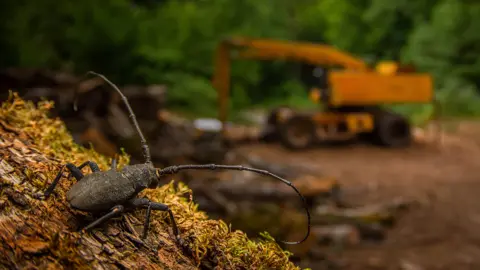
Andrea Dominizi, Junior Grand Prize and 15- to 17-year-old winner: "After the Destruction"
From the Lepini Mountains in Lazio, Italy, Andrea Dominizi’s photograph, "After the Destruction," clinched the Junior Grand Prize and the 15- to 17-year-old category. His image presents a longhorn beetle, its long antennae raised in a striking pose, resting on a freshly cut log. Behind it, the blurred, imposing silhouette of a yellow digger underscores the stark reality of its environment – a forest once abundant with old-growth beech trees, now scarred by logging. Andrea’s photograph serves as a powerful commentary on habitat loss, a pervasive challenge faced by countless species. "This photo shows the story and challenge faced by many animal species: habitat loss," he explains. "In this case, it’s a beetle that loses the tree and the wood it needs to lay its eggs." The image captures a moment of fragile existence for the beetle, dependent on the very resources being systematically destroyed, making it a poignant symbol of nature’s struggle against human encroachment.
Category winners
The 2025 competition celebrates a diverse array of photographic talent, from seasoned professionals to young enthusiasts, each capturing unique moments that highlight the beauty, complexity, and fragility of the natural world. These category winners, selected from tens of thousands of entries, collectively paint a vivid picture of our planet’s wild inhabitants and the environmental narratives that shape their lives.
Shane Gross, Animals in their Environment: "Like an Eel out of Water"
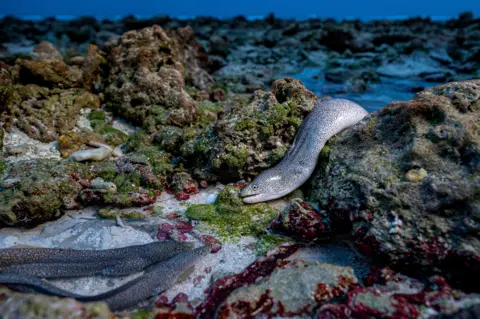
Shane Gross, a previous winner in this esteemed competition, continues to impress with his entry "Like an Eel out of Water," securing victory in the Animals in their Environment category. Captured on D’Arros Island in the Amirante archipelago of Seychelles, the photograph shows three peppered moray eels, their sleek bodies weaving through a maze of rocks and tidal pools. They are actively scavenging for carrion at low tide, a less commonly observed behaviour for these marine predators. Gross’s patience was legendary, as he spent weeks enduring the intense sun, oppressive heat, and relentless flies, waiting for the perfect moment where dead fish had washed ashore. His dedication paid off, yielding a dynamic and intimate portrait of these fascinating creatures adapting to their intertidal hunting grounds.
Jamie Smart, 10 Years and Under category: "Spider’s Dewy Retreat"
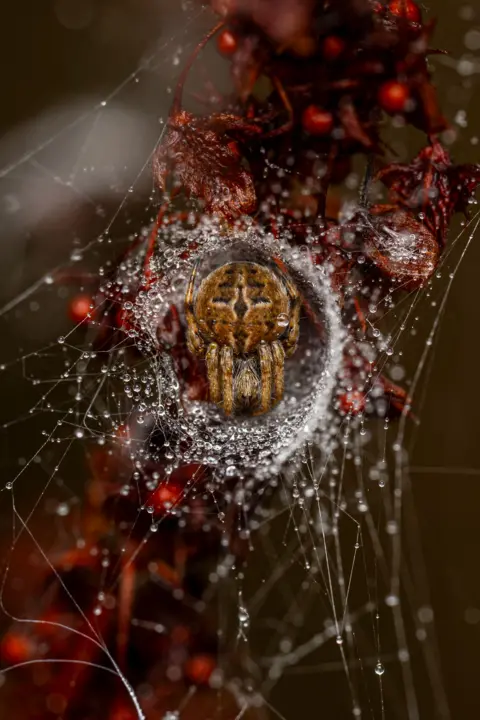
In the 10 Years and Under category, UK-based Jamie Smart presented a delicate and enchanting image of an orb-weaver spider, simply titled "Spider’s Dewy Retreat." On a cold September morning, Jamie discovered the spider curled up within its intricately spun silken hideaway, surrounded by web threads dusted with glistening dew. The photograph highlights the often-overlooked beauty of common garden inhabitants and encourages a shift in perspective. "It’s also quite special for me because I get to show something that people are usually afraid of," Jamie shared, emphasizing the power of her image to foster appreciation for creatures often misunderstood or feared. Her photograph transforms a simple spider into a subject of wonder, framed by the sparkling intricacies of its own creation.
Sebastian Frölich, Wetlands: The Bigger Picture: "Methane Micro-World"
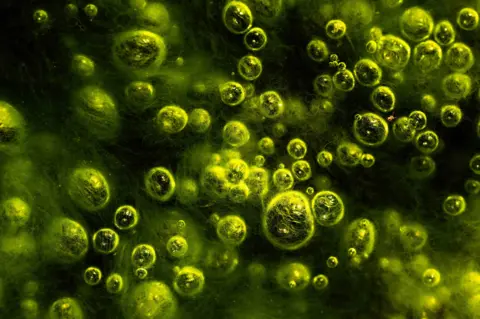
Germany’s Sebastian Frölich triumphed in the Wetlands: The Bigger Picture category with "Methane Micro-World," a stunning macro shot captured in Platzertal, Tyrol, Austria. The image features a tiny springtail insect, seemingly floating among clusters of neon green methane bubbles, an ethereal scene that underscores the delicate balance of wetland ecosystems. Frölich’s photograph serves as a critical reminder of the vital role moorlands play as carbon sinks and rich habitats for diverse, often microscopic, wildlife. His work comes at a crucial time, as Austria has tragically lost 90% of its peat bogs, emphasizing the urgency of protecting these fragile and invaluable natural resources.
Lubin Godin, Mountain Landscapes: "Above the Clouds"
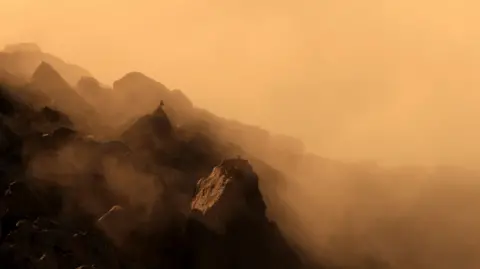
French photographer Lubin Godin won for "Above the Clouds," captured at Col de la Colombière, Haute-Savoie, France. During an arduous early ascent of the Alpine peaks, Godin encountered an Alpine ibex, majestically resting on a rocky mountain ridge. Below it, a vast, golden blanket of clouds stretched to the horizon, creating a breathtaking "sea of clouds" effect. The sky above was a dusty orange, illuminated by the first rays of dawn. He initially descended, but as the sun broke through the mist, he retraced his steps, racing against time to capture the scene before the ethereal mist inevitably returned, resulting in this magnificent and serene portrait of mountain solitude.
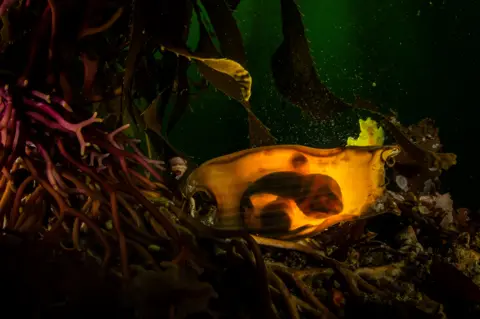
Ralph Pace, Underwater Wonders: "Kelp Forest Cradle"
From Monterey Bay, California, USA, Ralph Pace’s "Kelp Forest Cradle" secured a win, showcasing the vulnerable beauty of marine life. Battling powerful underwater currents, Pace captured an intimate image of a swell shark egg case. The leathery, translucent case reveals a glowing embryo within, complete with discernible gill slits and a yolk sac, illuminated by a gentle green underwater light. Swell sharks rely heavily on kelp forests for anchoring their eggs, making them acutely vulnerable to the alarming decline of these crucial underwater ecosystems. Researchers estimate that Monterey Bay’s once-thriving kelp forests have diminished by more than 95 per cent over the past 34 years, making Pace’s image a stark reminder of the urgent need for marine conservation.
Philipp Egger, Animal Portraits: "The Gaze of the Night Hunter"
Philipp Egger, from Italy, was awarded in the Animal Portraits category for "The Gaze of the Night Hunter," a captivating image of a Eurasian eagle owl. Captured in Naturns, South Tyrol, Italy, the owl is depicted in deep shadow, its intense orange eye glowing with an almost otherworldly luminescence as a subtle brush of light illuminates its dark, cryptic feathers. Egger’s dedication to his subject is evident, as he observed this particular eagle owl’s nest from afar for over four years. Eurasian eagle owls are among the world’s largest owl species, roughly twice the weight of a common buzzard. These formidable nocturnal hunters typically nest on cliffs or in secluded crevices, often returning to the same site year after year, a testament to their territorial nature and Egger’s commitment to documenting their lives.
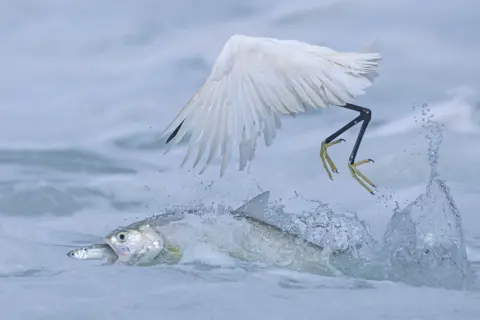
Qingrong Yang, Behaviour: Birds: "Synchronised Fishing"
Chinese photographer Qingrong Yang’s "Synchronised Fishing," taken at Yundang Lake, Fujian Province, China, earned him the Behaviour: Birds category award. Yang masterfully captured the precise moment a ladyfish breaks the water’s surface, snatching its prey with remarkable agility, just as a little egret flies directly above, seemingly in perfect, albeit accidental, synchronicity. Yundang Lake is a known hotspot for such frenzied feeding moments, and Yang frequently visits the location to document these dynamic interactions between different species. His image encapsulates the vibrant, competitive energy of a shared hunting ground and the unexpected harmony that can emerge in the wild.
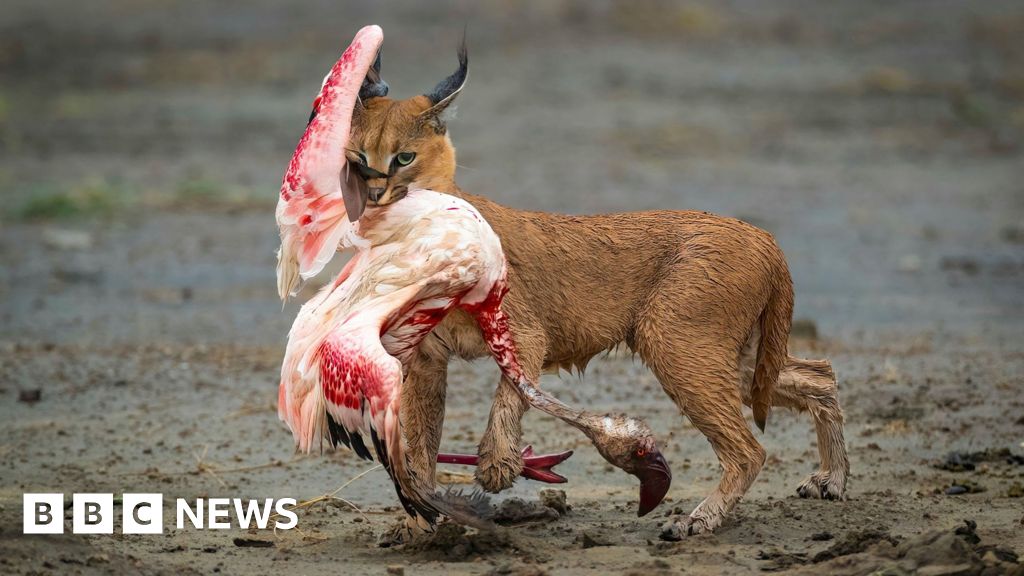
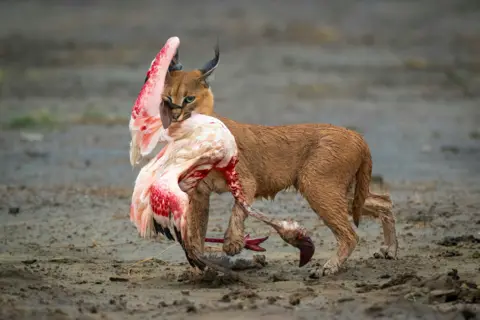
Dennis Stogsdill, Behaviour: Mammals: "Cat Amongst the Flamingos"
Dennis Stogsdill from the USA won the Behaviour: Mammals category with "Cat Amongst the Flamingos." His dramatic photograph, taken at Ndutu Lake, Serengeti National Park, Tanzania, shows a caracal gripping a bloody flamingo mid-hunt on a sandy lakeshore. Caracals are renowned for their incredible acrobatic leaps, often catching birds in mid-air with astonishing precision. However, documented sightings of these agile predators successfully hunting flamingos are exceptionally rare, making Stogsdill’s image a unique and compelling record of natural predation and the harsh realities of survival in the wild.
Jon A Juárez, Photojournalism: "How to Save a Species"
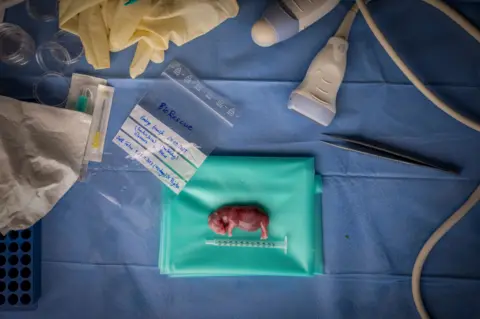
Spanish photographer Jon A Juárez’s "How to Save a Species" was recognized in the Photojournalism category, providing a powerful look into cutting-edge conservation efforts. His image, taken at Ol Pejeta in Nanyuki, Laikipia County, Kenya, shows a southern white rhino foetus on a surgical mat, surrounded by medical tools in a laboratory setting. After years of closely following the BioRescue Project, Juárez witnessed a significant breakthrough in rhino conservation: the first successful transfer of a rhino embryo to a surrogate mother. Although the pictured foetus did not survive due to infection, this milestone proved the viability of in-vitro fertilization (IVF) for rhinos, bringing scientists considerably closer to saving the critically endangered northern white rhino from extinction.
Quentin Martinez, Behaviour: Amphibians and Reptiles: "Frogs in the Deluge"
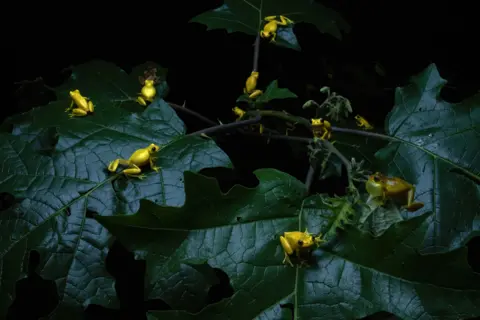
Quentin Martinez, from French Guiana, won the Behaviour: Amphibians and Reptiles category with "Frogs in the Deluge." In the midst of a heavy downpour on Kaw Mountain, French Guiana, Martinez navigated a flooded path to a forest clearing where a pool had formed. There, he captured the mesmerizing sight of lesser tree frogs gathering to breed, their skin exhibiting a striking metallic sheen under the challenging conditions. His photograph highlights the adaptations of amphibians to their environment and the vibrant life that thrives even in extreme weather.
Javier Aznar González de Rueda, Photojournalist Story: "End of the Round-up"
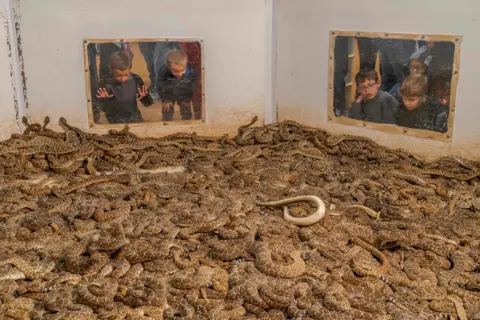
Spanish photographer Javier Aznar González de Rueda’s "End of the Round-up" was awarded in the Photojournalist Story category. His compelling series explores the complex and often conflicted views society holds towards rattlesnakes across the US, ranging from deep respect in some cultures to widespread fear and persecution in others. The image shows a large enclosure teeming with hundreds of western diamondback rattlesnakes, as visitors observe through thick glass windows. This photograph confronts the viewer with the reality of rattlesnake round-ups, controversial events where these reptiles are captured, often to be sold or killed, encapsulating the ongoing tension between human activity and wildlife conservation.
Georgina Steytler, Behaviour: Invertebrates: "Head-Stacker’s Defence"
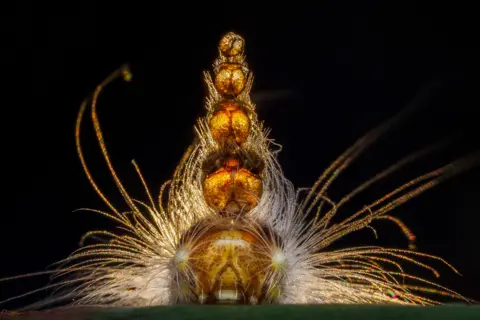
Australia’s Georgina Steytler secured a win in the Behaviour: Invertebrates category for "Head-Stacker’s Defence." Captured in Torndirrup National Park, Western Australia, her photograph brilliantly showcases the gum-leaf skeletoniser caterpillar’s peculiar defensive mechanism: a towering stack of discarded head capsules from its past moults. Backlit by the warm glow of sunset, the image highlights this fascinating biological oddity. Each time the caterpillar sheds its skin, it carefully retains the old head capsule, adding it to a growing column. This strange ‘tower’ is thought to confuse potential predators, making the caterpillar appear larger or less appealing.
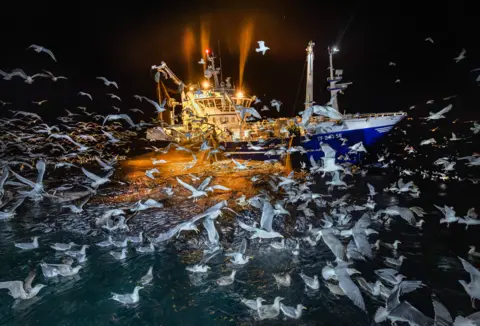
Audun Rikardsen, Oceans: The Bigger Picture: "Fishing the Polar Night"
Norwegian photographer Audun Rikardsen’s "Fishing the Polar Night" won the Oceans: The Bigger Picture category. His striking image, taken in Kvænangen Fjord, Skjervøy, Norway, depicts a flock of gulls swarming around an Atlantic fishing trawler at night. The sky is pitch-black, illuminated only by the stark glow of the boat’s powerful lights, as the birds desperately try to snatch fish trapped in the nets. Rikardsen’s work aims to highlight the escalating conflict between seabirds and the commercial fishing industry, particularly the alarming number of birds that drown each year in purse seine nets, emphasizing the devastating impact of unsustainable fishing practices on marine ecosystems.
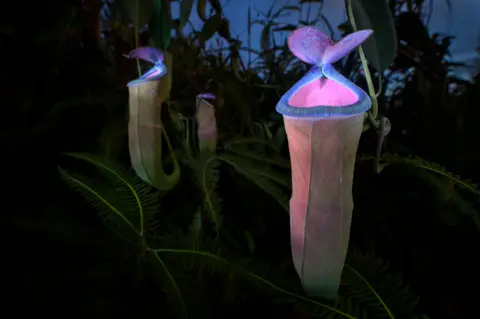
Chien Lee, Plants and Fungi: "UV Lure"
Chien Lee from Malaysia was awarded first place in the Plants and Fungi category for "UV Lure." Photographed in Kuching, Sarawak, Borneo, Malaysia, the image shows carnivorous pitcher plants glowing in vibrant pink and violet hues under UV torchlight in the darkness. These remarkable plants use a combination of colour, scent, and nectar, enhanced by their ability to reflect UV light, to effectively lure unsuspecting insect prey into their traps. To capture this unseen beauty, Lee employed a long exposure technique coupled with a UV torch, revealing a hidden aspect of the natural world and the ingenious strategies plants use for survival.
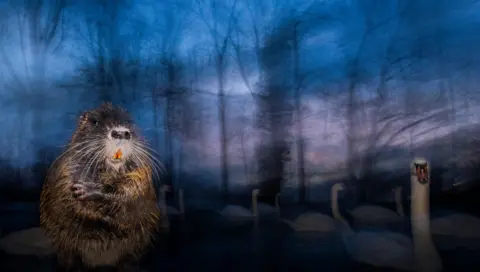
Luca Lorenz, Urban Wildlife: "Coypu Crashers"
German photographer Luca Lorenz’s "Coypu Crashers" captures an unexpected moment of urban wildlife. While he was intently photographing elegant mute swans on an urban lake in Germany during twilight, a coypu – an introduced species – unexpectedly "photobombed" his frame. The image shows the coypu standing upright near the water’s edge, its presence adding a touch of quirky humour to the otherwise serene scene of ghostly swans gliding across the water. The background is a dreamy, blurred expanse of leafless trees against a soft blue and purple sky, illustrating how wildlife can surprise us in even the most human-dominated landscapes.
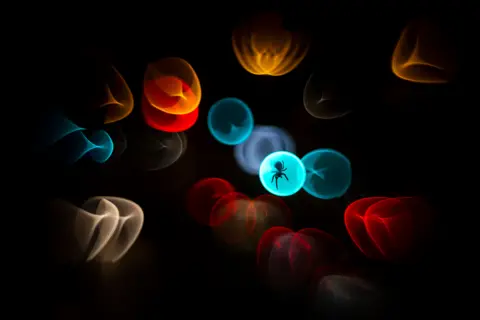
Simone Baumeister, Natural Artistry: "Caught in the Headlights"
In the Natural Artistry category, Germany’s Simone Baumeister won with "Caught in the Headlights." This creative and abstract photograph, taken in Ibbenbüren, North Rhine-Westphalia, Germany, features an orb-weaver spider dramatically silhouetted against the blurred, colourful circular shapes of city traffic lights. Baumeister achieved this kaleidoscopic effect by reversing one of the six glass elements in her lens, intentionally framing the spider within a vibrant, abstract halo of urban light. The image transforms a common urban encounter into a stunning piece of art, blending nature’s intricate details with the dynamic colours of human infrastructure.
Fernando Faciole, Impact Award Winner 2025 & Highly Commended, Photojournalism: "Orphan of the Road"
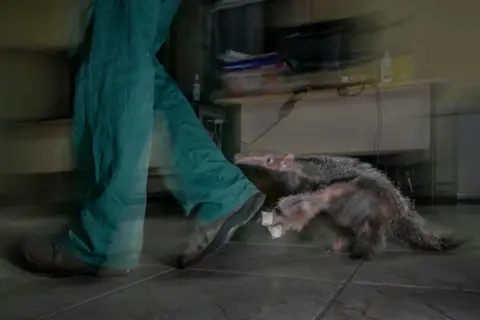
Fernando Faciole, from Brazil, was honoured with the Impact Award Winner 2025 and also received a Highly Commended recognition in Photojournalism for his poignant work, "Orphan of the Road." His photograph, taken at CETAS (Centro de Triagem de Animais Silvestres) in Belo Horizonte, Brazil, captures an orphaned giant anteater pup trailing closely behind its caregiver, whose green pants and dark shoes are visible. The motion blur in the image conveys a sense of movement across the tiled floor, emphasizing the pup’s dependency. Faciole’s powerful image aims to highlight the devastating consequences of road collisions, a major and growing threat to these vulnerable animals in Brazil and beyond, underscoring the human impact on wildlife populations.
Alexey Kharitonov, Portfolio Award: "Visions of the North"
Alexey Kharitonov, an Israeli/Russian photographer, was awarded the prestigious Portfolio Award for his series "Visions of the North," represented here by a breathtaking aerial shot. The image showcases the recently frozen surface of Svetlyachkovskoye Swamp, revealing three distinct dark circles etched with intricate, crack-like veins, all surrounded by layers of cracked ice. At the bottom, larger curved lines of snow and frost gracefully frame these mysterious shapes. Using a drone, Kharitonov masterfully captures the rapid and dramatic transition from summer to winter across the vast taiga forests and Arctic tundra, offering a unique, abstract perspective on the raw, ephemeral beauty of the northern wilderness.

 Ramos Leo
 atisusanti
 Nakalama John
 George Anjay

 Roy Suryo