
 Ramos Leo
Two properties connected to Peter Mandelson, the prominent former Labour minister, in Wiltshire and north London, have been subjected to police searches. The Metropolitan Police confirmed the operations were carried out following allegations of misconduct in public office, specifically concerning the alleged passing of market-sensitive government information to the late convicted sex offender Jeffrey Epstein. The police launched their investigation into Lord Mandelson earlier this week, marking a significant development in the ongoing fallout from the Epstein scandal and its far-reaching implications.
The Metropolitan Police, in a formal statement, clarified that Lord Mandelson has not been arrested and that inquiries are actively ongoing. This clarification underscores the preliminary nature of the searches, which are understood to be part of an evidence-gathering process rather than an immediate prelude to charges. Sources close to Lord Mandelson, 72, indicate that his position is one of asserting no criminal action on his part and denying any motivation of financial gain from his interactions. He has previously acknowledged and expressed profound regret for his continued association with Epstein, offering an unequivocal apology to the women and girls who suffered at Epstein’s hands.
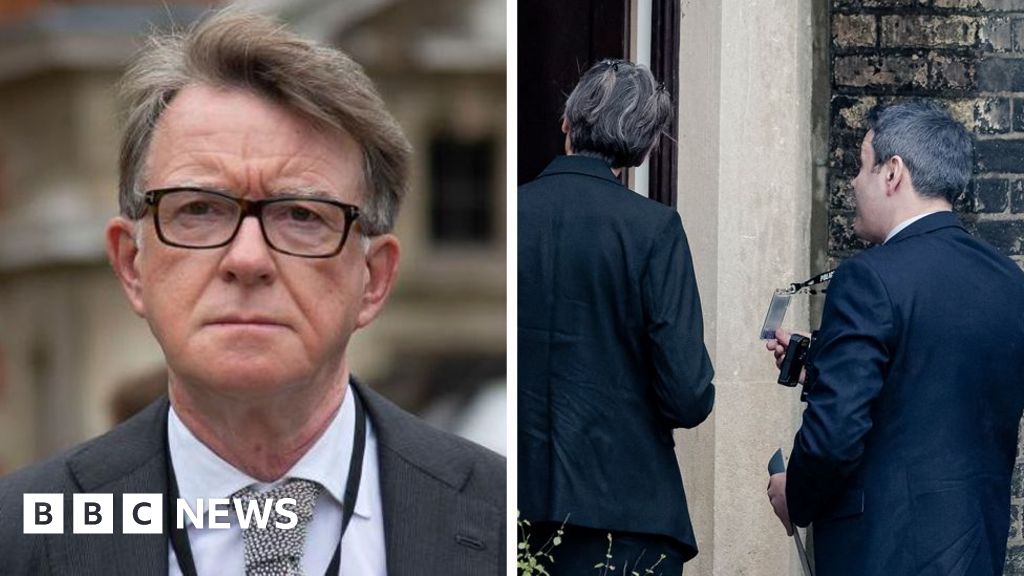
The searches commenced with officers arriving at one of the addresses linked to Lord Mandelson in central London, near Camden. The BBC understands that Lord Mandelson was present at this location when police began their search. Observers noted officers briefly inspecting a car outside the property before re-entering the residence. Subsequently, police were seen leaving the building carrying several boxes, suggesting the collection of documents or other materials pertinent to their investigation. Concurrently, Lord Mandelson facilitated the entry of police into his Wiltshire address, avoiding the need for forced entry. At this second property, officers were also observed carrying unfolded archive boxes, indicating a systematic approach to collecting potential evidence, and extended their investigation to include outhouses on the premises.
The impetus for this police investigation stems from accusations that Lord Mandelson, while serving as a government minister, leaked confidential information to Epstein. These allegations gained prominence after the US Department of Justice released a substantial tranche of documents related to Epstein, including numerous emails exchanged with various individuals. Among these documents were messages from 2008 that appeared to show Lord Mandelson, then the Business Secretary in Gordon Brown’s government, discussing sensitive Treasury plans for a one-off tax on bankers’ bonuses with Epstein.
The timeline suggested by the released documents is particularly concerning. Just two days after these initial exchanges about the bankers’ bonus policy, further conversations between Lord Mandelson and Epstein were indicated. An email from Epstein reportedly inquired whether "jamie" should contact then-Chancellor Alistair Darling "one more time." This reference is widely understood to point to Jamie Dimon, who was at that time the chief executive of the prominent US banking giant JP Morgan. Lord Mandelson’s alleged reply to Epstein, advising him to call the Chancellor again and suggesting he should "mildly threaten" him, has raised serious questions about the nature of their relationship and the potential for undue influence or improper disclosure of government policy.
Further emails within the released documents also hinted that Lord Mandelson provided Epstein with advanced notice of a colossal €500bn bailout package from the European Union, intended to rescue the Euro during a period of intense financial instability. While the United Kingdom ultimately did not contribute to this particular bailout, then-Chancellor Alistair Darling was present in Brussels for the negotiations. The pre-emptive disclosure of such a significant and market-moving financial decision, especially to an individual like Epstein, carries substantial ethical and potentially legal implications, regardless of the UK’s direct financial involvement.
Following the initiation of the police investigation, a UK government spokesperson issued a statement affirming the government’s readiness to provide "whatever support and assistance the police need." This highlights the seriousness with which the allegations are being treated at the highest levels of government. The specific offence under investigation, misconduct in public office, is a serious common law offence in England and Wales. It typically applies to individuals holding public service roles, such as civil servants or police officers, who wilfully neglect their duty and/or wilfully misconduct themselves to such a degree as to amount to an abuse of the public’s trust in the office holder. The maximum sentence for this offence can be as severe as life imprisonment, reflecting the gravity of betraying public trust.
The scandal has ignited a firestorm of political controversy, particularly within the Labour Party, where Lord Mandelson has long been a highly influential figure. In the face of a threatened rebellion by Labour MPs, Downing Street pledged to release documents pertaining to its appointment of Lord Mandelson as the UK’s ambassador to the US. The sheer volume of this material is considerable, with the BBC being informed that the number of electronic communications alone could approach 100,000. Prime Minister Sir Keir Starmer, in a letter to the Intelligence and Security Committee, acknowledged the "very significant volume of material" that would require review but stressed the importance of making these documents available to Parliament "as soon as possible." However, the publication process is expected to be protracted, as the government has requested to withhold some material for national security reasons, and the Metropolitan Police has made a similar request to prevent any interference with its ongoing criminal investigation.
Sir Keir Starmer has faced intense scrutiny and criticism over his past association with Lord Mandelson. He previously apologised to Epstein’s victims, stating he was "sorry for having believed Mandelson’s lies." Former Prime Minister Gordon Brown also weighed in, expressing his "great regrets" over appointing Mandelson to his government. In a Guardian article, Brown conveyed his profound "revulsion at what has been uncovered about Epstein and his impact on our politics" and took "personal responsibility" for Mandelson’s appointment. However, he maintained that he had been informed Mandelson’s record was "unblemished" at the time and that there were "no reports of a relationship with anyone named Epstein."
The anger and frustration among Labour MPs have been palpable, both publicly and privately. Liverpool Riverside MP Kim Johnson publicly criticised Sir Keir’s handling of the situation as "appallingly" and suggested he should "consider resigning." Brian Leishman, MP for Alloa and Grangemouth, told the BBC that Sir Keir had "shown an incredible misjudgement in appointing Lord Mandelson, and it goes beyond saying sorry," questioning whether his judgment was "good enough for that office" and concluding with a "categorical no." Stroud MP Simon Opher went further, suggesting the prime minister "needs to change his advisers in Number 10," specifically naming chief of staff Morgan McSweeney, who was known to be close to Lord Mandelson, as a figure who should depart over the scandal.
The Conservative Party leader, Kemi Badenoch, seized upon the escalating crisis, declaring Sir Keir’s position "untenable" and calling for a vote of no confidence. The political pressure on Sir Keir Starmer intensified dramatically following these revelations and the subsequent police action.
In a swift and significant response to the mounting pressure and the police investigation, Lord Mandelson announced his resignation from the Labour Party on Sunday. Just three days later, he further confirmed his retirement from the House of Lords, effectively withdrawing from formal political life amidst the swirling allegations and the profound public and political fallout from his connections to Jeffrey Epstein. These resignations mark a dramatic conclusion to a long and often controversial career at the heart of British politics.




 atisusanti
 Nakalama John
 George Anjay
 Roy Suryo