Nana Banana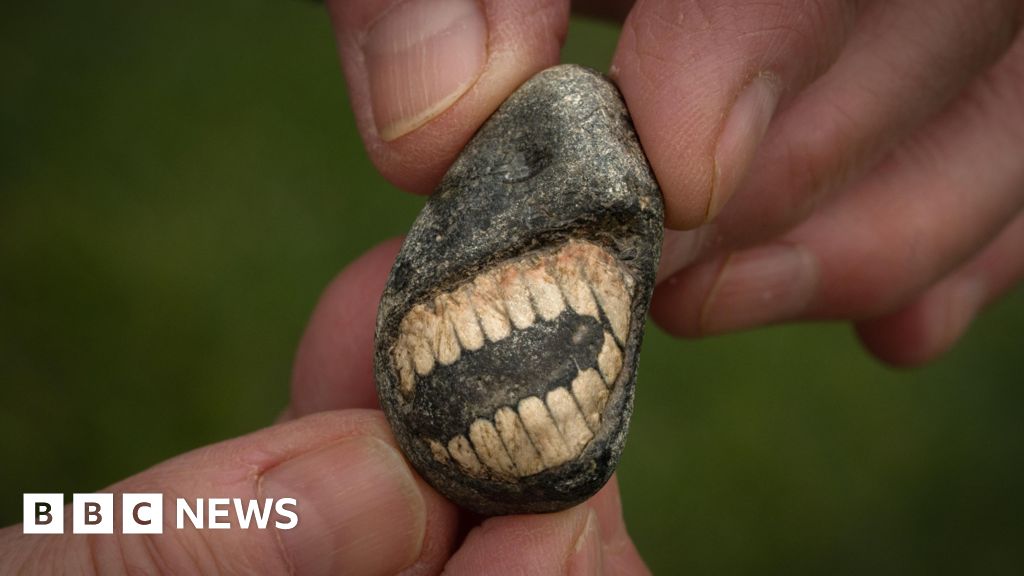
A remarkable fossil, described as "smiling" by its discoverer, Christine Clark, has been unearthed on the historic Holy Island of Lindisfarne in Northumberland. The 64-year-old was enjoying a Boxing Day walk and indulging in her favourite pastime of fossil hunting when a tiny pebble, nestled among countless others, seemed to gaze back at her with an uncanny grin. "It looked like someone’s fake teeth," Clark recounted, immediately captivated by the unusual formation embedded in the rock. The unique find quickly garnered widespread attention after she shared photographs of it on a Facebook fossil identification page, amassing thousands of likes and comments from fellow enthusiasts who largely confirmed her suspicion that she had indeed stumbled upon the remains of an ancient marine animal.
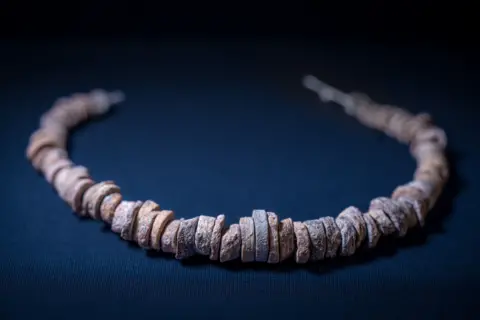
Christine and her husband Gerard make an annual pilgrimage to Northumberland, a tradition that often involves searching the island’s shores for ‘Cuddy’s beads.’ These small, disc-shaped fossils are fragments of crinoid stems, renowned locally for their historical and spiritual significance. Holy Island, a spit of land accessible only twice daily by a tidal causeway, is home to a mere 150 residents and holds a profound place in English history as the "cradle of early English Christianity." Its isolation and rich heritage make it a compelling destination for both spiritual pilgrims and amateur palaeontologists alike.
The ‘Cuddy’s beads’ derive their evocative nickname from St. Cuthbert, a pivotal figure in Northumbrian history and venerated as the patron saint of the North of England. Dr. Frances McIntosh, collections curator in the North East at English Heritage, explains the deep-rooted legend: "He arrived on the island in the 670s as a monk coming to the priory, he is buried here and miracles took place around his shrine." Centuries later, in the 1300s, locals and pilgrims began discovering these distinctive small fossils. Unaware of their true biological origin, people attributed their existence to St. Cuthbert himself, believing he crafted them as part of his spiritual practice. Collecting these ‘beads’ was thought to impart spiritual benefits, a tradition that has endured through generations.
On that particular Boxing Day, while searching for these familiar circular beads, Christine’s keen eye was drawn to something entirely different. "I saw this fossil smiling at me – it’s the first set of teeth I have found," she quipped, delighted by the whimsical appearance of her discovery. The fossil’s distinctive configuration, with its curved arrangement of segments creating the illusion of an open mouth and teeth, set it apart from the more common ‘Cuddy’s beads.’ Its striking visual appeal resonated widely online, prompting numerous inquiries and expressions of awe.
To officially identify the intriguing specimen, the BBC submitted the fossil to the British Geological Survey (BGS). Dr. Jan Hennissen, a senior palaeontologist at the BGS, confirmed that Christine’s find is indeed a larger, more complete section of a crinoid, specifically a connected series of its stem segments. Crinoids are an ancient and resilient group of marine animals, first appearing in the fossil record during the Cambrian period, over 500 million years ago. This makes them one of the oldest complex animals known on Earth, with various species still thriving in oceans today. Often referred to as "sea lilies" due to their plant-like appearance, crinoids are animals with a flexible stem that typically anchors them to the seafloor. At the top of this stem, a cup-shaped body (calyx) bears an array of feathery, branching arms used for filter feeding.
Dr. Hennissen further elaborated on the fossil’s anatomy: "The stem consists of these little discs, called ossicles, and what Christine has found is a number of these ossicles connected together, in what is called a columnal." Unlike the individual, isolated ossicles that form ‘Cuddy’s beads,’ Christine’s fossil preserves a segment of the stem where multiple ossicles remain articulated. The remarkable "mouth-like" or "smiling" shape is a result of this columnal having been split lengthways and subsequently curved during the fossilization process or through geological pressures over millions of years. This unusual preservation has created a captivating optical illusion, giving the ancient marine creature a distinctly human expression.
The rock matrix surrounding the fossil, according to Dr. Hennissen, is likely from the Alston formation, a dark limestone characteristic of the region. This geological formation dates back approximately 350 million years, placing the fossil firmly within the Carboniferous period. During this era, the area now known as Northumberland was submerged under warm, shallow tropical seas, teeming with marine life, including vast colonies of crinoids. These conditions were ideal for the proliferation and subsequent fossilization of such creatures.

Crinoids belong to the phylum Echinodermata, a diverse group that also includes more familiar marine animals such as sea urchins, starfish, and sea cucumbers. While crinoid fossils are relatively common, particularly the detached ossicles, finding a complete crinoid specimen—with its stem, calyx, and arms intact—is considered quite rare. Christine’s discovery, while not a complete organism, is significant because it represents a more substantial and unusually preserved segment of the animal, offering a clearer glimpse into its ancient form than the ubiquitous ‘Cuddy’s beads.’
Dr. Hennissen provided guidance for aspiring fossil hunters on the Northumberland coast, explaining how to distinguish crinoid fossils from their surrounding rock: "The biological form is very different from the surrounding rock normally – either a different colour or a different composition. And you can see these very strict lines, which are very defined as opposed to the [surrounding] mudstone." The distinct structural patterns of the ossicles, often appearing as star-shaped or circular segments, make them relatively easy to identify against the less organized textures of the sedimentary rock.
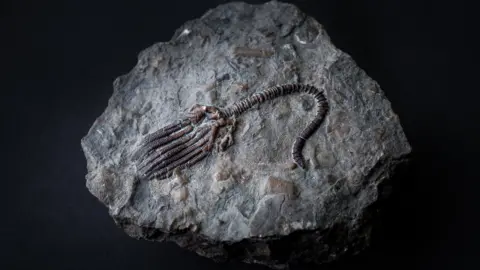
Despite receiving several offers to purchase her unique "smiling" fossil, Christine Clark has no plans to part with it. For her, the fossil holds a special place in her personal collection, a tangible piece of ancient history discovered during a cherished holiday tradition. "It brings a lot of amusement to many people," she remarked, acknowledging the widespread joy and fascination her discovery has sparked. Her find not only highlights the incredible geological richness of the Northumberland coast but also serves as a charming reminder of the wonders that can be uncovered through simple curiosity and a keen eye, connecting the present day to marine ecosystems that thrived hundreds of millions of years ago.
The discovery underscores the valuable role of amateur enthusiasts in palaeontology, often bringing to light specimens that might otherwise remain hidden. Christine Clark’s "smiling" crinoid is more than just a fossil; it is a delightful intersection of natural history, local folklore, and personal discovery, continuing to enchant all who encounter its ancient grin.



 George Anjay
 Ramos Leo
 Nakalama John

 atisusanti