Nana Banana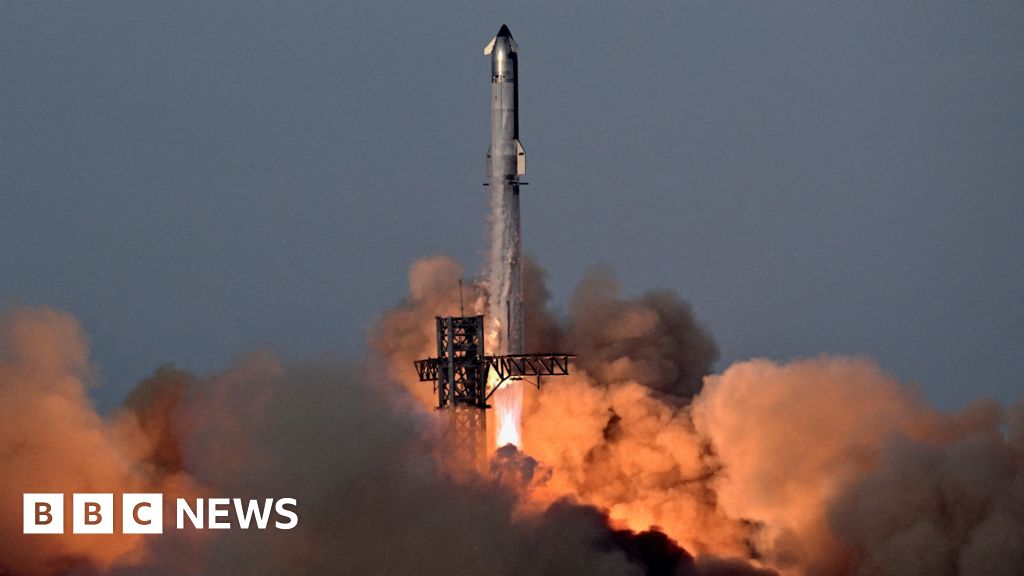
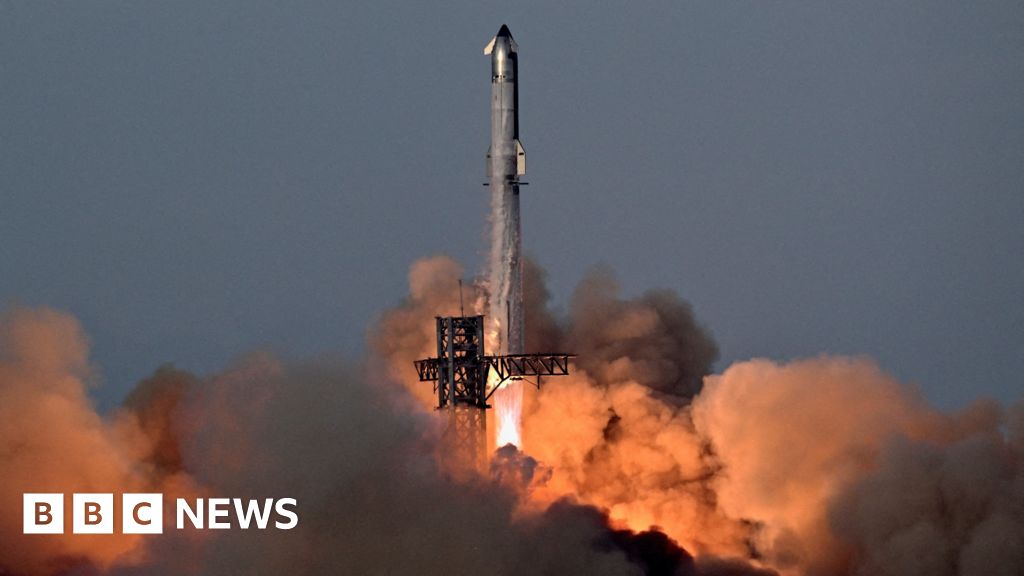
The world’s largest and most powerful rocket, standing at an unprecedented 121 meters (397 feet) tall, roared to life from SpaceX’s Starbase facility near Boca Chica, Texas, just after 18:30 local time (00:30 BST). What followed was a nail-biting, approximately 60-minute flight that captivated observers worldwide, showcasing the system’s capabilities while pushing its design limits. Unlike its predecessors, this integrated flight test demonstrated a much higher degree of operational success, laying crucial groundwork for future endeavors.
The launch itself was a spectacle of raw power. All 33 of the Super Heavy booster’s advanced Raptor engines ignited in a thunderous display, generating an astonishing 16.7 million pounds of thrust – nearly double that of the iconic Saturn V rocket that carried Apollo astronauts to the Moon. This unprecedented power propelled the colossal vehicle skyward with an initial ascent that was smooth and robust, a welcome departure from previous attempts that encountered engine issues early in the flight.
Approximately seven minutes into the mission, a critical maneuver known as "hot staging" occurred. This innovative technique involves igniting Starship’s engines while it is still attached to the Super Heavy booster, just moments before separation. This daring sequence, designed to enhance efficiency and payload capacity, was successfully executed, with the Super Heavy booster cleanly detaching and beginning its controlled descent towards a targeted splashdown zone in the Gulf of Mexico. This separation marked the end of the booster’s primary role for this test, paving the way for the Starship spacecraft to continue its journey independently.
As Starship continued its ascent, it reached an impressive maximum altitude of nearly 200 kilometers (124 miles) above Earth, briefly entering space before orienting itself for a controlled coast around the planet. The flight profile was specifically designed to stress the spacecraft under extreme conditions, collecting invaluable performance data. During its dramatic re-entry into Earth’s atmosphere, engineers closely monitored several critical parameters. Footage from onboard cameras revealed parts of the rocket’s flaps, crucial for aerodynamic control, appeared to burn intensely and swing wildly. While visually alarming, these events were largely anticipated as the spacecraft endured the scorching temperatures and immense pressures of atmospheric friction, serving as a real-world test of its advanced heat shield and structural integrity.
This successful flight holds immense strategic importance, particularly for the US space agency NASA. The agency plans to utilize a modified version of Starship as the Human Landing System (HLS) for its ambitious Artemis program, which aims to return humans to the Moon by 2027. Starship’s unprecedented payload capacity and its potential for reusability make it a cornerstone of NASA’s lunar exploration architecture, promising to enable longer, more complex missions to the lunar surface. However, many observers within the space community caution that the 2027 target date is highly optimistic and likely to slip, given the extensive development and rigorous human-rating processes still required.
SpaceX CEO Elon Musk, who has personally invested billions into the development of Starship, with each launch estimated to cost around $100 million, expressed his elation on X, posting, "Great work by the SpaceX team!!" This sentiment underscores the significant personal and financial stakes involved in the program. Starship is not merely a rocket; it’s envisioned as a fully reusable transport system capable of carrying vast quantities of cargo and, ultimately, people to destinations far beyond Earth, including Mars. Musk’s long-term vision for Starship is to enable the creation of permanent human settlements on other celestial bodies, making humanity a multi-planetary species.
The integrated Starship system comprises two primary components: the Super Heavy booster, responsible for the initial ascent, and the Starship spacecraft itself, which carries the payload and crew (in future missions) and performs orbital maneuvers and re-entry. This modular design, coupled with SpaceX’s relentless pursuit of full reusability, is central to significantly reducing the cost of space access and increasing the frequency of launches.
A particularly innovative aspect of SpaceX’s reusability strategy is the "chopstick" maneuver, where the Super Heavy booster is intended to be caught by massive mechanical arms extending from the launch tower upon its return to Earth. While this test flight did not attempt a full "chopstick" capture (the booster performed a controlled splashdown), the successful controlled descent demonstrated progress towards this complex recovery method, which is vital for rapid turnaround and cost efficiency.
Dr. Simeon Barber, a planetary scientist at the Open University, lauded the achievement, stating, "This was a great day for SpaceX, executing its full mission for the first time and deploying some test dummy satellites along the route." He emphasized the invaluable data gathered from all phases of the flight – take-off, cruising, and landing – which represents a significant leap forward for the company’s iterative development process. This data will be meticulously analyzed to refine Starship’s design and operational procedures.
The path to this success has been anything but smooth. While an earlier version of the Starship prototype (known as Starhopper and subsequent high-altitude test vehicles) had five successful test launches, all previous attempts to launch the full, integrated Starship and Super Heavy system had ended in spectacular explosions, or "rapid unscheduled disassemblies" (RUDs), as SpaceX euphemistically calls them. These high-profile failures, while visually dramatic, were consistently framed by SpaceX as critical learning opportunities, embodying their "fail fast, learn fast" mantra. The company’s philosophy prioritizes rapid iteration and data collection over a cautious, slow development cycle.
However, after three consecutive failures this year, pressure had been mounting on SpaceX. Questions were beginning to surface about the program’s viability and whether Elon Musk’s increasing involvement in US politics, including his significant support for former US President Donald Trump during the 2024 election campaign (prior to a reported falling out in June), might be diverting his focus from his aerospace ventures. This successful flight provides a much-needed vindication of SpaceX’s engineering prowess and its unique development approach.
Despite the obvious triumph, challenges remain. Dr. Ken Kremer, a research scientist and founder of the website Space UpClose, acknowledged that the success "gets the program back on track," but cautioned, "getting to the Moon is another question." He expressed significant skepticism about the 2027 target for the US to return humans to the Moon, calling it "extremely unlikely," if not impossible. This sentiment is echoed by many in the industry who understand the immense technical, safety, and logistical hurdles involved in human-rating a spacecraft of Starship’s complexity.
The race to the Moon is not just an American endeavor. The US is locked in a fierce competition with China, which has its own ambitious lunar exploration program, including plans for crewed missions. Some scientists suggest that even with Starship’s significant progress, China’s more centralized and often less transparent approach to space development might allow it to achieve a human lunar landing sooner.
Ultimately, Starship returned to Earth on Tuesday battered and bruised from its journey through the atmosphere, but undeniably victorious. Its survival and successful execution of the mission objectives represent a monumental step forward for SpaceX. It is a critical validation that the company can indeed develop a safe and reliable transport system capable of carrying humans to the Moon and, eventually, to Mars, propelling humanity closer to a future beyond Earth.




 Ramos Leo
 Nakalama John
 George Anjay