Nana Banana
The groundbreaking excavation, undertaken by a dedicated team from Pre-Construct Archaeology, took place on a building site situated just a few miles from the historic market town of Thetford. Dig leader Peter Crawley recounted a strong intuitive sense about the location even before the first spade hit the earth, stating, "It felt like one of those special sites that you do get every so often." His premonition proved remarkably accurate, culminating in the unearthing of a hoard that has sent ripples of excitement throughout the archaeological community.
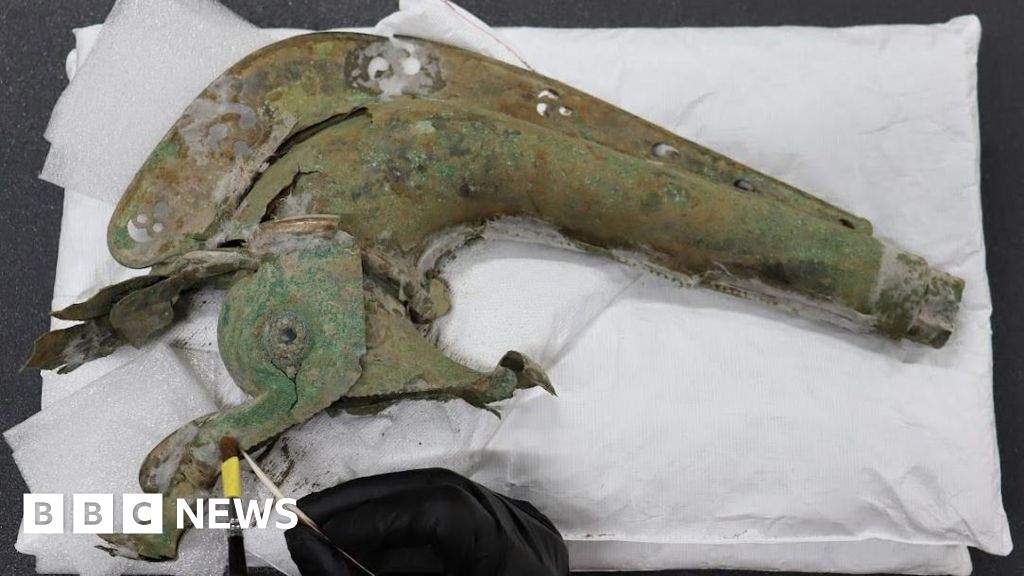
At the heart of this remarkable cache lies the most complete battle trumpet, known as a carnyx, ever recovered in Europe. Alongside it, in an equally astonishing discovery, was the first-ever boar’s head flag standard found on British soil. Gary Trimble, Senior Project Officer for the excavation, underscored the unparalleled nature of these items during an interview for BBC Two’s Digging for Britain, remarking, "Carnyces are extraordinarily rare… a boar standard, that’s even rarer." The combination of these two immensely significant objects in a single deposit makes the Thetford hoard uniquely valuable.
The carnyx itself is a masterpiece of Iron Age craftsmanship and a powerful symbol of Celtic warfare. Crafted from extremely thin sheets of bronze, the instrument features a dramatic animalistic head, characterized by a gaping mouth and an elaborate crest along its neck. Its design incorporates intricate pierced patterns, a long, finely sculpted nose, and, as conservator Jonathan Carr observed with evident admiration, "a wonderful little eye, which is a remarkable survivor and you can’t help but be impressed and charmed by it." This intricate detail suggests a high level of artistry and possibly a symbolic significance beyond its practical function.
These formidable war trumpets were wielded by Celtic tribes across vast swathes of Europe, serving a dual purpose on the battlefield. Their primary function was psychological warfare: the deep, resonant, and often unsettling sound they produced was designed to strike terror into the hearts of their enemies, creating a cacophony that heralded the charge. Simultaneously, the piercing calls of the carnyx would have inspired and directed Celtic warriors amidst the chaos of battle, acting as a vital form of communication and a rallying cry. The Romans, formidable military engineers themselves, were evidently fascinated and perhaps even intimidated by these instruments, frequently depicting them as prized war trophies in their art and sculpture, a testament to the carnyx’s fearsome reputation.
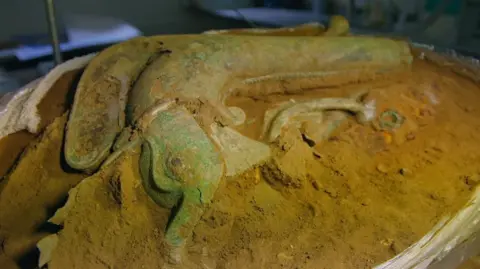
The conservation of such delicate artefacts presents immense challenges. Jonathan Carr, responsible for the painstaking work, highlighted the extreme fragility of the carnyx, noting it was made from "extremely thin sheets of metal which have become extremely brittle after 2,000 years in the ground." The initial removal of the hoard involved carefully lifting the entire soil block in which the items were embedded, a technique crucial for preserving the delicate context and preventing further damage. Subsequent to its extraction, the block underwent advanced scanning, likely using X-ray or CT technology, to precisely map the position of each item before the arduous process of micro-excavation and stabilization could begin in a controlled laboratory environment. This meticulous approach ensures that every fragment is preserved and studied in its original context.
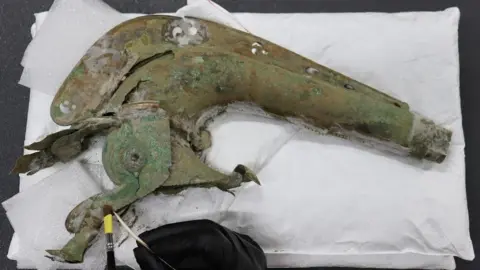
Dr. Fraser Hunter, the esteemed Iron Age and Roman curator at National Museums Scotland, emphasized the profound academic impact of this find. "I’ve looked at carnyces from around Europe, and the full research and conservation of these incredibly fragile remains will reshape our view of sound and music in the Iron Age," he stated. This suggests that detailed analysis of the Thetford carnyx could unlock new understandings of Celtic acoustics, musical traditions, and the role of sound in their ritualistic and military practices, moving beyond mere speculation to evidence-based insights.
Equally significant is the boar’s head standard, another rare and potent symbol of Iron Age power and identity. Fashioned from sheet bronze, this object would have been mounted atop a pole and held aloft, much like a modern flag, serving as a powerful rallying point for troops during combat. The symbolism of the boar held deep significance for Celtic peoples. As Dr. Hunter explained, "They were very fierce animals to face in the hunt, so the symbolism of the boar is a lot about the strength of it – a very appropriate adversary in battle." The boar represented ferocity, courage, and untamed strength, qualities highly valued in warrior societies. A standard bearing its image would not only have instilled pride and cohesion among a tribe’s fighters but also projected an intimidating aura to their adversaries, embodying the martial spirit and perhaps even a protective deity or ancestral spirit of the community.
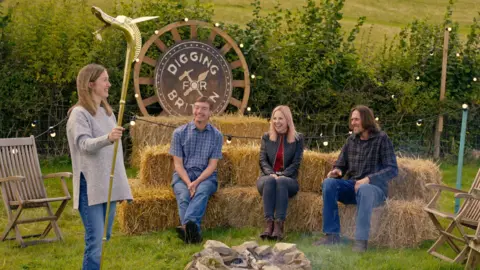
The Thetford hoard dates to a crucial period in British history, roughly between 50 BC and AD 50. This timeframe places its deposition on the cusp of, or shortly after, the Roman conquest of Britain, a period of immense upheaval and conflict. Beyond the carnyx and boar standard, the hoard also contained five shield bosses – the central, protective metal components of shields – and an intriguing iron object whose purpose remains, for now, unknown. The presence of multiple military items suggests a deliberate deposition, potentially a ritual offering to the gods, a cache hidden during times of war, or perhaps even grave goods for a high-status warrior or chieftain. The proximity to the Iceni heartland in Norfolk, famously associated with Queen Boudica’s rebellion against the Romans, adds a compelling layer of historical context, hinting at the turbulent socio-political landscape of the region during this era. Such valuable military regalia would have been paramount to tribal identity and power, and their burial could reflect a dramatic event or a profound communal decision.
Following its meticulous recovery and initial conservation, the find was promptly reported to the coroner, a standard procedure in the UK for archaeological discoveries. An inquest will be held to formally determine if the hoard qualifies as "treasure" under the Treasure Act 1996. If declared treasure, the items will legally belong to the Crown, but the finder and landowner may be eligible for a reward. The long-term future of this extraordinary collection, including where it will ultimately be displayed, is yet to be decided, but it is expected to become a cornerstone of public exhibitions, allowing wider access to this incredible piece of history.
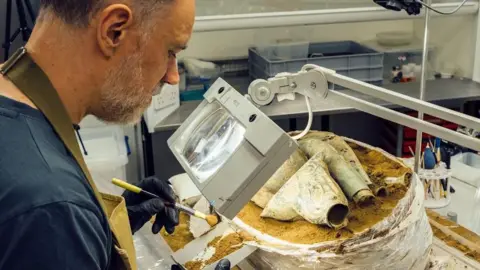
The collaborative effort to research and conserve these finds is extensive, involving several key institutions: Historic England, Pre-Construct Archaeology, Norfolk Museums Service, and the National Museum of Scotland. This interdisciplinary approach ensures that the artefacts receive the highest level of care and that their historical context is fully explored. Dr. Tim Pestell, a senior curator of archaeology for Norfolk Museums Service, articulated the profound significance for local heritage: "This find is a powerful reminder of Norfolk’s Iron Age past which, through the story of Boudica and the Iceni people, still retains its capacity to fascinate the British public." He emphasized that "The Norfolk Carnyx Hoard will provide archaeologists with an unparalleled opportunity to investigate a number of rare objects and ultimately, to tell the story of how these came to be buried in the county 2,000 years ago."
Claudia Kenyatta CBE and Emma Squire CBE, co-CEOs of Historic England, echoed this sentiment, calling it a "remarkable discovery." They expressed their eagerness to "uncover and share the story of the Norfolk community that owned and used these items," highlighting the human narrative embedded within these ancient objects.
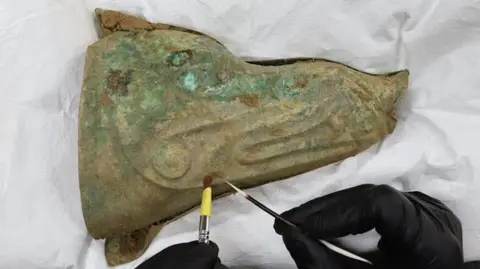
The full, captivating story of this momentous discovery, from its initial unearthing to the intricate conservation efforts and the early insights gleaned by experts, will be featured on BBC Two’s Digging for Britain. Viewers can tune in on January 14 at 21:00 GMT, or catch up on BBC iPlayer, to witness Professor Alice Roberts and the team unravel the mysteries of this unparalleled Iron Age treasure.


 Ramos Leo
 Nakalama John
 George Anjay