Nana Banana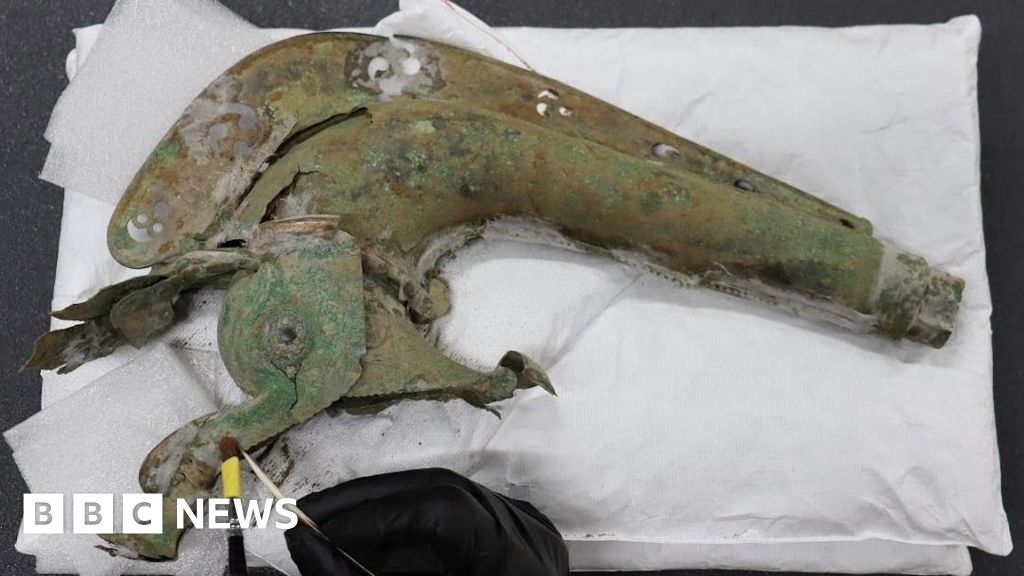
At the heart of this unparalleled find lies the most complete battle trumpet, known as a carnyx, ever recovered in Europe. Alongside it, in a truly unprecedented occurrence for British archaeology, lay the first-ever boar’s head flag standard to be found on British soil. Senior project officer Gary Trimble, speaking on BBC Two’s Digging for Britain, underscored the immense significance of these artifacts, stating that carnyces "are extraordinarily rare… a boar standard, that’s even rarer."
The carnyx, a distinctive bronze wind instrument, was a fearsome and visually striking instrument used by Celtic tribes across Europe from approximately 300 BC to 200 AD. Characterised by its vertical design and an elaborate, zoomorphic bell shaped like an open-mouthed animal head – often a boar or serpent – it would have produced a loud, raucous, and deeply unsettling sound. Its primary purpose was psychological warfare: to intimidate enemies, create chaos on the battlefield, and inspire and direct Celtic warriors during engagements. The Romans, who frequently encountered these instruments in battle against Celtic tribes, were both fascinated and unnerved by them, often depicting them as war trophies in their art and sculpture, testifying to their powerful impact.
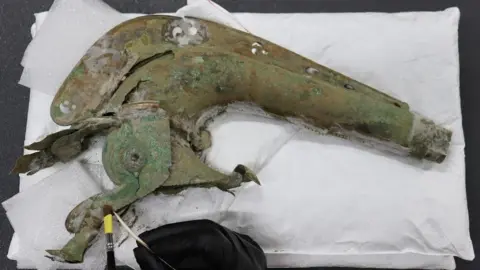
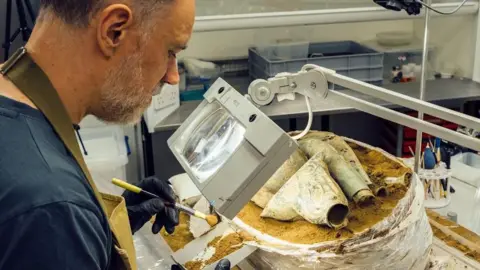
The Thetford carnyx is particularly noteworthy for its exceptional preservation. Conservator Jonathan Carr, who meticulously worked on the fragile find, highlighted its delicate nature, noting it was made "from extremely thin sheets of metal which have become extremely brittle after 2,000 years in the ground." Despite its age and fragility, Carr remarked on "a wonderful little eye, which is a remarkable survivor and you can’t help but be impressed and charmed by it," indicating the intricate craftsmanship that went into its creation. Dr. Fraser Hunter, Iron Age and Roman curator at National Museums Scotland, emphasized the academic impact of the find: "I’ve looked at carnyces from around Europe, and the full research and conservation of these incredibly fragile remains will reshape our view of sound and music in the Iron Age." The careful study of this instrument promises to reveal new insights into Celtic metallurgical techniques, acoustic properties, and the role of music in Iron Age society and warfare.
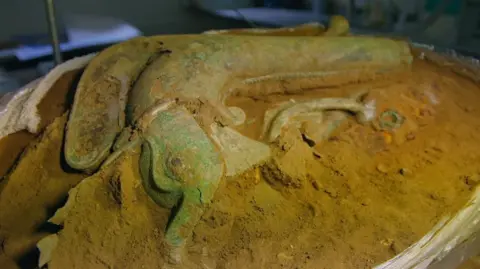
Equally, if not more, significant is the discovery of the boar’s head standard. Crafted from sheet bronze, this artifact would have been mounted atop a pole and carried into battle, serving as a powerful rallying point for troops. The symbolism of the boar was profound for Iron Age Celts, embodying ferocity, courage, strength, and spiritual power. As Dr. Hunter explained, "They were very fierce animals to face in the hunt, so the symbolism of the boar is a lot about the strength of it – a very appropriate adversary in battle." The visual impact of such a standard, glinting in the sun and representing the tribal identity and martial prowess, would have been immense. Its discovery in Britain provides an unprecedented glimpse into the military iconography and tribal identities of the Iron Age inhabitants of this region, potentially shedding light on specific groups or elite warriors who might have carried such a potent emblem.
The excavation itself was marked by a sense of anticipation. Dig leader Peter Crawley confessed to having a "gut feeling" about the site even before the full extent of the excavation began. "It felt like one of those special sites that you do get every so often," he recalled, a premonition that proved remarkably accurate. The hoard, which has been dated to approximately 50 BC and AD 50, places it at a critical juncture in British history – the period immediately preceding or coinciding with the Roman invasion and subsequent conquest. This dating raises intriguing questions about why these exceptionally valuable and symbolic items were buried. Was it a votive offering to deities, a desperate attempt to conceal them from advancing Roman forces, or a ceremonial burial marking a significant event or the death of a prominent warrior?
Beyond the carnyx and the boar standard, the hoard also included five shield bosses and an iron object of currently unknown origin. These additional artifacts further enrich the context of the find, suggesting a collection of military or high-status items deposited together. The method of recovery was as painstaking as the subsequent conservation. Following its initial discovery, the entire hoard was carefully lifted out of the earth within a large block of soil. This ‘block lift’ technique ensured the fragile items remained undisturbed in their archaeological context, allowing for detailed laboratory excavation. Once in the lab, the block was meticulously scanned using advanced imaging techniques to precisely map the position of each item before the delicate process of conservation began.
The long-term future of these extraordinary artifacts has yet to be decided. The find has been reported to the coroner, a standard procedure for archaeological discoveries in the UK, and an inquest will be held to determine if it meets the legal definition of "treasure." If declared treasure, the items will likely be acquired by a museum, ensuring their permanent preservation and public display. In the interim, a collaborative effort is underway involving Historic England, Pre-Construct Archaeology, Norfolk Museums Service, and the National Museum of Scotland to coordinate the comprehensive research and conservation of the finds.
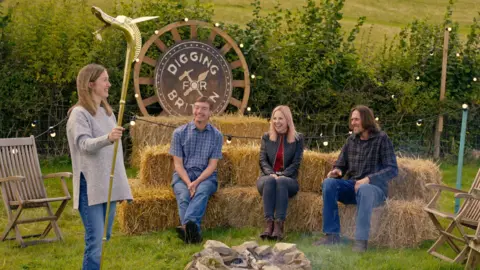
Dr. Tim Pestell, a senior curator of archaeology for Norfolk Museums Service, highlighted the profound local and national significance of the discovery. "This find is a powerful reminder of Norfolk’s Iron Age past which, through the story of Boudica and the Iceni people, still retains its capacity to fascinate the British public," he stated. The Iceni, a powerful Celtic tribe whose territory encompassed much of modern-day Norfolk, are famous for their resistance against Roman rule, most notably under the warrior queen Boudica in AD 60/61. The Norfolk Carnyx Hoard, therefore, offers a tangible link to this dramatic period, promising "an unparalleled opportunity to investigate a number of rare objects and ultimately, to tell the story of how these came to be buried in the county 2,000 years ago."
Claudia Kenyatta CBE and Emma Squire CBE, co-CEOs of Historic England, echoed this sentiment, calling it a "remarkable discovery." They added, "We look forward to uncovering and sharing the story of the Norfolk community that owned and used these items," emphasizing the human element behind these ancient treasures. The meticulous work of conservators like Jonathan Carr, whose expertise is crucial in stabilizing and preserving the brittle metalwork, will enable future generations to appreciate the artistry and historical context of these objects.
The full story of this momentous archaeological find, including the dramatic moments of its discovery and the intricate work of its conservation, will be featured on BBC Two’s Digging for Britain. Viewers can tune in on 14 January at 21:00 GMT, or catch up on BBC iPlayer, to witness firsthand the unearthing of these magnificent symbols of Iron Age power and culture. This Thetford hoard not only enriches our understanding of Iron Age Britain but also powerfully connects us to the lives, beliefs, and martial traditions of the people who shaped this land two millennia ago.



 George Anjay
 Ramos Leo
 Nakalama John