Nana Banana
Countries worldwide are engaged in an accelerating race to secure the critical minerals and rare earth elements indispensable for powering modern society and the unfolding green revolution. These vital resources are the building blocks for an immense array of technologies, from the ubiquitous smartphones and advanced computing devices to the electric vehicles and renewable energy infrastructure central to global decarbonization efforts. The strategic importance of these materials has elevated them to a top priority for national security and economic policy, prompting nations to aggressively seek diversified supply chains and domestic production capabilities amidst a landscape heavily dominated by a single geopolitical actor.
Defining Critical Minerals
Critical minerals are officially designated by a country as being essential for its economy and national security, yet subject to significant supply chain risks. These risks can stem from geological scarcity, concentrated geographical production, geopolitical instability, trade policies, or a lack of processing infrastructure. Unlike bulk commodities, critical minerals are often used in relatively small quantities but are crucial due to their unique properties and the absence of viable substitutes in many high-tech applications. Their criticality is dynamic, evolving with technological advancements, market demand, and geopolitical shifts. As such, critical mineral lists vary between nations, reflecting their unique industrial bases, domestic resource endowments, and strategic priorities. For example, the European Union’s list emphasizes minerals vital for its manufacturing sector and green transition, while the United States prioritizes those essential for its defense industry and advanced technology sectors.
Some of the critical minerals and rare earths projected to see the most significant growth in demand in the coming years include:
- Lithium: Essential for rechargeable batteries in electric vehicles (EVs), laptops, and grid-scale energy storage.
- Cobalt: A key component in many lithium-ion battery cathodes, offering stability and energy density.
- Nickel: Used in various battery chemistries, stainless steel, and aerospace alloys.
- Graphite: The primary anode material in lithium-ion batteries and a component in high-temperature applications.
- Copper: Fundamental for electrical wiring, renewable energy systems, and EVs due to its excellent conductivity.
- Manganese: Used in steel production, aluminum alloys, and some battery chemistries.
- Silicon: A semiconductor material vital for microchips, solar panels, and various electronic components.
- Rare Earth Elements: A group of 17 chemically similar elements with unique magnetic and phosphorescent properties.
Understanding Rare Earth Elements
Rare earth elements (REEs) frequently appear on the critical minerals lists of virtually all industrialized nations due to their irreplaceable roles in high-performance technologies. This group comprises the 15 lanthanide elements on the periodic table, along with scandium and yttrium. They possess important electrical, magnetic, and optical qualities that make them indispensable for advanced applications. For instance, neodymium and praseodymium are crucial for creating powerful permanent magnets found in EV motors, wind turbine generators, and precision-guided missiles. Europium and terbium are vital for phosphors in displays, while cerium and lanthanum are used in catalysts and petroleum refining.
Despite their name, rare earth elements are not intrinsically "rare" in the Earth’s crust. For example, neodymium is found at approximately 20 parts per million, a concentration comparable to or even higher than common industrial metals like copper (27 parts per million). The "rarity" stems from their geological characteristic: they are rarely found in economically viable concentrations and are chemically similar, making their extraction, separation, and purification extremely complex, energy-intensive, and often environmentally damaging. This processing bottleneck, rather than geological scarcity, is a primary driver of their criticality.
Global Distribution and Mining Hotspots
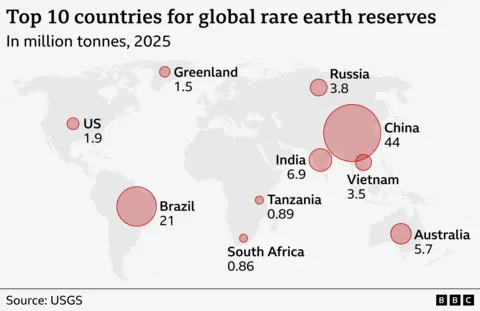
The distribution of critical minerals is global, yet often concentrated in specific regions, creating complex interdependencies. China is estimated to hold the largest reserves of rare earths, with approximately 44 million tonnes, followed by Brazil with 21 million tonnes and Vietnam with 3.5 million tonnes, according to the US Geological Survey. Other significant rare earth reserves exist in Russia, Australia, and the United States, with emerging potential in regions like Greenland.
Beyond rare earths, other critical minerals also have distinct geographical hubs:
- Lithium: Australia is the leading producer of hard-rock lithium, while the "lithium triangle" of Chile, Argentina, and Bolivia dominates brine-based extraction. China and the United States also have significant reserves.
- Cobalt: The Democratic Republic of Congo (DRC) accounts for an overwhelming majority (around 70-80%) of global cobalt production, raising significant ethical concerns regarding labor practices and environmental impact.
- Nickel: Indonesia has become the world’s largest nickel producer, followed by the Philippines, Russia, and Canada.
- Graphite: China is the largest producer, with significant output also coming from Brazil, Mozambique, and Madagascar.
- Copper: Chile and Peru are the world’s top copper producers, with substantial contributions from China, the United States, and the DRC.
Australia is a globally significant player across multiple critical minerals, being a leading producer of iron ore, gold, zinc, nickel, cobalt, and lithium. These concentrated mining operations highlight the delicate balance of resource availability and geopolitical stability.
China’s Dominance in Processing
The presence of minerals beneath the Earth’s surface is only one piece of the supply chain puzzle; the ability to process these raw materials into usable forms is equally, if not more, critical. Many countries possess mineral reserves but lack the capacity, expertise, or economic incentives to refine them. This is where China has established an unparalleled dominance.
China strategically pursued the development of critical mineral processing capabilities decades ago, recognizing the long-term value of these materials, particularly for emerging green technologies. While other nations focused on manufacturing, China invested heavily in the midstream and downstream sectors of the critical minerals supply chain. This foresight has resulted in China now controlling a staggering proportion of the global processing for many critical minerals, including rare earths, lithium, and cobalt. For some rare earths, China is responsible for more than 95% of the global processing capacity. The UK’s critical minerals assessment highlighted this disparity, noting that while silicon metal is mined in over 30 countries, only three possess the advanced capabilities to process it into the high-purity polysilicon required for microchips.
This dominance was achieved through a combination of factors:
- Strategic Government Support: Long-term planning, subsidies, and state-backed investments fostered the growth of processing facilities.
- Lower Production Costs: Historically, China benefited from lower labor costs and, significantly, less stringent environmental regulations. As BBC News has documented, rare earth mines in Northern China have been associated with extensive environmental damage, including toxic waste ponds, deforestation, and soil erosion, practices that would be far more costly or prohibited in many Western nations. This allowed Chinese producers to operate at lower costs, effectively outcompeting rivals.
- Technological Expertise: China invested heavily in developing the complex metallurgical and chemical processes required for refining these challenging materials.
As Bob Ward of The London School of Economics (LSE) Grantham Research Institute on Climate Change and the Environment noted, China recognized the growth in green energy a decade ago and "strategically pursued" processing. This calculated strategy has left the United States and other industrialized nations highly reliant on China, creating significant vulnerabilities.
The Indispensable Need for Critical Minerals
The need for critical minerals stems from their foundational role in three interconnected pillars of modern global society: the energy transition, advanced technological innovation, and national security.
-
The Energy Transition: The global push towards decarbonization and achieving net-zero emissions is profoundly dependent on critical minerals. Electric vehicles, wind turbines, solar panels, and grid-scale battery storage all require substantial quantities of these materials. For instance, an electric car typically uses six times more mineral resources than a conventional car, while an onshore wind plant requires nine times more mineral resources than a gas-fired power plant. The International Energy Agency (IEA) forecasts that demand for critical minerals could quadruple by 2040, driven primarily by the clean energy sector. Without secure and diverse supplies of lithium, cobalt, nickel, copper, and rare earths, the transition away from fossil fuels will be severely hampered, jeopardizing climate goals.
-
Advanced Technological Innovation: Beyond green energy, critical minerals are the bedrock of almost every advanced technology. They are vital for microchips, which are the brains of computers, smartphones, medical devices, artificial intelligence systems, and the internet of things. Gadolinium is used in medical imaging, yttrium in lasers, and various rare earths enhance display technologies. Innovation in quantum computing, advanced robotics, and biotechnology also hinges on access to these specialized materials. Without them, technological progress in countless sectors would grind to a halt.
-
National Security and Defense: Critical minerals are indispensable for modern military capabilities. They are used in stealth technology, precision-guided munitions, advanced radar systems, night vision goggles, fighter jets, and missile defense systems. Neodymium magnets are found in the actuators of missile guidance systems, while specialized alloys containing rare earths improve the performance and durability of military hardware. A 2023 report by a US Government Select Committee starkly warned that the failure of the US to shore up its critical minerals supply chains could cause "defense production to grind to a halt and choke off manufacturing of other advanced technologies." This direct link to national defense capabilities makes secure access to these minerals a matter of paramount strategic importance.
Geopolitical Vulnerability and Strategic Responses
The overwhelming concentration of critical mineral processing in China creates a significant geopolitical vulnerability for nations reliant on these supplies. As the European Central Bank noted in 2025, China’s "pivotal" role in the rare earth supply chain highlights "vulnerabilities to geopolitical disruptions." This reliance creates potential for supply disruptions, price volatility, and even political coercion, as exemplified by China’s temporary restriction of rare earth exports to Japan in 2010 during a diplomatic dispute.
In response, countries like the United States have made bolstering their critical minerals supply chains a top priority. Former US President Donald Trump emphasized this goal, with potential mining deals being part of his plans for regions like Greenland and Ukraine. In October 2025 (a historical reference from the original article), the US signed a critical minerals deal with Australia, with Trump declaring: "In about a year from now, we’ll have so much critical mineral and rare earths that you won’t know what to do with them." While the US does possess rare earth mineral reserves (just over 2% of global supply according to the US Geological Survey), establishing robust domestic processing capabilities would take years and massive investment.
Gracelin Baskaran, director at the Centre for Strategic and International Studies think tank, encapsulates the challenge: "No single country currently possesses the financial resources or technical capabilities to independently outpace China’s dominance." The capital expenditure and lead times for establishing new mines and, more critically, new processing plants are immense, often spanning a decade or more.
To mitigate these risks, nations are pursuing multi-pronged strategies:
- Diversification of Supply: Investing in new mining projects globally, fostering partnerships with resource-rich countries, and exploring unconventional sources.
- Domestic Production: Encouraging new mines and processing facilities within their borders, often through government incentives and streamlined permitting.
- Recycling and Circular Economy: Developing technologies and infrastructure for "urban mining" – recovering critical minerals from end-of-life products like batteries, electronics, and industrial waste.
- Research and Development: Investing in R&D for material substitution (finding alternative, more abundant materials) and developing more efficient extraction and processing methods.
- International Cooperation: Forming alliances and agreements to secure diversified supplies, share technological expertise, and establish resilient supply chains.
The quest for critical minerals is more than an economic endeavor; it is a fundamental pillar of national resilience, technological leadership, and a sustainable future. The geopolitical landscape of the 21st century will be shaped, in no small part, by which nations can successfully navigate the complexities of securing these indispensable elements.



 George Anjay
 Ramos Leo
 Nakalama John