Nana Banana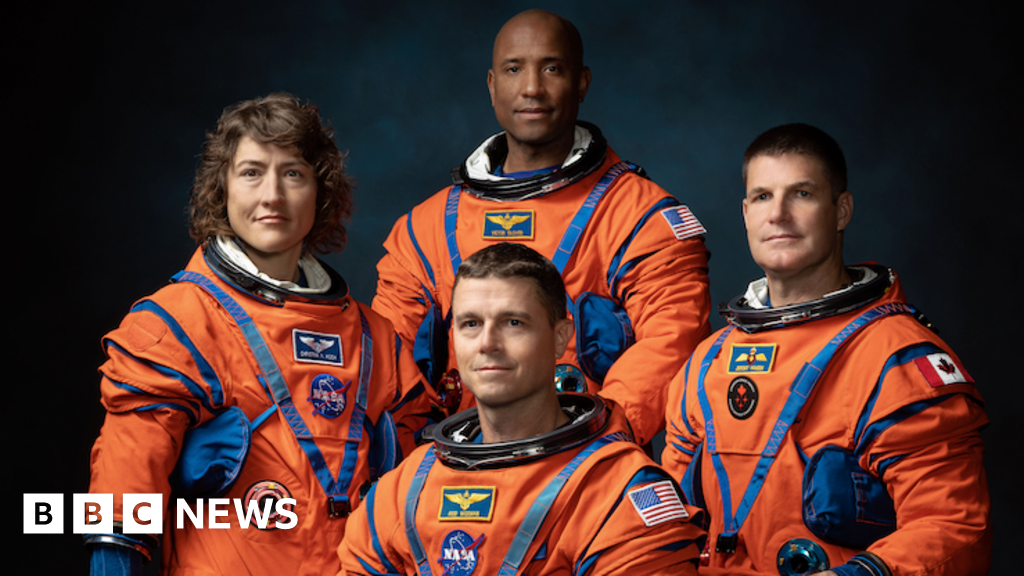
The dawn of a new era in lunar exploration is upon us, as NASA prepares for Artemis II, the first crewed mission to the Moon in over half a century. This pivotal journey, a testament to human ingenuity and international collaboration, is poised to launch as early as Friday, March 6th, marking a monumental step towards establishing a sustained human presence on the lunar surface and beyond. The mission, expected to last approximately 10 days, will not land on the Moon but will instead carry its four-person crew further into deep space than any humans have ventured before, meticulously testing the Orion spacecraft and setting the critical groundwork for future lunar landings.
The earliest window for the Artemis II launch is Friday, March 6th. NASA has identified several additional launch opportunities throughout the first half of March, with four further chances following the initial date. The mission planners have also outlined five more potential launch windows during the first week of April. This structured approach to launch scheduling is crucial, as a potential February launch was previously ruled out due to technical challenges. A pre-flight test, known as a wet dress rehearsal, had to be cut short after a hydrogen rocket fuel leak was detected from an umbilical connection that links the launch tower to the colossal Space Launch System (SLS) rocket. Addressing such technical issues is paramount for crew safety and mission success.
Beyond rectifying engineering challenges, mission planners must also align the launch with the Moon’s precise orbital position. This necessity dictates the specific launch windows, ensuring the optimal trajectory for the Orion spacecraft. In practice, this creates a pattern where approximately one week at the beginning of each month presents viable launch opportunities, followed by roughly three weeks during which no launch windows are available. This intricate dance with orbital mechanics highlights the immense complexity involved in deep space missions, where every variable, from fuel integrity to celestial alignments, must be perfectly orchestrated. The SLS rocket, the most powerful rocket ever built by NASA, will be instrumental in propelling the Orion capsule and its crew towards the Moon. Its successful uncrewed maiden flight, Artemis I, in late 2022, demonstrated the rocket’s capabilities, paving the way for this historic crewed journey.
The Artemis II crew comprises a diverse and highly experienced team of four astronauts: NASA Commander Reid Wiseman, Pilot Victor Glover, and Mission Specialist Christina Koch, alongside Canadian Space Agency (CSA) Mission Specialist Jeremy Hansen. This quartet represents the vanguard of humanity’s return to the Moon, bringing with them a wealth of experience from military service, space station expeditions, and pioneering spacewalks.
Reid Wiseman, the mission commander, is a distinguished US Navy veteran with 27 years of service. An accomplished pilot and engineer, he hails from Baltimore, Maryland. Wiseman was selected as an astronaut by NASA in 2009 and served with distinction as a Flight Engineer aboard the International Space Station (ISS) for Expedition 41 in 2014. During his 165 days in orbit, he conducted numerous scientific experiments, robotic operations, and two spacewalks, accumulating a total of 13 hours and 28 minutes outside the station. His leadership, technical expertise, and extensive experience in demanding environments make him an ideal choice to command this critical mission.
Victor Glover, the pilot for Artemis II, was selected as a NASA astronaut in 2013. A native of California, he is married with four children. Glover is a former Naval aviator and test pilot, and holds three master’s degrees in engineering. He made history as the pilot of SpaceX Crew-1, the first operational crewed flight of the Crew Dragon spacecraft, which docked with the ISS in November 2020. During his 168 days aboard the ISS as part of Expedition 64/65, he participated in four spacewalks, showcasing his exceptional skills and resilience. His experience with commercial spacecraft and deep understanding of flight systems will be invaluable for navigating Orion.
Christina Koch, a mission specialist, grew up in Michigan and joined the astronaut corps in 2013. She is renowned for her groundbreaking achievements on the International Space Station in 2019, where she set a new record for the longest single spaceflight by a woman, spending 328 consecutive days in orbit. During her extended stay, she also participated in the first-ever all-female spacewalk alongside fellow astronaut Jessica Meir, a monumental moment for gender equality in space exploration. Koch’s extensive scientific background in electrical engineering and physics, coupled with her record-breaking endurance and spacewalk experience, makes her a crucial asset for the Artemis II mission.
Jeremy Hansen, the second mission specialist, represents the Canadian Space Agency (CSA) and will become the first Canadian to venture to the Moon. Hansen joined the CSA in 2009 after a distinguished career as a Royal Canadian Air Force fighter pilot, flying CF-18s. He holds the unique distinction of being the first Canadian to lead astronaut training at NASA’s Johnson Space Center, a testament to his leadership and expertise. Canada’s participation in Artemis II is a result of its commitment to the broader Artemis program, including contributions to the Lunar Gateway, a planned space station in lunar orbit. Hansen’s military precision, training acumen, and pioneering spirit embody the international collaborative ethos of the Artemis program.
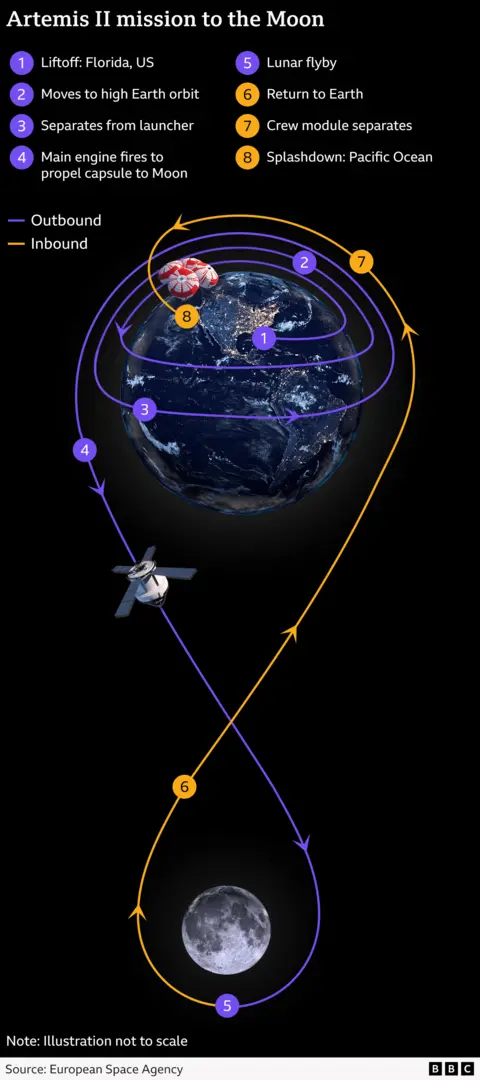
During their 10-day mission, the Artemis II crew will embark on a rigorous series of tests designed to validate the Orion spacecraft’s capabilities for future lunar landings. Once the Orion capsule and its service module are safely in Earth orbit, the astronauts will begin manually flying the capsule, practicing steering maneuvers and lining up the spacecraft. This hands-on experience is vital for understanding how the Orion handles in preparation for the precise orbital mechanics required for future Moon landings and rendezvous.
Following these initial tests, the crew will embark on a translunar injection burn, propelling them thousands of kilometers beyond the Moon. This lunar flyby trajectory, known as a free-return trajectory, is a carefully calculated path that uses the Moon’s gravity to slingshot the spacecraft back towards Earth, minimizing the need for propulsion and serving as a safety measure. At its farthest point, the Orion capsule will be approximately 4,600 miles (7,400 kilometers) beyond the lunar far side, reaching a maximum distance from Earth of around 230,000 miles (370,000 kilometers). During this deep space journey, the astronauts will meticulously check Orion’s life-support, propulsion, power, and navigation systems, pushing them to their limits in the harsh environment of deep space.
The crew will also serve as vital medical test subjects, sending back continuous data and imagery from deep space. They will live and work in the cramped confines of Orion’s cabin, which offers approximately nine cubic meters of living space, experiencing weightlessness throughout the mission. While radiation levels will be higher than those experienced on the International Space Station, which orbits within Earth’s protective magnetosphere, they are still considered safe for the duration of the mission. Upon their return to Earth, the astronauts will endure a high-speed, bumpy re-entry through the atmosphere, with speeds reaching nearly 25,000 miles per hour (40,000 km/h) and experiencing forces up to 4 Gs. The mission will conclude with a precision splashdown off the west coast of the United States, in the Pacific Ocean, where recovery teams will be waiting.
Artemis II will not land on the Moon; its primary objective is to lay the essential groundwork for a lunar landing by astronauts on the subsequent Artemis III mission. NASA initially projected the launch of Artemis III by 2028, but many experts in the space industry consider this timeline to be highly ambitious, given the complexities involved. The final selection of a Human Landing System (HLS) to transport the crew from Orion to the lunar surface has not yet been finalized. The primary contenders are SpaceX’s Starship lander, a colossal fully reusable spacecraft, or a craft designed by Jeff Bezos’s Blue Origin. Both companies are developing their landers under NASA contracts, but significant development and testing remain. Furthermore, new spacesuits, critical for lunar surface operations and currently being developed by the US company Axiom Space, are also not yet ready for flight.
When Artemis III finally flies, the astronauts will be heading to the Moon’s south pole, a region believed to harbor significant reserves of water ice in permanently shadowed craters. This ice is a crucial resource for future lunar outposts, as it can be converted into breathable air, drinking water, and rocket fuel. Following Artemis III, the long-term aim of the Artemis program is to establish a sustained human presence on the Moon. This ambitious vision includes Artemis IV and V, which will begin the construction of Gateway, a small modular space station designed to orbit the Moon. Gateway will serve as a vital staging post for lunar missions, a science laboratory, and a communications hub. These missions will be followed by more lunar landings, the addition of further sections to Gateway, and the deployment of new robotic rovers to explore the lunar surface. The program envisions increasing international involvement, with more countries contributing to and participating in keeping people living and working on and around the Moon for extended periods.
The last crewed Moon mission was Apollo 17, which landed in December 1972 and returned to Earth later that month. In total, 24 astronauts have journeyed to the Moon, and 12 of them have had the extraordinary privilege of walking on its surface, all during the historic Apollo program. Of those 24 individuals who traveled to the Moon, only five are still alive today. America’s initial foray into lunar exploration in the 1960s was primarily driven by the geopolitical imperative to beat the Soviet Union and assert its technological and ideological dominance during the Cold War. Once this ambitious goal was achieved with the successful Apollo landings, political enthusiasm and public interest gradually waned, leading to a significant reduction in funding for future Moonshots. The Artemis program, however, grew out of a renewed desire to return humans to the Moon, but this time with a fundamentally different approach: focusing on a longer-term, sustainable presence built around cutting-edge technology, commercial partnerships, and broad international collaboration.
Beyond NASA’s ambitious plans, several other countries harbor aspirations to send their own astronauts to the Moon, primarily targeting the 2030s. European astronauts are already slated to join later Artemis missions, leveraging the European Space Agency’s contributions to the Orion service module and Gateway. Japan has also secured seats on future Artemis missions, reflecting its growing capabilities and partnership with the US.
China, a rising power in space exploration, is actively developing its own independent crewed lunar program. It is building its own advanced spacecraft and aims for a first landing near the Moon’s south pole by 2030. China has already demonstrated significant prowess with its robotic Chang’e lunar missions, including the first-ever landing on the far side of the Moon, and the construction of its Tiangong space station. Their long-term strategy involves establishing a lunar research station.
Russia, a historical space giant, continues to voice ambitions of flying cosmonauts to the lunar surface and constructing a small base sometime between 2030 and 2035. However, the country’s space agency, Roscosmos, faces considerable challenges, including international sanctions, severe funding pressures, and technical setbacks, which cast a shadow of doubt over the feasibility of its highly optimistic timetable.
India, following the resounding success of its Chandrayaan 3 mission, which achieved a historic landing near the lunar south pole in August 2023, has also expressed clear ambitions to one day see its own astronauts walking on the Moon. India’s space agency has set out a goal of sending astronauts to the Moon by approximately 2040, as part of a broader strategic push to expand its human spaceflight program beyond low Earth orbit and establish itself as a major player in deep space exploration. This new era of lunar exploration is not just a race, but a testament to humanity’s enduring drive to explore, discover, and expand its presence across the cosmos.




 George Anjay

 Ramos Leo
 Nakalama John