Nana Banana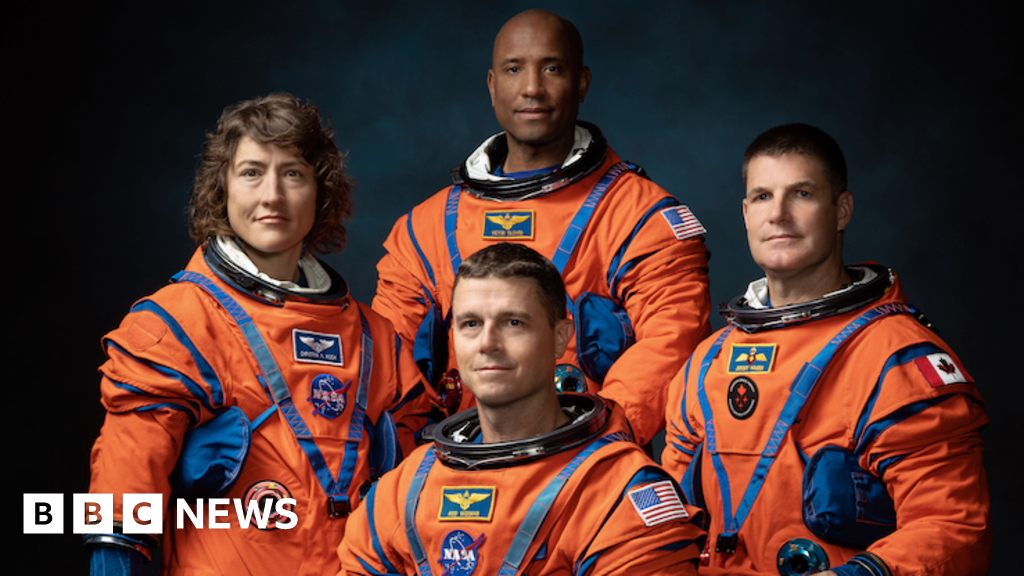
NASA’s Artemis II mission, marking humanity’s eagerly anticipated return to the vicinity of the Moon with a crew for the first time in over 50 years, is tentatively slated for launch as early as Friday, March 6. This groundbreaking mission, anticipated to span approximately 10 days, is designed to propel its four-person astronaut crew further into deep space than any human has ventured before. Its overarching purpose is to meticulously prepare and validate the systems necessary for an eventual human landing on the lunar surface, a feat not accomplished since the historic Apollo missions of the 1960s and 70s. Artemis II represents a crucial intermediate step, bridging the gap between the uncrewed Artemis I test flight and the future crewed lunar landing of Artemis III, setting the stage for a sustained human presence on and around the Moon.
The earliest possible launch date for Artemis II is March 6, 2026. However, this is not a rigid deadline but the first of several potential launch windows. NASA has identified four additional opportunities within the first half of that month, followed by five more windows available in the first week of April. These specific launch periods are dictated by complex orbital mechanics and mission requirements, ensuring optimal alignment between Earth and the Moon for the trajectory, as well as favorable lighting conditions for solar power generation and thermal control of the spacecraft.
A potential launch in February was preemptively ruled out following technical issues encountered during a critical pre-flight test, known as a wet dress rehearsal. This full-scale simulation involves loading super-cold propellants into the Space Launch System (SLS) rocket and practicing the entire launch countdown, stopping just before engine ignition. During this crucial test, a hydrogen rocket fuel leak was detected from an umbilical connection linking the launch tower to the massive rocket. Such leaks, while sometimes minor, require thorough investigation and resolution to ensure astronaut safety and mission success. The intricate dance of celestial mechanics also plays a significant role in determining launch opportunities. Mission planners must wait until the Moon is in the precise part of its orbit relative to Earth and the launch site (Kennedy Space Center) to enable the required translunar injection burn and the mission’s planned free-return trajectory. In practice, this careful timing creates a distinct pattern: typically, about one week at the beginning of each month offers viable launch windows when the rocket can be accurately aimed towards the Moon, followed by approximately three weeks during which no suitable launch opportunities exist. This meticulous planning underscores the inherent complexities and unforgiving nature of deep space missions.
The Artemis II mission will be crewed by an exceptionally accomplished and diverse team of four astronauts. Leading the mission as Commander is NASA veteran Reid Wiseman. He is joined by Pilot Victor Glover, and Mission Specialist Christina Koch, both from NASA. Completing the quartet is Mission Specialist Jeremy Hansen, representing the Canadian Space Agency (CSA). This crew marks a significant milestone, including the first woman, the first person of color, and the first non-American on a lunar mission.
Reid Wiseman, Commander: A seasoned US Navy veteran with 27 years of distinguished service, Reid Wiseman brings a wealth of experience to the command of Artemis II. Hailing from Baltimore, Maryland, he is not only an accomplished pilot but also an engineer. Wiseman was selected into NASA’s astronaut corps in 2009 and gained invaluable spaceflight experience as a Flight Engineer aboard the International Space Station (ISS) for Expedition 41 in 2014. During his time on the ISS, he performed spacewalks and conducted numerous scientific experiments, demonstrating his operational proficiency and leadership capabilities in microgravity. His extensive background as a test pilot in the Navy further equips him with the critical decision-making and spacecraft handling skills vital for a deep space mission.
Victor Glover, Pilot: Selected as a NASA astronaut in 2013, Victor Glover is a highly decorated US Navy pilot and test pilot. He previously served as the pilot of SpaceX Crew-1, the first operational crewed flight of the Crew Dragon spacecraft to the ISS, making him the first African American to serve on a long-duration mission on the orbital outpost. Glover holds three master’s degrees, showcasing his profound academic and technical expertise. Born in California, he is married with four children. His experience flying a new generation of commercial spacecraft to the ISS provides a unique perspective and skillset for piloting the Orion capsule.
Christina Koch, Mission Specialist: Growing up in Michigan, Christina Koch joined NASA’s astronaut program in 2013. Her career has been marked by pioneering achievements in space. In 2019, she embarked on a mission to the International Space Station, where she set a new record for the longest single spaceflight by a woman, spending 328 days in orbit. During her time on the ISS, she also participated in the historic first all-female spacewalk alongside fellow astronaut Jessica Meir. Koch’s background as an electrical engineer with experience in remote scientific field work, including deployments to Antarctica and Greenland, has prepared her for the rigorous demands of space exploration.
Jeremy Hansen, Mission Specialist: Representing Canada, Jeremy Hansen joined the Canadian Space Agency in 2009 after a distinguished career as a fighter pilot in the Royal Canadian Air Force. He made history by becoming the first Canadian to lead astronaut training at NASA’s Johnson Space Center, demonstrating his leadership and expertise in preparing future spacefarers. For Artemis II, Hansen will make history again as the first Canadian ever to venture to the Moon. His participation underscores the strong international collaboration that defines the Artemis program and highlights Canada’s significant contributions to human spaceflight.
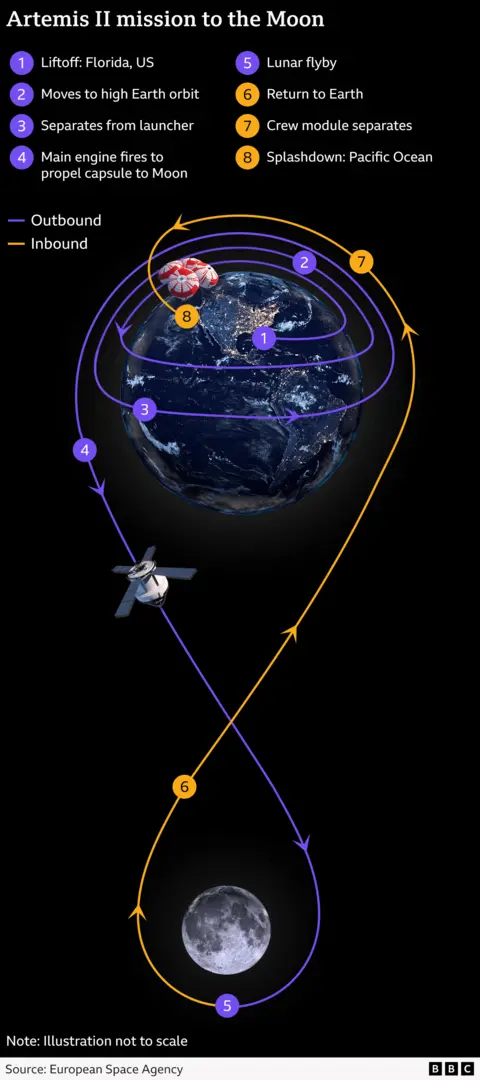
The mission profile of Artemis II is meticulously designed to test the capabilities of NASA’s powerful Space Launch System (SLS) rocket and the Orion crew capsule with humans aboard. The SLS, currently the world’s most powerful operational rocket, will propel the Orion spacecraft and its crew towards the Moon. Once safely in Earth orbit, the astronauts will embark on a series of critical tests to evaluate the Orion capsule’s performance. This includes manually flying the spacecraft in Earth orbit, practicing steering, and lining up the capsule for future rendezvous and docking maneuvers. This hands-on control is vital to understand the human interface with the spacecraft’s systems before committing to a lunar landing.
Following these initial tests, the crew will embark on a translunar injection burn, sending them on a trajectory that will take them thousands of kilometers beyond the Moon. This "free-return trajectory" is a figure-of-eight path that slingshots Orion around the Moon and uses the Moon’s gravity to naturally pull the spacecraft back towards Earth, providing a critical safety net. At its furthest point, the crew will be approximately 4,600 miles (7,400 kilometers) beyond the far side of the Moon, venturing further into space than any human has before. During this deep space phase, the astronauts will meticulously check Orion’s life-support, propulsion, power, and navigation systems in the harsh environment of deep space, far from Earth’s protective magnetic field.
The crew themselves will serve as invaluable medical test subjects, providing real-time data and imagery from deep space back to mission control. They will live and work in the relatively small cabin of the Orion module, approximately nine cubic meters of habitable space, experiencing prolonged periods of weightlessness. While radiation levels will be significantly higher than those experienced on the International Space Station, which remains within low-Earth orbit and is afforded some protection by Earth’s magnetosphere, the mission profile is designed to keep the crew safely within acceptable exposure limits. Their biological responses and psychological well-being will be closely monitored to inform future long-duration missions to Mars and beyond. Upon their return to Earth, the astronauts will experience a high-speed, bumpy re-entry through the atmosphere, with Orion’s advanced heat shield protecting them from extreme temperatures. The mission will conclude with a precision splashdown off the west coast of the United States, in the Pacific Ocean, where recovery teams will be standing by.
Crucially, Artemis II will not involve a lunar landing. Its primary purpose is to validate the Orion spacecraft and SLS rocket with a crew, paving the way for the more ambitious Artemis III mission, which aims to return humans to the lunar surface. NASA has outlined a target launch date for Artemis III by 2028, but many experts in the space industry consider this an exceptionally ambitious timeline given the technical complexities involved.
Several critical components for Artemis III are still under development or undergoing rigorous testing. The final choice of a Human Landing System (HLS) to ferry the crew from lunar orbit down to the surface has yet to be finalized. SpaceX’s Starship lander is currently a leading contender, with Blue Origin also developing a competing design. Both systems represent significant engineering challenges. Furthermore, new spacesuits, specifically designed for lunar surface operations, are being developed by US company Axiom Space and are not yet ready. These suits must allow for greater mobility and withstand the extreme temperatures and abrasive regolith of the lunar environment.
When Artemis III finally lifts off, its astronauts will be heading to the Moon’s south pole. This region is of particular scientific interest because it is believed to harbor significant reserves of water ice in permanently shadowed craters. Access to water ice would be transformative for future lunar exploration, as it could be processed into breathable oxygen and rocket fuel, enabling a sustained human presence and reducing the need to transport resources from Earth.
Beyond Artemis III, NASA envisions a continuous and expanding human presence on the Moon. The Artemis IV and V missions are planned to begin the construction of Gateway, a small modular space station orbiting the Moon. Gateway will serve as a vital staging post for lunar surface missions, a science laboratory, and a testbed for deep space technologies. Subsequent Artemis missions will involve more lunar landings, additional sections being added to Gateway, and the deployment of new robotic rovers to explore the lunar surface. The program emphasizes international collaboration, with more countries expected to join the effort, fostering a global partnership in keeping people living and working on and around the Moon for extended periods.
The last time humans journeyed to the Moon was during the Apollo 17 mission, which successfully landed in December 1972 and returned to Earth later that month. In total, 24 astronauts have traveled to the Moon throughout history, and 12 of them have had the extraordinary experience of walking on its surface, all accomplished during NASA’s Apollo program. Of those 24 individuals who ventured to the Moon, only five are still alive today. America’s initial foray into lunar exploration in the 1960s was primarily driven by the geopolitical imperative to beat the Soviet Union in the "Space Race," asserting technological and ideological dominance during the Cold War. Once that monumental goal was achieved, political enthusiasm and public interest gradually waned, leading to a significant reduction in funding for future crewed Moon missions. The Artemis program represents a renewed commitment to lunar exploration, born out of a desire not just to return to the Moon, but to establish a long-term, sustainable presence built upon advancements in technology and strategic commercial partnerships, with an eye towards eventually sending humans to Mars.
NASA is not alone in its ambitions for lunar exploration. Several other countries and international consortia are actively developing plans to send their own astronauts to the Moon, primarily targeting the 2030s. European astronauts are already slated to join later Artemis missions, leveraging the strong partnership with the European Space Agency (ESA), and Japan has also secured seats, demonstrating the growing international nature of lunar endeavors.
China, with its rapidly advancing space program, is independently building its own crewed spacecraft and aims for a first human landing near the Moon’s south pole by 2030. This parallel effort highlights a new era of space competition and collaboration. Russia, despite facing significant sanctions, funding pressures, and technical setbacks, continues to articulate ambitions of flying cosmonauts to the lunar surface and establishing a small base sometime between 2030 and 2035. However, many observers view this timetable as highly optimistic given current realities. India, following the remarkable success of its Chandrayaan-3 mission, which achieved a soft landing near the lunar south pole in August 2023, has also expressed its long-term goal of seeing its own astronauts walk on the Moon. India’s space agency has set an ambitious target of sending astronauts to the Moon by approximately 2040, as part of a broader strategic push to expand its human spaceflight program beyond low Earth orbit and establish itself as a major player in deep space exploration. The collective aspirations of these nations underscore a global resurgence of interest in lunar exploration, driven by scientific discovery, resource utilization, and the long-term goal of extending humanity’s reach across the solar system.
Additional reporting by Kevin Church and Emily Selvadurai.




 Ramos Leo
 Nakalama John
 George Anjay