
 Nana Banana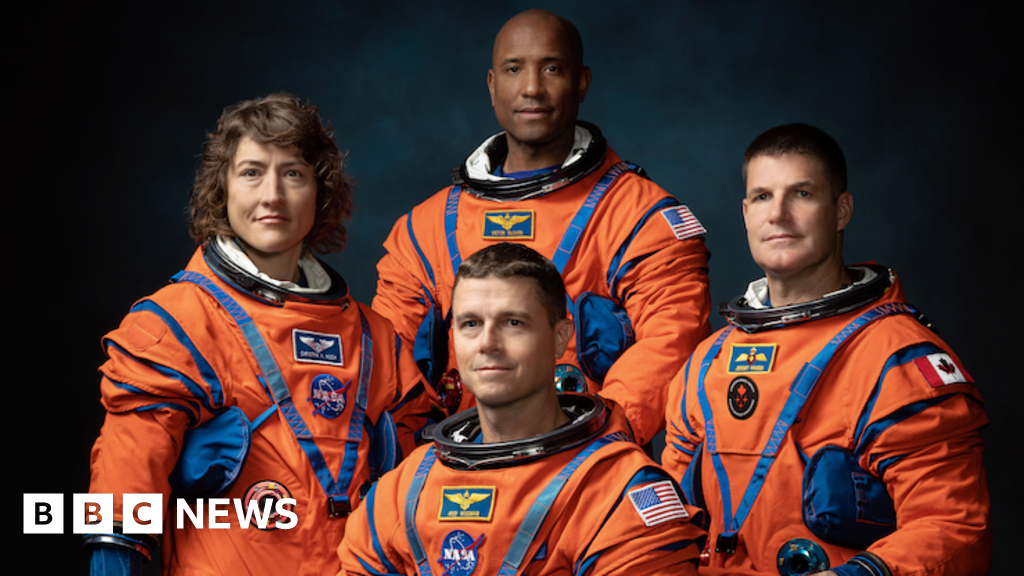
NASA’s ambitious journey to return humanity to the Moon, a pivotal step in its Artemis program, faces a revised timeline for its first crewed mission, Artemis II. Initially targeting a March launch for this historic circumlunar voyage, NASA confirmed a delay due to a newly detected fault, rendering a March launch "out of consideration." This setback follows a prior February launch postponement attributed to a hydrogen fuel leak during a crucial pre-flight test. The Artemis II mission, designed to last approximately 10 days, promises to take its four-person crew further into deep space than any human has traveled before, setting the critical groundwork for an eventual human landing on the lunar surface – a feat not accomplished since the Apollo missions of the 1960s and 70s.
When will Artemis II launch?
With the March launch window no longer viable, mission planners are now eyeing alternative dates, with April 1, 3, 4, 5, and 6 being the next possible opportunities. The precise timing of lunar missions is dictated by complex orbital mechanics, requiring the Moon to be in a specific alignment relative to Earth and the launch site for an optimal trajectory. This typically creates launch windows that last roughly one week at the beginning of each month, followed by about three weeks without suitable conditions.
The recent delays stem from ongoing technical assessments and repairs. A potential February launch was initially ruled out following a "wet dress rehearsal" – a comprehensive, full-scale test of the Space Launch System (SLS) rocket and Orion spacecraft, including fueling procedures. This rehearsal was cut short when engineers detected a hydrogen rocket fuel leak from an umbilical connection linking the launch tower to the rocket. While that issue was being addressed, a separate, unspecified fault was later discovered, necessitating further analysis and repair, pushing the timeline beyond March. These rigorous tests and subsequent delays underscore NASA’s commitment to crew safety and mission success, ensuring all systems are operating flawlessly before entrusting a crew to the powerful SLS rocket and the Orion capsule for a journey beyond Earth orbit. Each delay, though frustrating, provides invaluable data and refinement opportunities for future missions, including the highly anticipated Artemis III lunar landing.
Who are the Artemis II crew?
The crew of four for Artemis II represents a blend of seasoned astronauts and a historic international participant, embodying the collaborative spirit of modern space exploration. The team comprises NASA commander Reid Wiseman, pilot Victor Glover, mission specialist Christina Koch, and Canadian Space Agency (CSA) mission specialist Jeremy Hansen.
Reid Wiseman (Commander): A distinguished US Navy veteran with 27 years of service, Wiseman brings extensive experience as a pilot and engineer. Hailing from Baltimore, Maryland, he was selected as a NASA astronaut in 2009. His prior spaceflight experience includes serving as a Flight Engineer aboard the International Space Station (ISS) for Expedition 41 in 2014, where he conducted numerous scientific experiments and spacewalks. His leadership and operational expertise are critical for commanding this complex mission.
Victor Glover (Pilot): Selected as a NASA astronaut in 2013, Glover is another highly accomplished Navy veteran, test pilot, and engineer. He made history as the pilot of SpaceX Crew-1, the first operational flight of the Crew Dragon spacecraft, and served as a flight engineer on the ISS for Expedition 64. His impressive academic background includes three master’s degrees. Born in Pomona, California, he is married with four children, and his journey to the Moon marks another significant milestone in his pioneering career.
Christina Koch (Mission Specialist): Koch, an electrical engineer who grew up in Grand Rapids, Michigan, joined the astronaut corps in 2013. She is renowned for setting a record for the longest single spaceflight by a woman, spending 328 continuous days aboard the International Space Station from 2019 to 2020. During her time on the ISS, she also participated in the first-ever all-female spacewalk alongside fellow astronaut Jessica Meir, showcasing her expertise in extravehicular activities. Her experience in long-duration spaceflight and diverse engineering background make her an invaluable member of the Artemis II crew.
Jeremy Hansen (Mission Specialist): Representing the Canadian Space Agency, Hansen became an astronaut in 2009 after a distinguished career as a fighter pilot in the Canadian Armed Forces, flying the CF-18. He holds the unique distinction of being the first Canadian to lead astronaut training at NASA’s Johnson Space Center. His selection for Artemis II makes him the first Canadian ever to journey to the Moon, highlighting Canada’s integral role in the Artemis program and strengthening international partnerships in space exploration.
What will the Artemis crew do during the Moon mission?
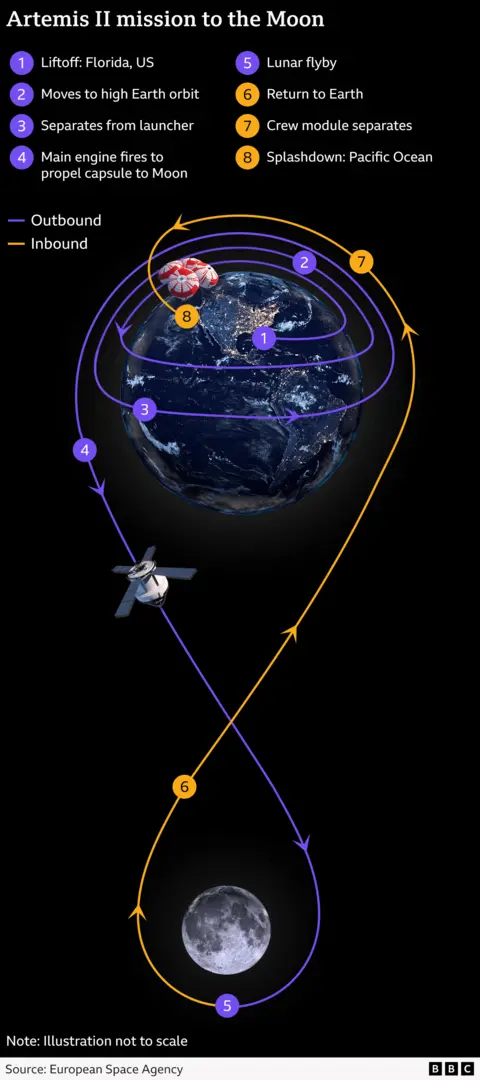
The Artemis II mission is a meticulously planned shakedown cruise, designed to thoroughly test the SLS rocket and the Orion spacecraft with a human crew onboard. Following lift-off from Kennedy Space Center, the crew will embark on a trajectory that takes them around the Moon and back to Earth.
The mission begins with the powerful ascent of NASA’s gigantic Space Launch System (SLS) rocket. After achieving Earth orbit, the Orion capsule, with its crew, will separate from the rocket’s upper stage. The initial phase of the mission involves extensive checks of the Orion spacecraft’s critical systems. Astronauts will meticulously test life-support, propulsion, power, and navigation systems, ensuring they are fully operational and reliable for deep-space travel. A crucial part of this phase will involve manually flying the capsule in Earth orbit. This manual piloting practice is essential for honing the crew’s skills in steering and maneuvering the spacecraft, providing invaluable experience for future Moon landings where precise control will be paramount.
Once these initial checks are complete, the Orion spacecraft will perform a Trans-Lunar Injection (TLI) burn, a powerful engine firing that propels it out of Earth’s orbit and onto a trajectory towards the Moon. The mission will follow a "free-return trajectory," looping around the far side of the Moon at an altitude of approximately 10,400 kilometers (6,400 miles) above the lunar surface. This trajectory uses the Moon’s gravity to naturally slingshot the spacecraft back towards Earth, a critical safety feature.
During their journey beyond the Moon, the crew will conduct further in-depth testing of Orion’s systems in the deep-space environment, which differs significantly from low-Earth orbit. This includes evaluating deep-space communication protocols, thermal control systems, and the radiation environment. The astronauts will also serve as medical test subjects, constantly sending back data on their physiological responses and psychological well-being. They will live and work in the small, confined cabin of the Orion module, experiencing prolonged weightlessness. While radiation levels will be higher than those experienced on the ISS, which is protected by Earth’s magnetosphere, they are still within safe limits for the mission’s duration.
The mission will conclude with a challenging re-entry into Earth’s atmosphere. The Orion capsule’s heat shield will be tested against the intense temperatures generated during its fiery descent. The astronauts will experience significant G-forces before the capsule splashes down off the west coast of the United States, specifically in the Pacific Ocean, where recovery teams will be waiting. The entire mission is expected to last about 10 days, marking a vital step in preparing for sustained human presence on the lunar surface and beyond.
Will Artemis II land on the Moon?
No, Artemis II is not designed to land on the Moon. Its primary objective is to conduct a crewed test flight around the Moon, validating the SLS rocket and Orion spacecraft’s capabilities for human deep-space travel. This mission is a crucial precursor to the Artemis III mission, which is planned to facilitate the first human landing on the lunar surface since Apollo 17 in 1972.
NASA has set a target for the launch of Artemis III by 2028, though many experts consider this an ambitious timeline given the significant technological hurdles that still need to be overcome. Key challenges include the development and certification of the Human Landing System (HLS) and new generation spacesuits.
For the lunar landing, NASA has chosen SpaceX’s Starship as the primary HLS provider, with Blue Origin’s Blue Moon as a secondary option. Both companies are developing complex, reusable landers capable of transporting astronauts from Orion in lunar orbit down to the Moon’s surface and back. The Starship, in particular, is a massive and intricate vehicle, and its development and testing are ongoing, representing a critical path item for Artemis III.
Similarly, new spacesuits are being developed by US company Axiom Space. These next-generation suits are designed to offer greater flexibility, durability, and a wider range of motion than the Apollo-era suits, crucial for exploring the Moon’s south pole, the target landing site for Artemis III. The south pole is of immense scientific interest due to the potential presence of water ice in permanently shadowed craters, which could be a vital resource for future lunar habitats. However, these suits are also still in development and require rigorous testing before they are ready for flight.
Beyond Artemis III, the program envisions a sustained human presence on and around the Moon. Artemis IV and V will focus on building the Gateway, a small modular space station orbiting the Moon. The Gateway will serve as a staging post for lunar surface missions, a science laboratory, and a potential waypoint for future missions to Mars. Subsequent missions will involve more Moon landings, the expansion of Gateway, and the deployment of advanced robotic rovers to explore the lunar environment. The Artemis program also emphasizes increased international collaboration, with more countries expected to join in the effort to establish a long-term human presence, fostering a global lunar economy and paving the way for further solar system exploration.
When was the last Moon mission?
The last time humans journeyed to and landed on the Moon was during the Apollo 17 mission, which touched down in December 1972 and returned to Earth later that same month. This historic mission marked the final lunar landing of NASA’s Apollo program, with Commander Gene Cernan and Lunar Module Pilot Harrison Schmitt spending three days on the lunar surface, while Command Module Pilot Ronald Evans orbited above.
In total, 24 astronauts have traveled to the Moon, and 12 of them have had the extraordinary experience of walking on its surface, all accomplished within the Apollo program. Of those 24 lunar voyagers, just five are still alive today, a testament to the passage of time since humanity’s last direct engagement with the Moon.
America’s initial push to reach the Moon in the 1960s was primarily driven by the geopolitical imperative of the "Space Race" with the Soviet Union, aiming to assert technological and ideological dominance during the Cold War. Once this monumental goal was achieved with the Apollo 11 landing in 1969, political enthusiasm and public interest gradually waned. Coupled with the immense financial investment required, this led to a reduction in funding for future Moonshots, ultimately bringing the Apollo program to an end.
The current Artemis program represents a renewed desire to return humans to the Moon, but with a fundamentally different approach. Unlike the Space Race, Artemis emphasizes long-term sustainability, international collaboration through initiatives like the Artemis Accords, and commercial partnerships with private companies like SpaceX and Blue Origin. The goal is not just to plant a flag, but to establish a sustained human presence, utilizing new technologies, exploring lunar resources, and ultimately using the Moon as a proving ground and stepping stone for crewed missions to Mars.
Do other countries plan to send astronauts to the Moon?
The ambition to send humans to the Moon is not exclusive to NASA; several other nations and international consortia are actively developing their own lunar exploration programs, with crewed missions targeted for the 2030s and beyond.
European astronauts are already slated to join later Artemis missions through the European Space Agency (ESA), contributing to the Gateway space station and potentially participating in lunar landings. Japan, through its Japan Aerospace Exploration Agency (JAXA), has also secured seats on future Artemis missions, underscoring the growing international nature of lunar exploration.
China is rapidly advancing its independent space program, including ambitious plans for crewed lunar exploration. Following the success of its robotic Chang’e missions, China is developing its own heavy-lift rockets and spacecraft, targeting a first crewed landing near the Moon’s south pole by 2030. Their long-term vision includes establishing an international lunar research station, potentially inviting other nations to participate.
Russia, a historic player in space exploration through Roscosmos, continues to articulate ambitions for flying cosmonauts to the lunar surface and establishing a small base sometime between 2030 and 2035. However, their timetable is widely considered highly optimistic by international observers, primarily due to ongoing sanctions, significant funding pressures, and various technical setbacks that have affected their space program.
India, a rising power in space, has also expressed strong ambitions to see its own astronauts walk on the Moon. Following the remarkable success of its Chandrayaan-3 mission, which achieved a soft landing near the lunar south pole in August 2023, the Indian Space Research Organisation (ISRO) has set an ambitious goal of sending astronauts to the Moon by approximately 2040. This objective is part of a broader strategic push to expand India’s human spaceflight program beyond low Earth orbit and establish its presence in deep-space exploration.
The renewed global interest in lunar exploration signifies a new era of scientific discovery, resource utilization, and international cooperation, transforming the Moon from a distant destination into a potential outpost for humanity’s expansion into the solar system.
Additional reporting by Kevin Church and Emily Selvadurai.




 atisusanti
 Nakalama John
 George Anjay
 Ramos Leo
 Roy Suryo