
 Nana Banana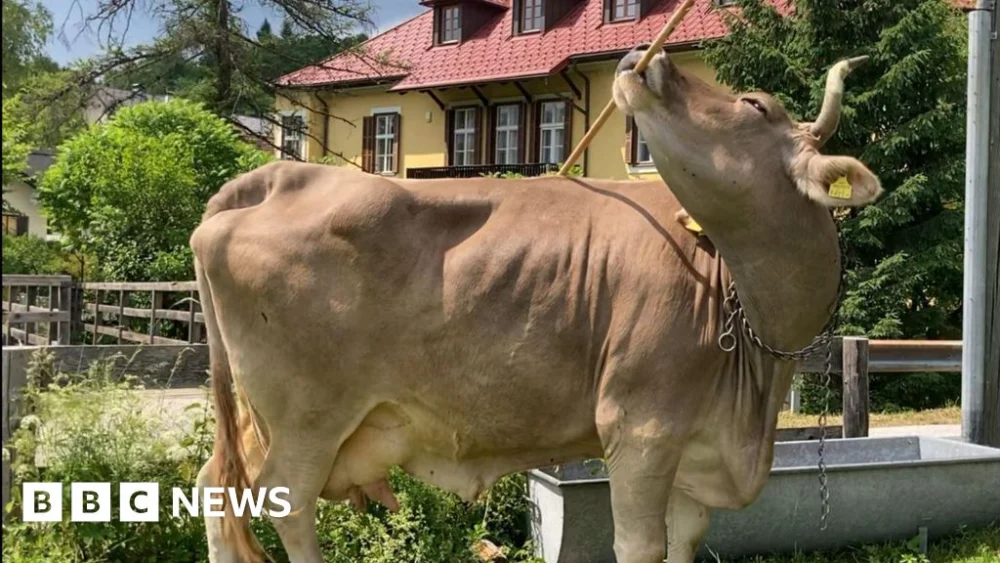
The scientific community is currently undergoing a significant re-evaluation of bovine cognitive capabilities, spurred by the extraordinary observations of an Austrian cow named Veronika, who has demonstrated a sophisticated and unprecedented ability to use tools. This groundbreaking discovery, brought to light by a team of researchers from the University of Veterinary Medicine in Vienna, suggests that the intelligence and problem-solving skills of cattle may be far more advanced than previously understood, challenging long-held assumptions about these commonly farmed animals.
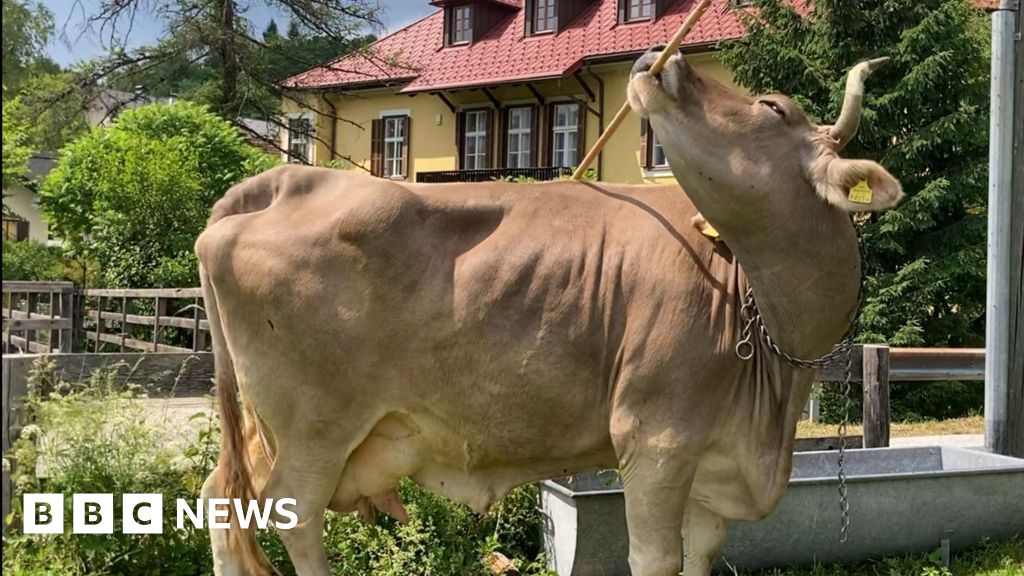
Veronika, a Swiss brown cow residing in a picturesque mountain village nestled within the serene Austrian countryside, has spent an impressive number of years refining a unique skill: the art of self-grooming using various implements. Her repertoire includes ordinary farm objects such as sticks, rakes, and brooms. This consistent and deliberate behavior, initially observed by her owner, organic farmer Witgar Wiegele, eventually caught the attention of local residents, and word of her unusual talents began to spread, eventually reaching specialists in animal intelligence in Vienna. What these researchers discovered upon closer examination was not just simple tool manipulation, but a nuanced and adaptive application of objects, particularly a broom, as a multipurpose instrument.
The most compelling aspect of Veronika’s behavior lies in her discerning choice of which end of a tool to use, depending on the specific area of her body that required attention. For robust areas, such as her back or other tough, itchy spots that demanded a thorough scratch, she would expertly employ the stiff, bristle end of a broom. This demonstrated an understanding of the bristles’ abrasive quality and its effectiveness for deep relief. Conversely, when a more delicate touch was needed, particularly for sensitive regions like her underbelly, she would pivot the broom, utilizing the smooth, gentle surface of its handle. This precise and context-dependent application of different parts of a single tool is a hallmark of advanced cognitive processing and adaptive behavior. It suggests not only an awareness of her own body’s varying sensitivities but also a profound understanding of the physical properties of the tool at her disposal.
Such sophisticated tool use is an exceedingly rare phenomenon within the animal kingdom, and until Veronika’s documented actions, it had never been observed or formally reported in cattle. This places Veronika in an exclusive club of animals recognized for their cognitive ingenuity. Dr. Antonio Osuna-Mascaro, a leading researcher from the University of Veterinary Medicine in Vienna and a key figure in this study, articulated the profound surprise of the scientific team. "We were not expecting cows to be able to use tools, and we were not expecting a cow to use a tool as a multipurpose tool," he stated, highlighting the unexpected nature of the findings. He further emphasized the significance by adding, "Until now this has only been consistently reported in chimpanzees."
The comparison to chimpanzees is crucial. Chimpanzees are widely regarded as one of the most intelligent non-human primates and exhibit the most varied and complex range of tool use outside of our own species. They are known to fashion and utilize sticks to "fish" for termites, employing different lengths and textures depending on the insect species and nest structure. They also use stones as hammers and anvils to crack open nuts, a behavior that requires considerable force, precision, and an understanding of leverage. Some chimpanzee populations have even been observed using sticks as rudimentary spears for hunting. The fact that Veronika’s behavior, particularly her multipurpose application of a single tool, draws a direct parallel to the cognitive abilities previously attributed almost exclusively to chimpanzees, underscores the extraordinary nature of this discovery in a bovine species.
Despite the fact that humans have lived in close proximity to cattle for approximately 10,000 years, domesticating them for milk, meat, and labor, this marks the very first instance where scientists have formally documented a cow engaging in spontaneous, purposeful tool use. This long history of interaction, which has often led to an underestimation of bovine intelligence, makes Veronika’s case even more remarkable. The researchers involved in the study contend that their findings unequivocally demonstrate that cows possess greater cognitive capabilities than previously imagined. They also propose that Veronika’s unique skills might not be an isolated anomaly, suggesting that other cows could potentially develop similar abilities, provided they are given the appropriate environment and opportunities for exploration and problem-solving. This raises critical questions about how agricultural practices and animal husbandry might be adapted to foster greater cognitive enrichment for cattle.
The methodology employed by the researchers primarily involved extensive observational studies, initially spurred by anecdotal reports from the village. Once the scientific team arrived, they set up controlled observation points to meticulously record Veronika’s behavior, ensuring that her actions were spontaneous and not merely a learned trick prompted by human intervention. Video evidence, like the footage showing Veronika skillfully using the broom, became instrumental in their analysis, allowing for detailed behavioral coding and verification of her consistent and deliberate choices. The long-term nature of her practice—"years perfecting the art"—also indicates a capacity for learning, memory, and refinement of motor skills, further reinforcing the complexity of her cognitive processes.
Veronika’s owner, Witgar Wiegele, an organic farmer, plays a significant role in her story. His farming philosophy, rooted in organic principles, likely provides an environment that is more conducive to natural behaviors and independent problem-solving for his animals. Organic farming often emphasizes animal welfare, providing more space, less restrictive conditions, and opportunities for natural behaviors, which might have inadvertently created the conditions under which Veronika could explore and develop her unique skill set. Wiegele expressed his hope that Veronika’s unexpected talents will serve as an inspiration for people to foster a deeper appreciation and value for the natural world. His personal philosophy, eloquently articulated, resonates deeply with the implications of this discovery: "Save the nature, then you protect yourself. Nature diversity is the key to survive on this planet." Veronika’s intelligence, flourishing in a relatively natural setting, stands as a testament to the hidden complexities and wonders within the natural world that we often overlook or underestimate.
This discovery opens numerous avenues for future research. Scientists are now pondering whether tool use can be taught to other cows, or if Veronika’s abilities are indicative of a latent capacity present across the bovine species, simply awaiting the right stimuli and environment to manifest. It also prompts deeper investigations into the neurological underpinnings of bovine cognition and problem-solving. Veronika’s story may well usher in a new era of research into animal intelligence, pushing the boundaries of what we thought was possible for animals like cattle and potentially inspiring more humane and enriched environments for livestock globally. The "Veronika effect" could lead to a broader re-evaluation of how we interact with, perceive, and manage the animal kingdom, reminding us that intelligence and ingenuity can emerge in the most unexpected of forms and places.



 Roy Suryo

 Nakalama John
 atisusanti
 Ramos Leo
