Nana Banana
By Mark Poynting, Climate Researcher
Global temperatures in 2025 registered a slight dip compared to the scorching peaks of 2024, a phenomenon attributed largely to the natural cooling influence of the La Niña weather pattern in the Pacific Ocean. New data released jointly by the European Copernicus Climate Change Service and the UK Met Office confirms this marginal decrease, offering a fleeting moment of respite in an otherwise relentless upward trend. However, this temporary reprieve does little to assuage the profound concerns of climate scientists, who unequivocally warn that humanity remains on a perilous trajectory towards breaking more heat records and facing increasingly severe weather extremes in the immediate future.

Despite 2025 not claiming the title of the hottest year on record, the period spanning 2023, 2024, and 2025 collectively represents the warmest three-year stretch ever documented. This alarming sequence brings the planet perilously close to breaching the critical international climate targets established under the Paris Agreement. Even with the natural cooling effect of La Niña, 2025’s average global temperature remained significantly higher than those observed just a decade ago, serving as a stark reminder of the persistent and accelerating impact of humanity’s unchecked carbon emissions on the planet’s thermal balance.
Scientists are unified in their prognosis: unless global greenhouse gas emissions are dramatically and swiftly reduced, further temperature records are not just probable, but inevitable. This escalating warmth will, in turn, trigger a cascade of worsening weather extremes, impacting communities and ecosystems worldwide. Dr. Samantha Burgess, Deputy Director of Copernicus, encapsulated this stark reality with a sobering outlook: "If we go twenty years into the future and we look back at this period of the mid-2020s, we will see these years as relatively cool." Her statement underscores the long-term, irreversible nature of the changes already set in motion, highlighting that the current "hot" years will be considered mild in comparison to what lies ahead if current trends persist.
The global average temperature in 2025 hovered more than 1.4°C above "pre-industrial" levels, a benchmark referring to the late 1800s before the widespread industrial burning of fossil fuels began to fundamentally alter Earth’s atmosphere. This figure, derived from comprehensive analyses by Copernicus and the Met Office, indicates a relentless march towards the 1.5°C warming limit that nations globally pledged to pursue. While precise figures might vary slightly between major climate groups due to minor differences in baseline calculations or data assimilation techniques, there is an overarching, undeniable scientific consensus regarding the world’s profound and ongoing long-term warming trend.

Prof. Rowan Sutton, Director of the Met Office Hadley Centre, emphasized the fundamental physics driving this phenomenon: "We understand very well that if we continue to pump greenhouse gases into the atmosphere, the concentrations of those gases increase in the atmosphere, and the planet responds by warming." This direct cause-and-effect relationship, firmly established by decades of climate science, leaves no room for debate about the origin of the observed warming. The primary culprits are carbon dioxide (CO2) from burning fossil fuels and deforestation, and methane (CH4) from agriculture and fossil fuel extraction, all of which trap heat in the atmosphere, leading to the greenhouse effect.
Even though 2025 wasn’t the absolute warmest year globally, the year was far from tranquil. Extreme weather events, increasingly linked to anthropogenic global warming, continued to wreak havoc across continents. The devastating California wildfires of January 2025, for instance, stand as a grim testament to this reality, becoming one of the most expensive weather-related disasters in US history. Firefighters battled infernos that ravaged vast swathes of land, displacing thousands and causing billions in damages, intensified by prolonged drought conditions and unusually high temperatures.
Later in the year, Hurricane Melissa brought widespread destruction and mass flooding to Haiti and other parts of the Caribbean in October 2025. Climate science indicates that a warmer atmosphere holds more moisture, leading to heavier rainfall during tropical storms. Furthermore, rising ocean temperatures provide more energy for hurricanes, potentially increasing their intensity and the speed at which they strengthen, making events like Melissa more powerful and destructive. These events are not isolated incidents but fit into a broader pattern of intensified heatwaves, prolonged droughts, unprecedented floods, and more powerful storms that are becoming the new normal.
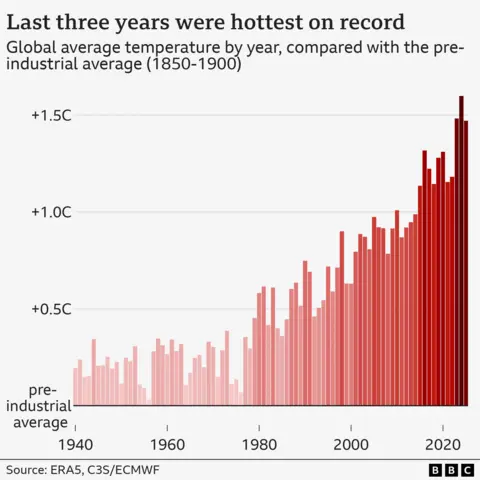
The Paris Agreement, signed by nearly 200 countries in 2015, set ambitious goals to limit global warming to well below 2°C above pre-industrial levels, with an aspiration to keep it to 1.5°C. This target was established to avoid the most catastrophic consequences of climate change, such as irreversible ecosystem collapse, widespread food and water scarcity, and mass displacement. The difference between 1.5°C and 2°C might seem small, but scientific models predict vastly different outcomes for sea-level rise, coral reef survival, and the frequency and intensity of extreme weather. Dr. Burgess’s projection, based on recent data, is particularly concerning: "Looking at the most recent data, it looks like we’ll exceed that 1.5 degree level of long-term warming by the end of this decade." This suggests that the aspirational target of 1.5°C may soon become a historical footnote rather than a future achievement.
While the long-term warming trend is unequivocally driven by human activities, individual years can experience slight variations in temperature due to natural climate phenomena. The El Niño-Southern Oscillation (ENSO) is one such major driver, characterized by fluctuations in sea surface temperatures in the equatorial Pacific. El Niño phases are typically associated with warmer global average temperatures as heat is released from the ocean into the atmosphere, while La Niña phases, marked by cooler Pacific waters, tend to have a moderating, cooling effect on global temperatures. The return of La Niña conditions in 2025 is widely believed to have suppressed global warmth, preventing it from surpassing the record set in 2024. However, the fact that temperatures remained so remarkably high even during a La Niña year "is a little worrying," according to Dr. Zeke Hausfather, a climate scientist at Berkeley Earth in the US. This indicates that the underlying human-induced warming signal is so strong that it significantly offsets natural cooling mechanisms.
The last three years have seen global temperature records broken by significant margins, illustrating the profound acceleration of warming. A detailed analysis of monthly temperature anomalies since 1979 reveals an astonishing fact: for every single month of the year, the warmest recorded instance has occurred within the last three years (2023-2025). This unprecedented consistency in record-breaking monthly temperatures points to a fundamental shift in the planet’s climate system, driven by the continuous accumulation of greenhouse gases.

Beyond greenhouse gas concentrations and ENSO, scientists are also exploring other factors that might be contributing to the observed rapid warming. Theories include subtle changes to clouds, which play a crucial role in regulating Earth’s energy balance by reflecting sunlight or trapping heat, and alterations in tiny atmospheric particles called aerosols. Some research suggests that a reduction in aerosol emissions, particularly from shipping due to cleaner fuel regulations, might be leading to less of the Sun’s energy being reflected back into space, thereby contributing to warming.
"We are seeing rapid warming at the upper end of our longer-term expectations," acknowledged Prof. Sutton. However, he cautioned that it is "not yet clear" whether the exceptional warmth of the last three years has significant implications for the very long-term climate projections, emphasizing the need for more data and continued scientific scrutiny before drawing definitive conclusions. Climate models are constantly being refined, and understanding the interplay of all these factors is critical for accurate future predictions.
Despite the gravity of these findings and the ominous warnings, scientists consistently emphasize that the future impacts of climate change are not immutable. Humanity retains the power to influence the trajectory of global warming. "We can strongly affect what happens," stated Sutton, highlighting two crucial avenues for action: "both by mitigating climate change – that’s by cutting greenhouse gas emissions to stabilise warming – and of course also by adapting, by making society more resilient to ongoing changes." Mitigation efforts involve a rapid global transition to renewable energy sources, enhancing energy efficiency, developing carbon capture technologies, and implementing policies that reduce industrial and agricultural emissions. Adaptation, on the other hand, focuses on preparing for the changes already underway, through initiatives like building sea walls, developing drought-resistant crops, implementing early warning systems for extreme weather, and designing resilient infrastructure. The message is clear: while the planet is heating up, decisive and concerted action can still temper the worst outcomes and safeguard a more stable future.




 Roy Suryo
 Nakalama John
 atisusanti
 Ramos Leo