Roy Suryo
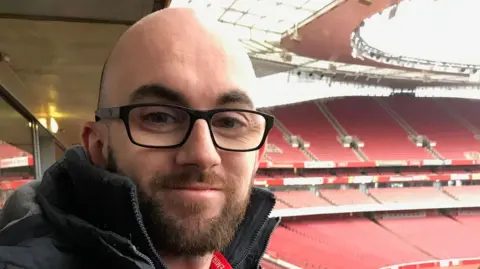
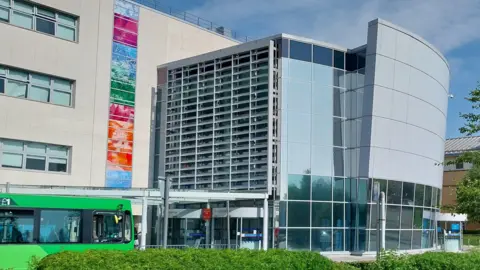
Peter Dervin had spent an agonizing day by his son Greg’s bedside at Broomfield Hospital, his heart heavy with worry. Before stepping out briefly to grab dinner, he implored the nursing staff not to leave his eldest child, Greg, alone. His pleas were met with what he described as a dismissive, almost mocking response: "This is what we do. We’re nurses and we look after patients." Greg, a 35-year-old structural engineer, Arsenal fan, and soon-to-be father from Roxwell, near Chelmsford, had been administered lorazepam, an anxiety medication known to cause unsteadiness and agitation. Tragically, within a short time of his father’s departure, Greg was found in a critical state. Left unattended in his room, he had fallen, striking his head on a piece of hospital equipment, an accident that resulted in a catastrophic brain injury. Greg succumbed to his injuries a week later, on 10 May 2024, leaving his family devastated.
"Greg was my first son, the one who made me walk taller and strive to be a better person," a visibly pained Peter Dervin shared from his home in Broomfield. "He was destined to be an incredible father. The fact that this didn’t happen has brought immense sadness to us all." Greg had been undergoing treatment for a heart condition, which his family attributes to what they term "mismanagement" of his Crohn’s disease. He had been transferred to Broomfield Hospital on 23 April 2024 from a London hospital, having spent nearly 500 days in treatment and was reportedly on the cusp of being discharged.
The inquest, held at Essex Coroner’s Court, heard from Area Coroner Sonia Hayes, who stated that Greg arrived in Essex with a "significant, comprehensive discharge plan" that included two-to-one care. However, these dedicated nurses were controversially replaced at Broomfield by a security guard, whose sole role was to observe Greg from outside his room. This guard, Olufemi Oyedeji, was explicitly forbidden from making any clinical interventions, rendering him powerless to assist Greg, even after witnessing him fall on multiple occasions prior to the fatal incident. The inquest revealed that these repeated falls should have triggered a referral to the trust’s dedicated falls team, a protocol that was alarmingly not followed.
Coroner Hayes critically labelled the hospital’s decision to assign a security guard for close supervision, while simultaneously employing someone incapable of providing clinical care, as a "gross failure." Peter Dervin recounted the harrowing experience: "He had to watch my son fall and die through a door because he wasn’t allowed in the room." Adding to the family’s distress, it was also raised during the inquest that a security guard might not have been an appropriate choice, given Greg had previously been assaulted by a security guard at a different healthcare facility.
The assessments concerning Greg’s condition were found to be "riddled with inaccuracies," according to Hayes. One assessment notably claimed he had no neurological deficit, a stark contradiction to his more than 450 days spent at the National Hospital for Neurology and Neurosurgery in London. However, the most critical oversight, the inquest concluded, was the failure of staff to recognize Greg’s "very particular sensitivity to lorazepam."
‘It ripped my heart out’
On the fateful day of his fall, 3 May 2024, Greg had been administered lorazepam shortly before a scheduled CT scan. Peter Dervin vividly recalled his desperate warning to the nurses: "We’ve been looking after him for more than a year in hospital, and lorazepam has affected him massively every single time – please look after him." When he left to retrieve his dinner, he reiterated his plea, asking to be called immediately if any issues arose.
"I came back a few hours later to find him in bed with a massive cut on the back of his head and unconscious," Dervin recounted, his voice thick with emotion. "That’s the last time I ever spoke to him. It ripped my heart out." He emphasized the depth of his regret: "If they hadn’t said they would look after him, I wouldn’t have gone home. I would’ve stayed because I knew what lorazepam was like for him."
‘Shocked and disappointed’
During the inquest proceedings, Coroner Hayes expressed her profound dismay, accusing the hospital trust of deliberately withholding crucial information. She suggested that the individual responsible for preparing the hospital’s evidence for the inquest had failed to engage with online drop-down menus, thereby omitting vital details. Hayes stated she was "shocked and disappointed," a sentiment echoed by the hospital’s lawyer, who, while denouncing the oversight as "unacceptable," denied any intentional concealment.
"The process has been horrendous; all they’ve done is not be honest with us," Peter Dervin stated bitterly. He further revealed that hospital leaders had denied his family bereavement support, citing Greg’s death occurring at Addenbrooke’s Hospital in Cambridge, where he was transferred after the fall. "When your son has just died, for a hospital to say ‘We don’t owe you a duty of care at all’ is just the worst," he added, his voice trembling.
Greg had been on the verge of launching his own engineering consultancy before his admission to hospital. Described by his father as "a good person," he cherished spending time with his younger brothers. "It feels like something’s missing, and that’s a massive hole," Dervin confessed. "If this was the only kid I had, I’d find it hard to wake up in the morning."
The Dervin family’s enduring hope is that valuable lessons will be learned from Greg’s tragic passing, preventing any other family from enduring such unimaginable pain. "People go into hospital, and some people die. People get ill and die," Peter Dervin reflected. "But people shouldn’t go into hospital and not be cared about."
In response, the hospital trust acknowledged that Dervin’s case was "particularly complex," making the retrieval of all evidence a challenging endeavor. Sharon McNally, the trust’s chief nursing officer, stated, "We’d like to reiterate our condolences to Mr Dervin’s family, who have been kept regularly updated on the progress of our investigation throughout. A full multi-disciplinary review was completed, and learning and improvements have been made to help reduce the future chance of falls with harm."



 Nakalama John
 atisusanti
 Ramos Leo