
 Nana Banana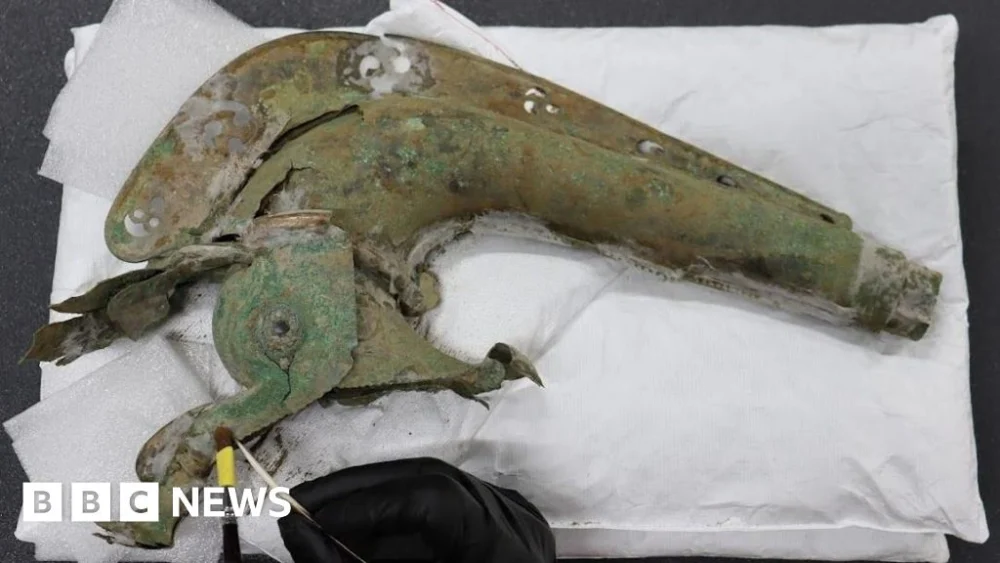
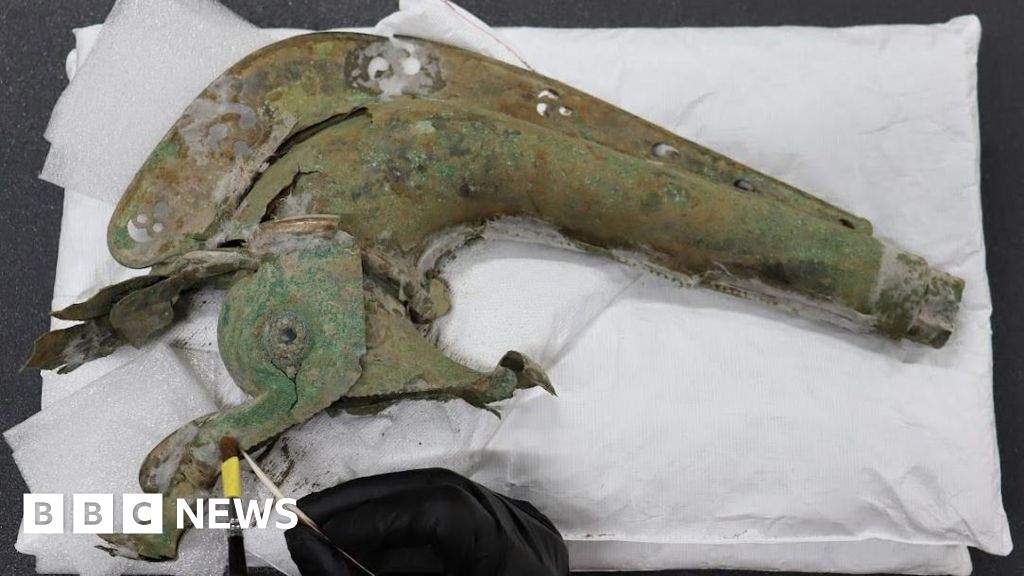
Archaeologists have been stunned by the discovery of two of the rarest Iron Age objects in the same excavation near Thetford, Norfolk, a find described by experts as "a discovery of a lifetime." The extraordinary hoard, unearthed last year by a team from Pre-Construct Archaeology on a building site a few miles from the historic town, has offered an unprecedented glimpse into the martial and ritualistic practices of late Iron Age Britain. At the heart of this remarkable cache were the most complete battle trumpet, known as a carnyx, ever found in Europe, and the first-ever boar’s head flag standard to be discovered in Britain.
Senior project officer Gary Trimble conveyed the immense significance of the find to BBC Two’s Digging for Britain, emphasizing the extreme rarity of both items. "Carnyces are extraordinarily rare," he stated, adding that "a boar standard, that’s even rarer." This dual discovery within a single hoard is what elevates its importance, providing a unique snapshot of Iron Age military regalia and cultural symbolism. Dig leader Peter Crawley, reflecting on the initial stages of the excavation, revealed a premonition about the site’s potential. "It felt like one of those special sites that you do get every so often," he recalled, a gut feeling that proved profoundly accurate.
The carnyx, a distinctive brass wind instrument, was a fearsome psychological weapon used by Celtic tribes across Europe. Its primary purpose was to intimidate enemies on the battlefield and to inspire and direct warriors amidst the chaos of combat. The instrument typically featured a bell shaped like an open-mouthed animal head, often a boar or a serpent, mounted vertically, allowing its sound to project over the heads of the combatants. The Romans, who frequently encountered Celtic warriors, were particularly fascinated by these instruments, often depicting them as exotic war trophies in their art and sculpture, a testament to their striking appearance and powerful sound. The Thetford carnyx, with its remarkably preserved features including "a wonderful little eye," has captivated conservators. Jonathan Carr, involved in the intricate conservation process, noted how this detail makes it impossible "not to be impressed and charmed by it."
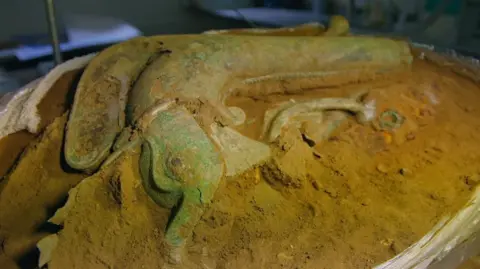
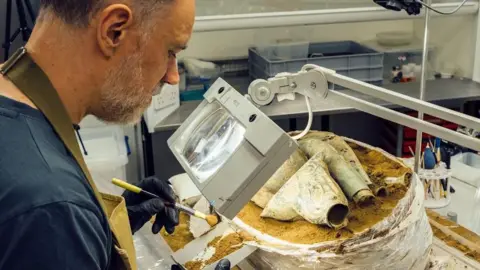
The fragile nature of the carnyx presented significant challenges for its recovery and conservation. Conservator Jonathan Carr explained that the instrument was crafted "from extremely thin sheets of metal which have become extremely brittle after 2,000 years in the ground." This delicate state necessitated meticulous handling, requiring the entire hoard to be carefully lifted out of the earth in a solid block of soil. This block was then transported to a specialist laboratory where it underwent detailed scanning to map the precise location and orientation of each item before any physical conservation work could begin. The painstaking process of removing the ancient, fragile metals from their sandy matrix demands immense skill and patience, as any misstep could lead to irreparable damage.
Dr. Fraser Hunter, Iron Age and Roman curator at National Museums Scotland, underscored the transformative potential of the Thetford carnyx. Having studied carnyces from across Europe, he asserted that "the full research and conservation of these incredibly fragile remains will reshape our view of sound and music in the Iron Age." This suggests that the completeness and detail of this particular carnyx could offer unprecedented insights into its construction, acoustic properties, and the role it played in Celtic society, beyond just warfare. It might reveal more about ritualistic uses, communal gatherings, or even the musical scales and harmonies of the period.
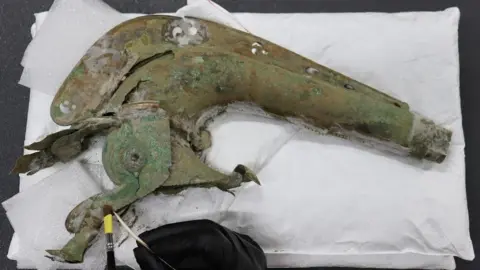
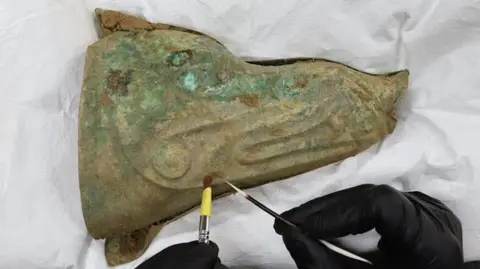
Equally significant is the boar’s head standard, also meticulously crafted from thin sheets of bronze. This item represents the first such standard ever found in Britain, making it an archaeological landmark. Standards like this would have been held aloft in battle, serving as crucial rallying points for troops, visual symbols of tribal identity, and potent totems of power. Dr. Hunter elaborated on the profound symbolism of the boar in Celtic culture: "They were very fierce animals to face in the hunt, so the symbolism of the boar is a lot about the strength of it – a very appropriate adversary in battle." The wild boar was revered for its ferocity, courage, and untamed spirit, making it an ideal emblem for warriors preparing for combat. Its presence on a standard would have instilled both fear in enemies and confidence in the ranks of its own tribe.
The entire hoard, which dates to a pivotal period between approximately 50 BC and AD 50, reflects a time of immense change in Britain, coinciding with the eve of the Roman invasion and the early stages of Roman presence. Besides the carnyx and the boar standard, the cache included five shield bosses – the central, protective hubs of shields – and an enigmatic iron object whose original purpose is yet to be determined. The strategic deposition of these items in a single hoard suggests a deliberate act, possibly a ritualistic offering, a hidden cache intended for later retrieval, or perhaps the burial of a fallen chieftain’s prized possessions. The precise context of its burial will be a key focus of ongoing research.
Following its initial discovery and careful extraction, the find was duly reported to the coroner, a standard procedure in the UK for archaeological finds that might be classified as treasure. An inquest will be held to officially determine if the hoard meets the criteria for "treasure" under the Treasure Act 1996, which would then open avenues for its acquisition by public museums. Its long-term future, including where it will ultimately be housed and displayed, has yet to be decided.
The collaborative effort behind this discovery highlights the multidisciplinary nature of modern archaeology. Historic England is actively working alongside Pre-Construct Archaeology, Norfolk Museums Service, and the National Museum of Scotland to coordinate the comprehensive research and conservation efforts. This ensures that the delicate objects are preserved using the best available techniques and that their historical context is thoroughly understood and documented.
Dr. Tim Pestell, a senior curator of archaeology for Norfolk Museums Service, articulated the broader cultural impact of the find. He described it as "a powerful reminder of Norfolk’s Iron Age past which, through the story of Boudica and the Iceni people, still retains its capacity to fascinate the British public." This connection to the Iceni, the powerful Celtic tribe led by Queen Boudica who famously rebelled against Roman rule, adds a layer of rich historical resonance to the discovery. The Norfolk Carnyx Hoard, therefore, promises to provide archaeologists with an unparalleled opportunity to investigate a collection of exceptionally rare objects and, crucially, to illuminate the story of how these items came to be buried in the county some two millennia ago, potentially shedding light on Iceni military organization, ritual, and resistance.
Claudia Kenyatta CBE and Emma Squire CBE, co-CEOs of Historic England, echoed the sentiment of profound importance, calling it a "remarkable discovery." They expressed their anticipation, stating, "We look forward to uncovering and sharing the story of the Norfolk community that owned and used these items." This emphasizes the human element behind the artifacts, reminding us that these were not mere objects, but tools and symbols integral to the lives, beliefs, and struggles of a vibrant ancient society.
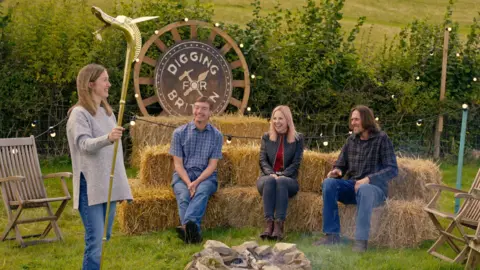
The full narrative of this extraordinary archaeological breakthrough, from its initial uncovering to the intricate conservation efforts and the insights gained, will be prominently featured on BBC Two’s Digging for Britain. The programme, hosted by anatomist, author, and broadcaster Prof. Alice Roberts, will air on 14 January at 21:00 GMT, and will also be available for viewing on BBC iPlayer, allowing a wide audience to witness firsthand the unfolding story of this once-in-a-lifetime Iron Age find.



 Roy Suryo

 Nakalama John
 atisusanti
 Ramos Leo
