Nana Banana
The term "bloom" typically describes a rapid, often temporary, increase in the population of a species, often triggered by favourable environmental conditions. In this instance, warmer winters, increasingly linked to global climate change, are believed to have created an ideal environment for Octopus vulgaris, the common octopus, to thrive. This species, more typically associated with the warmer climes of the Mediterranean Sea, has found the UK’s southern coast surprisingly hospitable, leading to a dramatic shift in local marine biodiversity.
Supporting the charity’s observations are compelling official figures from the fishing industry. Data reveals that more than 1,200 tonnes of octopus were caught in UK waters during the summer of 2025 alone. This figure represents an astonishing increase compared to previous years; since 2021, only once had the annual catch exceeded 200 tonnes, highlighting the sheer scale of this year’s population explosion. The dramatic rise suggests a significant ecological event rather than a minor fluctuation.
Experts point to Octopus vulgaris as the primary species responsible for this bloom. Volunteers from the Cornwall and Devon Wildlife Trusts have been particularly instrumental in documenting this phenomenon, reporting an staggering increase of over 1,500 percent in sightings along a specific stretch of the south coast compared to 2023 figures. This exponential growth underscores the rapid adaptation and expansion of the species within these newly warmer habitats.
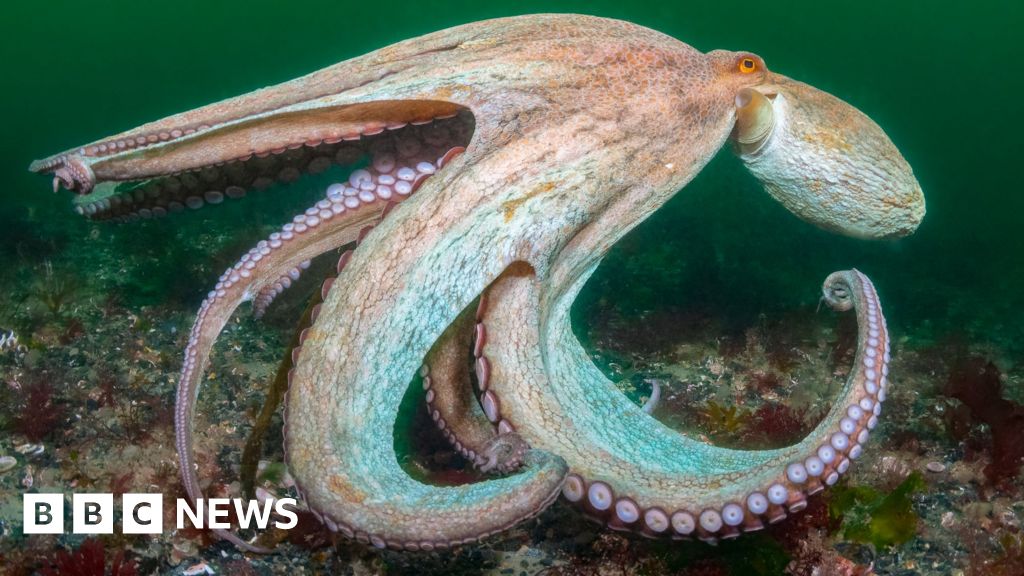
Matt Slater, from the Cornwall Wildlife Trust, described the sightings as "exceptional." He recounted vivid observations of octopuses exhibiting a fascinating array of behaviours previously less commonly seen in these waters. "We’ve seen octopuses jet-propelling themselves along with incredible speed and agility," Slater detailed. "We’ve witnessed their masterful camouflaging abilities, making them appear indistinguishable from the surrounding seaweeds and rocks. Divers have even captured footage of them cleaning themselves, meticulously maintaining their skin, and perhaps most remarkably, ‘walking’ – using just two arms to nonchalantly cruise away from an observer underwater, a behaviour often associated with deeper, more complex environments." Such detailed observations not only confirm the sheer abundance but also provide valuable insights into the behavioural ecology of these creatures adapting to new territories.
The scientific consensus suggests that warmer ocean temperatures play a crucial role in the lifecycle of Octopus vulgaris. Elevated water temperatures can accelerate their metabolic rates, leading to faster growth, earlier sexual maturity, and increased reproductive success. Furthermore, milder winters reduce mortality rates for juvenile octopuses, allowing more individuals to survive and contribute to the breeding population. This creates a positive feedback loop, leading to the rapid population expansion observed. The UK’s coastal waters, historically at the northern edge of the common octopus’s range, are now providing conditions more akin to their traditional Mediterranean strongholds.
However, the long-term implications of this octopus bloom are a subject of ongoing scientific inquiry and concern. It remains "unclear at this point whether the rise in numbers is permanent or cyclical," as the Wildlife Trusts noted. If this is a temporary cyclical event, numbers might naturally recede in future years. However, if it signifies a permanent range shift driven by persistent climate change, the ecological balance of UK waters could be fundamentally altered.
The dietary habits of Octopus vulgaris present a significant challenge to existing marine ecosystems and human industries. These highly effective predators primarily feed on shellfish, including economically important species such as lobsters, crabs, and scallops. Ruth Williams, head of marine for The Wildlife Trusts, articulated these concerns on the BBC’s Today programme. "They are having an impact on those [shellfish] species around our shores. And as a consequence, they will be having an impact on our fishing industry who target those species as well," she explained.
Indeed, government data already indicates a measurable impact, with crab landings showing a decrease compared to previous years. While catches of lobster, crawfish, and scallops have remained relatively stable, this stability may mask underlying pressures or indicate a lag in the observable effects. The increased predation pressure from a booming octopus population could lead to declines in these commercially valuable species over time, potentially disrupting the livelihoods of countless coastal communities reliant on the shellfish industry.
Yet, Williams also highlighted potential "opportunities" and the proactive stance of the fishing industry. "Our fishing industry are doing some research into that at the moment to try and evolve with the changing fisheries that we’re seeing as a result of climate change," she added. This forward-thinking approach could involve exploring new fishing methods tailored for octopus, developing new markets for octopus as a seafood, or even adapting traditional fishing practices to mitigate the impact on shellfish. Such adaptation is crucial in an era of rapid environmental change, where flexibility and innovation will be key to the sustainability of marine industries. The shift in species distribution due to climate change is a global phenomenon, and the UK’s experience with the octopus bloom serves as a vivid local example of this broader trend.
The Wildlife Trusts’ comprehensive marine review, while highlighting the dramatic octopus surge, also contained a mix of news for other species, underscoring the complex and often contrasting impacts of environmental change. Amidst the "sobering news" of general marine health challenges, there were beacons of hope. For instance, good news emerged for another charismatic marine bird: puffins. A record-breaking 46,000 puffins were recorded on Skomer Island in Pembrokeshire, indicating a robust breeding season and healthy prey fish populations in that region. Furthermore, the beloved black and white bird has made a remarkable comeback on the Isle of Muck, thanks to dedicated conservation efforts by Ulster Wildlife Trust, specifically the successful removal of invasive brown rats, which prey on eggs and chicks. These successes demonstrate that targeted conservation strategies can yield significant positive outcomes, even in the face of broader environmental shifts.
However, these localized victories for species like puffins and the intriguing bloom of octopuses cannot overshadow the overarching concerns about the long-term health of marine ecosystems. The "Year of the Blooming Octopus" is a powerful reminder of how interconnected marine life is with global climate patterns. It forces a re-evaluation of our understanding of marine biodiversity, species distribution, and the resilience of ecosystems in the face of rapid environmental alterations. As oceans continue to warm, scientists anticipate further shifts in species ranges and population dynamics, necessitating continuous monitoring, adaptive management strategies, and sustained conservation efforts to protect the delicate balance of our marine world. The octopus bloom serves as both a fascinating ecological event and a potent symbol of the profound changes underway beneath the waves.




 Roy Suryo

 Nakalama John
 atisusanti
 Ramos Leo