Nana Banana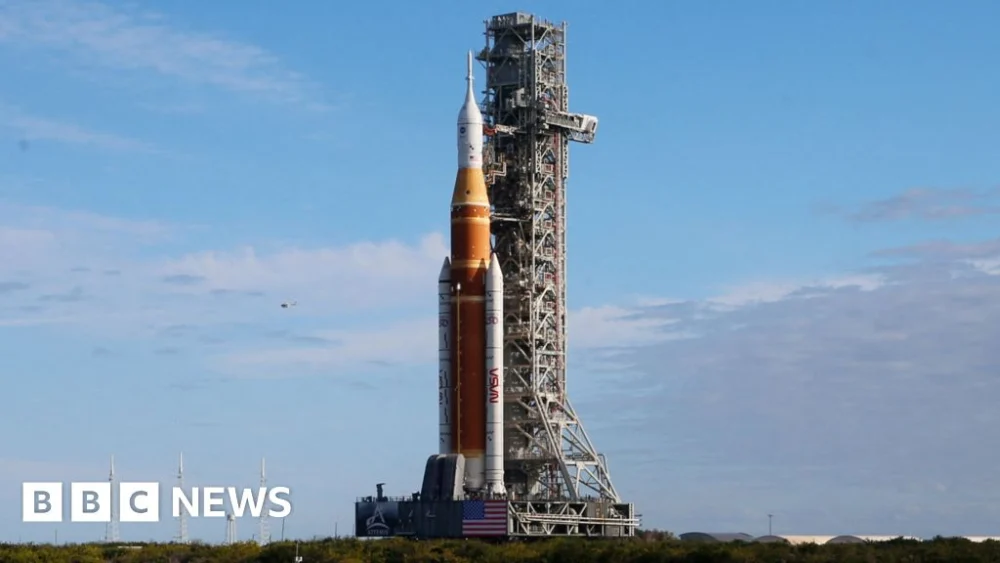
The majestic 98-meter-tall (322-foot) rocket, integrated with the Orion spacecraft, embarked on its deliberate 6.5-kilometer (4-mile) trek from the iconic Vehicle Assembly Building (VAB) to the launch pad, a journey that unfolded over nearly 12 hours. The sheer scale of the operation captivated onlookers and garnered live coverage, as the towering rocket, vertically assembled, was meticulously transported atop the massive Crawler-Transporter. This legendary behemoth, a cornerstone of NASA’s launch operations since the Apollo program, lumbered along at a top speed of a mere 0.82 mph (1.3 km/h), demonstrating the precision and care required for handling such an invaluable piece of hardware. The process, commencing at 07:04 local time (12:04 GMT), culminated in the rocket’s secure arrival at Pad 39B at 18:41 local time (23:42 GMT), marking a significant step in a mission fraught with historical significance and immense technical complexity.
With the SLS now firmly in position at the launch pad, an intensive series of final tests, comprehensive checks, and a crucial dress rehearsal are slated to take place. These rigorous procedures are designed to validate every system and protocol before the official "go-ahead" is granted for the 10-day Artemis II mission, which will see four astronauts journey around the Moon. Nasa has indicated that the earliest possible launch window opens on 6 February, with subsequent opportunities available later that month, as well as in March and April. The flexibility in launch dates underscores the agency’s commitment to mission readiness and safety over adherence to a rigid schedule.

The Artemis II mission is a trailblazing endeavor, representing a pivotal step in Nasa’s ambitious Artemis program, which aims to establish a long-term human presence on the Moon and eventually pave the way for crewed missions to Mars. Unlike the subsequent Artemis III mission, Artemis II is not scheduled to land on the lunar surface. Instead, its primary objective is to test the Orion spacecraft’s systems with a human crew in deep space, rehearse critical maneuvers, and validate the capabilities of the SLS rocket in a real-world, crewed environment. This uncrewed lunar flyby will lay indispensable groundwork for future lunar landings.
The four intrepid astronauts selected for this historic voyage – Nasa’s Reid Wiseman (Commander), Victor Glover (Pilot), Christina Koch (Mission Specialist), and Canadian Space Agency’s Jeremy Hansen (Mission Specialist) – were present at the Kennedy Space Center, witnessing the awe-inspiring spectacle of their future ride to the Moon. In a few weeks, these pioneers will be strapped into the Orion spacecraft, nestled atop the SLS rocket, ready to embark on a journey that will take them further into space than any human has traveled before. This mission will mark the first time humans have ventured to the Moon since Apollo 17’s lunar landing in December 1972, signifying a generational leap in space exploration.
Christina Koch, reflecting on the moment, expressed an "amazing feeling" seeing the rocket. She noted the unique composure of astronauts on launch day: "Astronauts are the calmest people on launch day. And I think… it feels that way because we’re just so ready to fulfil the mission that we came here to do, that we’ve trained to do." Jeremy Hansen echoed her sentiments, conveying his hope that the mission would serve as a global inspiration. "The Moon is something that I’ve taken for granted. I’ve looked at it my whole life, but then you just glance at it and glance away," he remarked. "But now I’ve been staring at it a lot more, and I think others will be joining us and staring at the Moon a lot more as there will be humans flying around the far side and that is just good for humanity."
The mission profile for Artemis II is meticulously planned. The initial two days will involve intricate maneuvers in Earth orbit, testing various systems and preparing for the translunar injection burn. "We’re going to be going into an orbit almost right away that is 40,000 miles out – like a fifth of the way of the Moon," Koch elaborated to BBC News. "We will have the Earth out the window as a single ball, something none of us have seen in that perspective. And then we’re going to travel a quarter of a million miles away… we’re going to do a lot of science and operations along the way." This extended Earth orbit phase provides valuable opportunities for the crew to acclimatize to space and verify spacecraft performance before committing to the deep-space leg of the journey.
Once en route to the Moon, the Orion spacecraft will perform a lunar flyby, taking the crew around the far side of the Moon. During this critical phase, the astronauts will dedicate approximately three hours to lunar observation. This dedicated period will allow them to gaze upon the unexplored side of Earth’s natural satellite, capture invaluable imagery, and conduct preliminary geological studies. These observations are not merely for aesthetic appreciation; they are crucial for planning and preparing for future lunar landings, particularly at the Moon’s enigmatic south pole, an area believed to hold significant water ice reserves.
A cornerstone of the Orion spacecraft, and indeed the entire Artemis mission, is the European Service Module (ESM). Fabricated in Bremen, Germany, by Airbus, the ESM represents the European Space Agency’s (ESA) substantial contribution to this international endeavor. Situated directly behind the crew capsule, this sophisticated module is indispensable for the mission’s success. Sian Cleaver, a spacecraft engineer at Airbus, highlighted its critical role: "The European Service Module is so important – we basically can’t get to the Moon without it. It provides the propulsion that Orion needs to get us to the Moon." Beyond propulsion, the ESM’s expansive solar arrays are designed to generate all the electrical power required for the craft, sustaining operations throughout the mission. Furthermore, it houses large tanks filled with oxygen and nitrogen, meticulously mixed to create breathable air, along with water supplies, ensuring the astronauts’ survival and well-being during their extensive journey.

Inside their pristine cleanroom facilities, the dedicated team at Airbus is already immersed in the intricate process of constructing additional European Service Modules for subsequent Artemis missions. Each module demands approximately 18 months for assembly, a culmination of thousands of engineering hours dedicated to its design and rigorous testing. The inherent complexity and unforgiving nature of space travel necessitate absolute perfection in every component. "We’ve got to get those astronauts to the Moon and then back again, completely safely," Cleaver stressed, underscoring the paramount importance of safety that drives every decision and engineering effort.
The Artemis program has encountered its share of challenges and delays over the years, a testament to the unprecedented engineering feats and the meticulous validation required for human spaceflight. With the rocket now positioned on Launch Pad 39B, the Artemis team is operating around the clock, working tirelessly to ensure every system is ready for lift-off. While there is undeniable pressure to launch the astronauts as soon as feasible, Nasa remains unwavering in its commitment to crew safety. John Honeycutt, chair of the Artemis mission management team, articulated this non-negotiable priority: "I’ve got one job, and it’s the safe return of Reid and Victor and Christina and Jeremy. We’re going to fly when we’re ready… crew safety is going to be our number one priority." This steadfast dedication ensures that when Artemis II finally blasts off, it will do so with the highest possible degree of confidence and readiness, ushering in a new era of lunar exploration for humanity.




 George Anjay
 Nakalama John
 atisusanti
 Ramos Leo