Nana Banana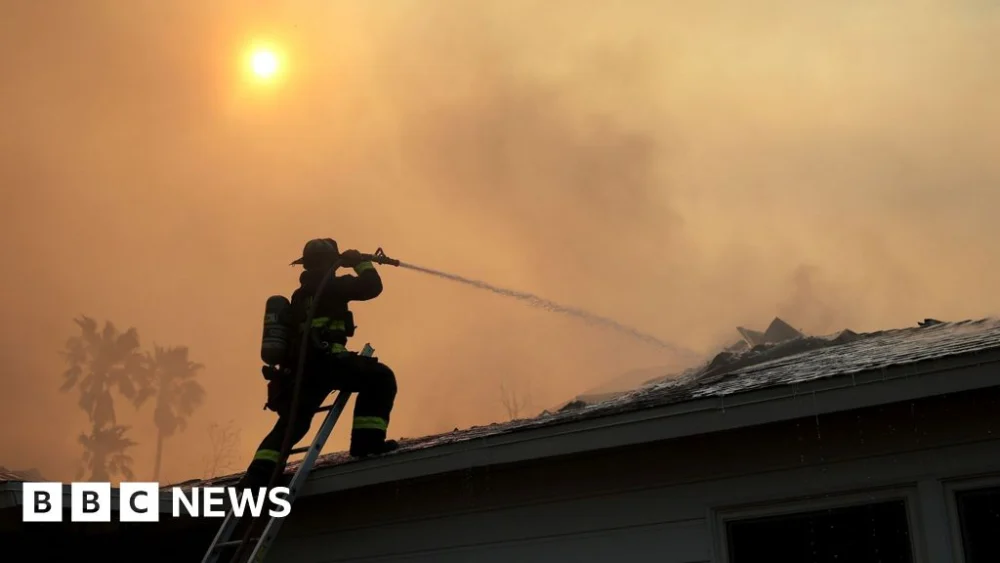
Authored by climate researcher Mark Poynting, this assessment highlights a concerning paradox. Even with the Pacific’s natural cooling mechanism in play, 2025 registered temperatures significantly higher than those observed just a decade ago. This persistent warmth underscores the undeniable impact of humanity’s unabated carbon emissions, which continue to trap heat in the atmosphere, fundamentally altering Earth’s climate system. Scientists unequivocally state that without drastic and immediate reductions in these greenhouse gas emissions, the world will inevitably face a future defined by further temperature records and an escalation in the severity and frequency of weather extremes.
Dr. Samantha Burgess, deputy director of Copernicus, offered a sobering perspective on the current climate reality. "If we go twenty years into the future and we look back at this period of the mid-2020s, we will see these years as relatively cool," she commented, emphasizing that what we now perceive as alarmingly hot will soon be surpassed by even more intense heatwaves and environmental challenges. This statement serves as a stark reminder of the rapidly shifting baseline for what constitutes a "normal" temperature, illustrating how quickly the planet is warming due to anthropogenic factors.
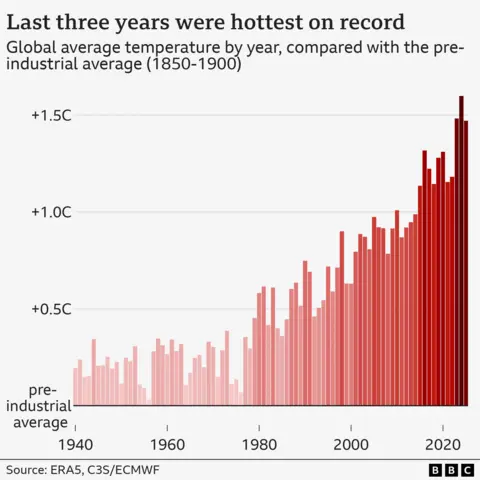
The global average temperature in 2025 stood more than 1.4C above "pre-industrial" levels, defined as the late 1800s before the widespread industrialization and mass burning of fossil fuels began. This figure, derived from the rigorous methodologies of Copernicus and the Met Office, brings the world alarmingly close to the 1.5C warming limit enshrined in the Paris Agreement. While minor discrepancies in precise temperature calculations exist between major climate groups, primarily due to slight variations in defining the pre-industrial baseline, there is absolute scientific consensus regarding the undeniable and accelerating long-term warming trend of the planet.

Prof. Rowan Sutton, director of the Met Office Hadley Centre, articulated the fundamental scientific understanding driving these warnings. "We understand very well that if we continue to pump greenhouse gases into the atmosphere, the concentrations of those gases increase in the atmosphere, and the planet responds by warming," he explained. This direct causal link between human activity and global warming forms the bedrock of climate science, making the continued rise in temperatures a predictable, albeit catastrophic, consequence of current emission trajectories.
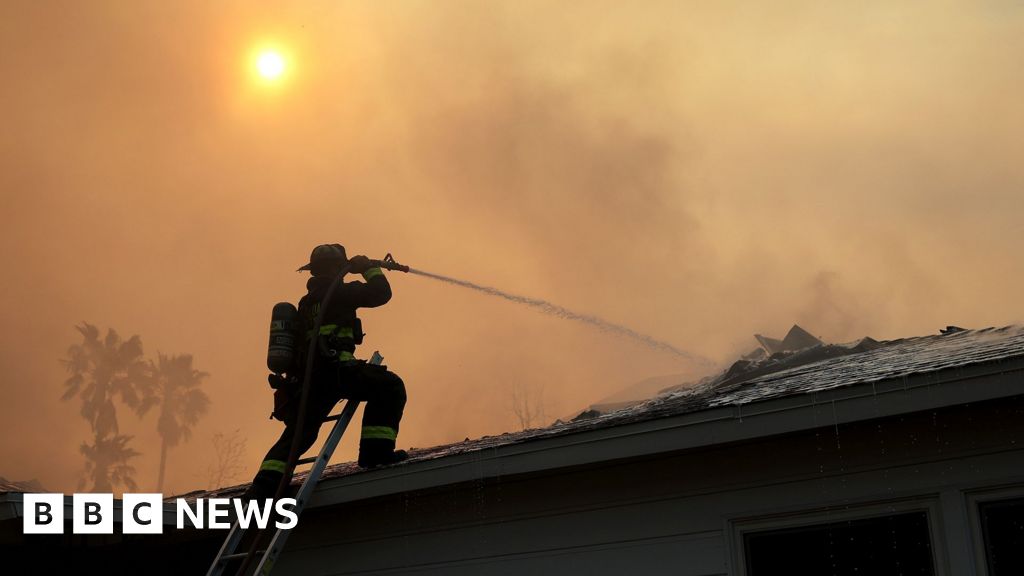
Despite 2025 not claiming the title of the single hottest year on record globally, the year was far from tranquil. It was punctuated by a relentless barrage of extreme weather events, each bearing the unmistakable fingerprints of a warming planet. The devastating California fires in January 2025, for instance, became one of the most expensive weather-related disasters in US history. Images captured by Justin Sullivan for Getty Images depicted firefighters silhouetted against hazy, smoke-filled skies, battling infernos that consumed homes in Altadena, a stark visual representation of the increasing vulnerability of communities to climate-driven catastrophes. These fires, intensified by prolonged drought and higher temperatures, showcased how a warming climate amplifies natural hazards.
Later in the year, the Caribbean faced its own wrath. Hurricane Melissa, which struck in October 2025, brought mass flooding to Haiti, as depicted by Egeder Pq Fildor for Reuters, showing people cleaning debris in front of a submerged house in Petit Goave. The scientific consensus is clear: global warming fuels hurricanes like Melissa, endowing them with stronger winds, heavier rainfall, and a greater capacity for devastation due to warmer ocean waters providing more energy for storm development. Such events underscore the urgent need for both mitigation and adaptation strategies, especially in vulnerable regions.
The international community, recognizing the profound risks posed by climate change, forged the Paris Agreement in 2015. Nearly 200 countries committed to limiting global warming to "well below 2C" above pre-industrial levels, with an ambitious target of pursuing efforts to cap it at 1.5C. This 1.5C threshold is considered a critical guardrail, beyond which the risk of more severe and irreversible consequences – including intensified heatwaves, more frequent droughts, accelerated sea-level rise, and widespread ecosystem collapse – escalates dramatically. The scientific community’s current projections indicate a troubling trajectory. "Looking at the most recent data, it looks like we’ll exceed that 1.5 degree level of long-term warming by the end of this decade," warned Dr. Burgess, a prediction that sends shivers through climate negotiations and policy circles worldwide.

While the long-term upward trend in global temperatures is unequivocally a product of human-induced greenhouse gas emissions, individual years can experience slight fluctuations in warmth due to natural climate variability. The most prominent of these natural cycles are the El Niño-Southern Oscillation (ENSO) patterns: El Niño and La Niña. These phenomena primarily influence sea surface temperatures in the equatorial Pacific Ocean but have far-reaching "teleconnections" that affect weather patterns and temperatures across the globe. El Niño years are typically characterized by warmer global averages, as heat stored in the ocean is released into the atmosphere, while La Niña years, conversely, tend to be cooler.
The return of La Niña conditions is indeed believed to have suppressed the global average temperature in 2025, preventing it from surpassing the scorching highs of 2024. However, the fact that temperatures remained remarkably high even during a La Niña phase is a significant cause for concern among experts. Dr. Zeke Hausfather, a climate scientist at Berkeley Earth in the US, described this as "a little worrying." It suggests that the underlying human-caused warming signal is so strong that even a powerful natural cooling influence struggles to bring temperatures down significantly, indicating a potential acceleration of global warming beyond previous projections.
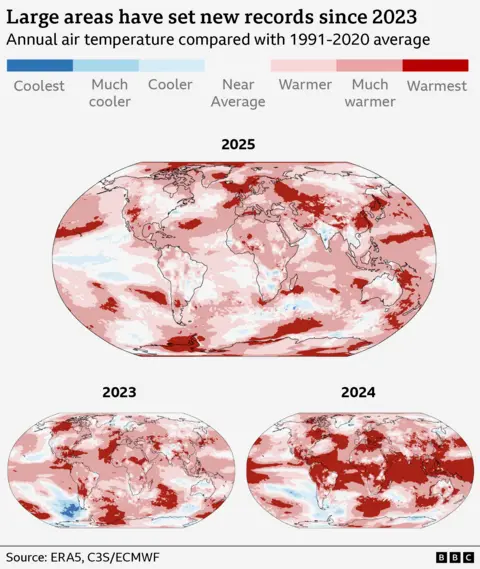
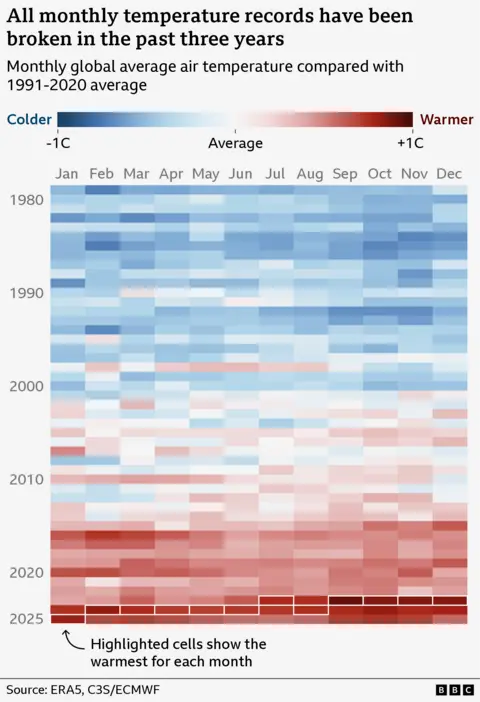
The unprecedented speed of recent warming is further illustrated by the consistent breaking of monthly temperature records. Since 2023, every single month of the year has seen its warmest iteration on record, according to Copernicus data. This continuous streak of record-breaking warmth across different seasons and regions points to a systemic and rapid heating of the planet. Scientists are actively investigating potential contributing factors to this accelerated warming, beyond the steady increase in greenhouse gases. Theories include changes in cloud cover patterns and a potential reduction in the reflective capacity of tiny atmospheric particles known as aerosols. Aerosols, often byproducts of industrial pollution, can reflect sunlight back into space, exerting a cooling effect. A reduction in certain types of aerosols, perhaps due to cleaner air policies, could be unmasking a stronger warming trend.
Prof. Sutton acknowledged this complex interplay, stating, "We are seeing rapid warming at the upper end of our longer-term expectations." However, he cautioned that more data is needed before drawing firm conclusions about the exact implications of the last three years’ rapid warming for the longer-term climate sensitivity. The scientific community is rigorously analyzing these trends to refine climate models and improve future projections.
Crucially, while scientists anticipate more temperature records will be shattered in the coming years, they adamantly emphasize that the future impacts of climate change are not immutable or set in stone. Humanity still possesses the agency to influence the trajectory of global warming. "We can strongly affect what happens," asserted Sutton, outlining a dual approach: "both by mitigating climate change – that’s by cutting greenhouse gas emissions to stabilise warming – and of course also by adapting, by making society more resilient to ongoing changes." Mitigation involves transitioning away from fossil fuels to renewable energy sources, enhancing energy efficiency, and implementing carbon capture technologies. Adaptation, on the other hand, focuses on building resilience through measures such as developing drought-resistant crops, constructing sea defenses, improving early warning systems for extreme weather, and urban planning that accounts for higher temperatures and altered precipitation patterns. The message from the scientific community is clear: urgent and coordinated global action on both fronts is imperative to avert the most catastrophic consequences of a rapidly warming world. Additional reporting by Jess Carr contributed to this article.



 Roy Suryo