Ramos Leo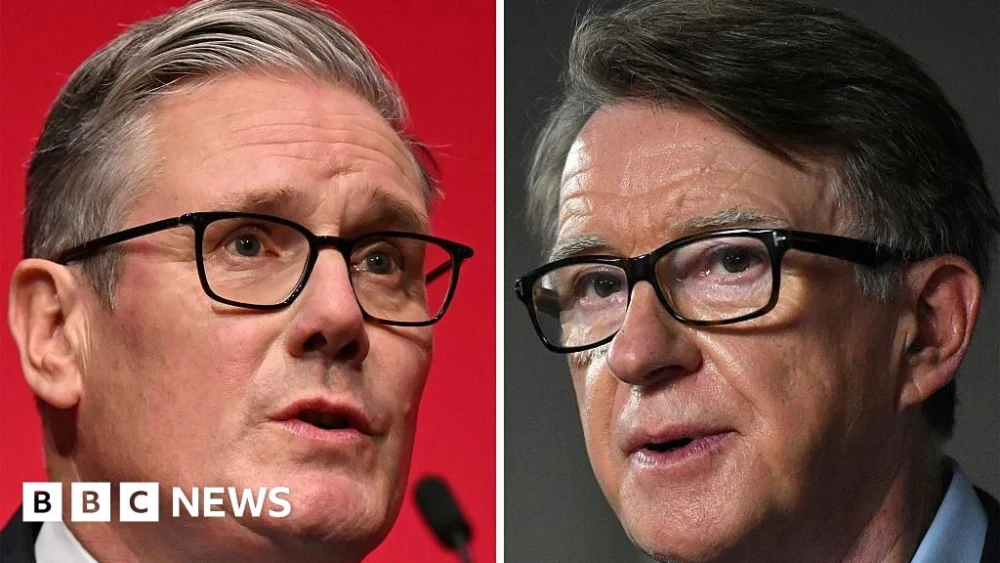
The deepening scandal, which has gripped Westminster and dominated headlines, compelled Prime Minister Sir Keir Starmer to issue a public apology on Wednesday. Addressing the victims of convicted sex offender Jeffrey Epstein, Sir Keir expressed profound regret for having believed Lord Mandelson’s "lies" and for appointing him to such a sensitive diplomatic role, even though the peer’s association with Epstein was already a matter of public record. The Prime Minister’s apology, delivered with solemnity, aimed to quell the growing public outrage and internal party dissent, yet its immediate effect has been to intensify calls for his resignation from within his own parliamentary ranks.
Despite Sir Keir’s concerted efforts to defuse the escalating row, a significant number of his own Members of Parliament are openly challenging his leadership, with some privately expressing the view that his position is becoming untenable. The severity of the situation has been underscored by commentary from former senior government figures. James Lyons, who previously served as No 10’s communications director, articulated the gravity of the impending disclosures during an appearance on BBC Newsnight. He warned that the release of private messages could potentially ensnare a wider circle of public figures in the scandal, drawing parallels to previous periods of acute political turmoil.
"I don’t think anyone can understate the gravity of the situation," Lyons stated, reflecting on the potential repercussions. He added, "We’ve seen with the Covid inquiry how a huge amount of stuff can be thrown up through that. I think this is at least the biggest scandal since the expenses scandal of 2009." The reference to the Covid inquiry highlights the disruptive power of detailed private communications entering the public domain, while the comparison to the 2009 expenses scandal – a period of widespread public anger over misuse of parliamentary allowances – underscores the perceived scale of the current crisis.
Central to the unfolding drama is Lord Mandelson’s position. The BBC understands that Lord Mandelson maintains that he accurately answered all questions posed to him during the vetting process for his ambassadorial role regarding his relationship with Epstein. This stance directly contradicts Sir Keir Starmer’s public assertion that Mandelson provided false information.
Sir Keir, facing immense pressure, has pledged to release official files which, he asserts, will conclusively prove that Lord Mandelson misrepresented the true extent and nature of his friendship with Epstein during the rigorous vetting procedures for the ambassadorial position. The precise content of these files and the timing of their release are now subject to intense speculation and anticipation across the political spectrum.
In a measure designed to manage the disclosure of highly sensitive material, any documents the government deems potentially unfit for immediate public consumption will first be submitted to Parliament’s Intelligence and Security Committee (ISC) for further, confidential scrutiny. The ISC, a body tasked with overseeing the UK’s intelligence and security agencies, plays a critical role in balancing transparency with national security concerns. Its involvement signals the highly sensitive nature of the information at stake. The committee has publicly stated its expectation that the government will provide all documents falling within the scope of this process "very shortly." Crucially, this mandate explicitly includes personal exchanges between government figures and Lord Mandelson, with a timeframe stretching back to the Labour Party’s election victory. This wide scope suggests that the disclosures could reveal interactions over an extended period, potentially implicating a broad range of individuals.
The publication of these documents carries significant political risk. Should they reveal further embarrassing details for the government concerning the extent of knowledge about Lord Mandelson and Epstein’s relationship, it would undoubtedly precipitate yet another challenging and potentially damaging moment for the Prime Minister. The fallout could exacerbate existing tensions and further erode public trust.
In his apology, Sir Keir acknowledged that it had been publicly known for some time that Lord Mandelson had an acquaintance with Epstein. However, he emphasized a distinction, stating: "None of us knew the depths and the darkness of that relationship." Directly addressing Epstein’s victims, the Prime Minister conveyed a profound sense of remorse: "I am sorry, sorry for what was done to you, sorry that so many people with power failed you. Sorry for having believed Mandelson’s lies and appointed him and sorry that even now you’re forced to watch this story unfold in public once again."
The Prime Minister’s apology and the ongoing revelations have drawn sharp criticism from opposition parties. Kemi Badenoch, the leader of the Conservative Party, asserted that Sir Keir’s position as Prime Minister was "untenable," a strong political condemnation implying that he could no longer effectively govern. The Liberal Democrats went further, calling for a confidence vote to ascertain whether Labour MPs continued to support their leader, a move that could trigger a leadership challenge.
Within the Labour Party itself, the underlying anger towards Sir Keir remains palpable. While only a handful of backbenchers, often already critics of the Prime Minister, have spoken out publicly, many more have voiced their concerns in private conversations. The BBC reported stark anonymous comments from Labour MPs, reflecting a deep sense of unease and a perception of Starmer’s vulnerability. "He’s toast," one MP allegedly told the BBC. Another observed, "It’s got an inevitability but not an immediacy about it." A third, using vivid imagery, remarked, "He’s like a wounded wildebeest: fatally wounded but determined to show how strong he is knowing full well the end is nigh." However, not all sentiment is negative; some MPs remain supportive, with one noting, "I still think most Labour MP anger is directed at Mandelson himself rather than at Keir."
Specific Labour MPs have made their criticisms public. Jonathan Hinder, the MP for Pendle and Clitheroe, condemned the Prime Minister’s decision to appoint Lord Mandelson as US ambassador as a "catastrophic error of political and moral judgement." Scottish Labour MP Brian Leishman echoed these sentiments, describing Sir Keir’s actions as an "incredible misjudgement." Leishman suggested that "by doing the right thing and assessing his own position he can… prioritise the country and the future of the Labour Party," hinting at the possibility of resignation.
Luke Sullivan, Sir Keir’s former political director, offered a stark assessment of the Prime Minister’s predicament. Speaking on the BBC’s Newscast, he declared that he believed the Prime Minister was "fighting for his premiership." Sullivan elaborated, stating, "I don’t think you can understate how serious the situation and the peril is that the prime minister finds himself in." Further compounding the pressure, Baroness Harriet Harman, a former deputy Labour leader, criticized Sir Keir’s defence. She argued that claiming Lord Mandelson lied to him made the Prime Minister appear "weak and naive and gullible." Harman, speaking on Sky News’ Electoral Dysfunction podcast, cautioned, "I don’t think it’s inevitable that it will bring him down, but it will bring him down unless he takes the action that it’s really necessary for him to take."
The timeline of events surrounding Lord Mandelson’s appointment and subsequent dismissal is critical to understanding the current crisis. Lord Mandelson was appointed as US ambassador in December 2024. At that time, it was already public knowledge that he had maintained a friendship with Jeffrey Epstein even after Epstein’s conviction for soliciting sex from a minor. In 2023, the Financial Times had published reports detailing emails suggesting that Mandelson had stayed at Epstein’s Manhattan mansion in 2009, a period when the financier was serving time in jail.
Sir Keir Starmer has publicly stated that Lord Mandelson was directly questioned about the nature of his relationship with Epstein before his ambassadorial appointment. Specifically, Mandelson was asked whether he had stayed at Epstein’s home after his conviction and whether he had accepted gifts and hospitality from him. "The information now available makes clear that the answers he gave were lies," Sir Keir asserted. "He portrayed Epstein as someone he barely knew. And when that became clear and it was not true, I sacked him."
Lord Mandelson was ultimately sacked from his ambassadorial role last September, following the emergence of new emails that revealed supportive messages he had sent to Epstein after the financier had pleaded guilty to sex offences. In recent days, the situation has intensified further with the release of more documents by the US Department of Justice. These documents have laid bare what appears to be a more extensive relationship between the two men. Among the allegations emerging from these files are suggestions that Epstein made payments amounting to thousands of pounds to Lord Mandelson and his partner.
Compounding the severity of the allegations, police are now actively investigating claims of misconduct in public office. This investigation stems from other emails contained within the recently released files, which suggest that Lord Mandelson, while serving as Business Secretary during the financial crisis in 2009, forwarded market-sensitive information to Epstein. The potential misuse of official information for private gain or improper purposes constitutes a grave breach of public trust and, if proven, could carry significant legal and political consequences.
Lord Mandelson has not yet responded directly to specific requests for comment regarding these latest allegations. However, the BBC understands his current position to be that he has not acted in any way criminally and that any actions taken were not motivated by financial gain. This denial sets the stage for a prolonged and complex legal and political battle, with the potential to reshape the landscape of British politics and further scrutinize the conduct of those in positions of power.


 Roy Suryo
 Nakalama John
 atisusanti