Nana Banana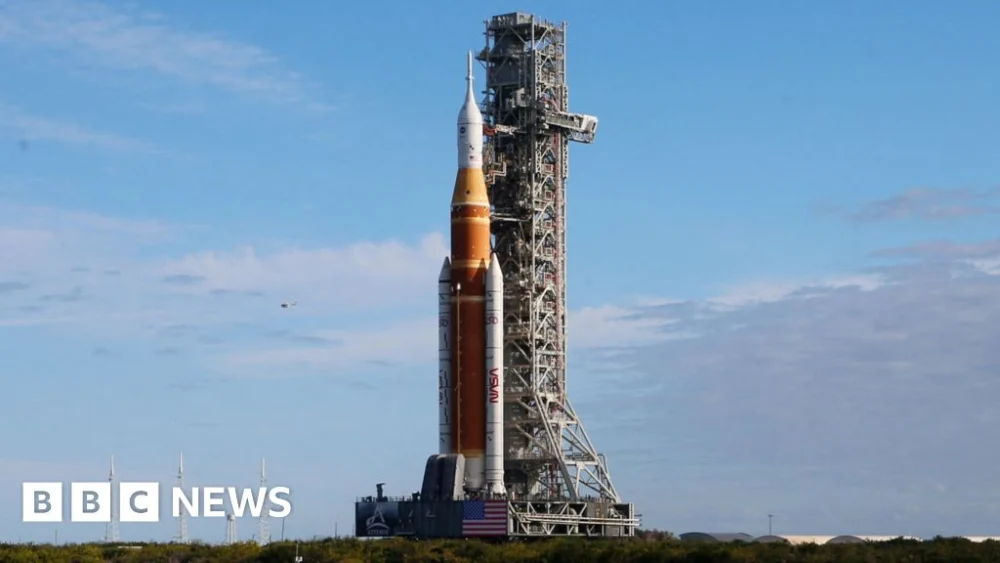
Nasa’s colossal Space Launch System (SLS) rocket, the most powerful rocket ever constructed, has been successfully rolled out to its launch pad at Cape Canaveral, Florida, marking a critical milestone in the final preparations for the first crewed mission to the Moon in over half a century. This monumental journey signifies the nearing launch of Artemis II, a mission poised to carry four astronauts around the Moon, laying essential groundwork for humanity’s sustained return to the lunar surface.
The towering 98-meter (322-foot) tall SLS, integrated with its Orion spacecraft, embarked on its deliberate 6.5-kilometer (4-mile) trek from the iconic Vehicle Assembly Building (VAB) to Launch Pad 39B. This intricate maneuver, which saw the fully stacked rocket moved vertically atop a massive crawler-transporter, unfolded over an extensive period of almost 12 hours. The VAB, a gargantuan structure originally built for the Apollo program, has once again served as the birthplace of lunar exploration, housing the assembly of this next-generation launch vehicle.
Upon its arrival at Launch Pad 39B, a site steeped in space history and used for Apollo and Space Shuttle launches, the SLS will undergo a series of exhaustive final tests, checks, and a crucial "wet dress rehearsal." This comprehensive rehearsal involves fueling the rocket and practicing countdown procedures to ensure all systems are fully operational and personnel are prepared for launch day. These rigorous evaluations are indispensable before the official go-ahead is given for the 10-day Artemis II mission. The mission’s primary objective is to send four astronauts on a circumlunar journey, venturing further into space than any human has traveled before.

Nasa has identified early launch windows, with the earliest possible blast-off slated for February 6th. Additional opportunities exist later in February, as well as in March and April, offering flexibility for mission planners. The precision and complexity of lunar missions demand specific orbital alignments, dictating these limited launch periods.
The dramatic rollout commenced at 07:04 local time (12:04 GMT) and concluded with the rocket’s secure placement at Launch Pad 39B at 18:41 local time (23:42 GMT). The entire spectacle was executed by the colossal crawler-transporter, a marvel of engineering that trundled along at a deliberate top speed of just 0.82 mph (1.3 km/h). Live coverage captured the slow, majestic progression, highlighting the immense scale of the rocket and the specialized equipment required to move it.
The Artemis II crew – Nasa astronauts Reid Wiseman (Commander), Victor Glover (Pilot), Christina Koch (Mission Specialist), and Canadian Space Agency astronaut Jeremy Hansen (Mission Specialist) – were present at the Kennedy Space Center, witnessing their future ride to the Moon being moved into position. Their presence underscored the tangible reality of the impending mission. In a matter of weeks, these four pioneering individuals will be strapped into the Orion spacecraft, perched atop the SLS, ready to embark on a journey that will rekindle humanity’s direct exploration of the lunar realm.
This mission marks a historic return to lunar space for a crewed mission, the first since Apollo 17 touched down on the Moon’s surface in December 1972. More than five decades have passed since humans last ventured beyond low Earth orbit, and Artemis II represents a pivotal step in Nasa’s ambitious program to establish a sustainable human presence on and around the Moon.
While Artemis II will not land on the Moon, its importance cannot be overstated. It is designed to thoroughly test the Orion spacecraft’s life support systems, propulsion, communication, and navigation capabilities in a deep-space environment, simulating the conditions of a lunar landing mission. The crew will perform various checks and maneuvers, ensuring the safety and functionality of the entire system before the subsequent Artemis III mission attempts a lunar touchdown. This methodical approach prioritizes crew safety and mission success.
Nasa has stated that the launch of Artemis III, which aims to land the first woman and the first person of color on the Moon’s south pole, will occur "no earlier than" 2027, with many experts suggesting 2028 as a more realistic timeframe. The delays reflect the inherent challenges and complexities of developing new deep-space exploration capabilities.
Christina Koch, who holds the record for the longest single spaceflight by a woman, expressed profound emotion upon seeing the rocket. "Astronauts are the calmest people on launch day," she reflected, "and I think… it feels that way because we’re just so ready to fulfil the mission that we came here to do, that we’ve trained to do." Her words encapsulate the dedication and focus of the crew.
Jeremy Hansen, the first Canadian to be assigned to a lunar mission, articulated his hope that Artemis II would serve as a profound source of inspiration globally. "The Moon is something that I’ve taken for granted. I’ve looked at it my whole life, but then you just glance at it and glance away," he said. "But now I’ve been staring at it a lot more, and I think others will be joining us and staring at the Moon a lot more as there will be humans flying around the far side and that is just good for humanity." His sentiment highlights the mission’s potential to re-engage public imagination with space exploration.

The initial two days of the Artemis II mission will be spent in Earth orbit, allowing the crew to conduct vital systems checks and prepare for their trans-lunar injection burn. "We’re going to be going into an orbit almost right away that is 40,000 miles out – like a fifth of the way of the Moon," Koch further elaborated to BBC News. "We will have the Earth out the window as a single ball, something none of us have seen in that perspective. And then we’re going to travel a quarter of a million miles away… we’re going to do a lot of science and operations along the way."
As they perform a lunar flyby, circling the far side of the Moon, the crew will dedicate approximately three hours to lunar observation. During this period, they will meticulously gaze at the lunar surface, capture images, and study its geology. This detailed reconnaissance will provide invaluable data for planning and preparing for future landings, particularly at the Moon’s south pole, an area of significant scientific interest due to the potential presence of water ice in permanently shadowed craters.
A crucial component of the Orion spacecraft, which will house the astronauts, is the European Service Module (ESM). This cylindrical module, positioned behind the crew capsule, is the European Space Agency’s (ESA) primary contribution to the Artemis mission and was meticulously built by Airbus in Bremen, Germany.
Sian Cleaver, a spacecraft engineer at Airbus, emphasized the ESM’s indispensable role: "The European Service Module is so important – we basically can’t get to the Moon without it. It provides the propulsion that Orion needs to get us to the Moon." She further explained its multi-faceted capabilities: "Its large solar arrays will generate all the electrical power for the craft. We’ve also got these big tanks full of oxygen and nitrogen, which are mixed to make air, and also water, so that we can provide everything that the astronauts need in the crew module to keep them alive on their journey." The ESM acts as the spacecraft’s engine room, providing power, propulsion, thermal control, and critical life support systems.

Inside their pristine cleanroom facilities, the Airbus team is already actively engaged in constructing additional ESMs for subsequent Artemis missions. Each module represents approximately 18 months of intensive assembly work, underpinned by thousands of engineering hours dedicated to its design and testing. The precision and reliability of every component are paramount. "We’ve got to get those astronauts to the Moon and then back again, completely safely," Cleaver stressed, highlighting the ultimate priority.
With the SLS rocket now firmly positioned on Launch Pad 39B, the dedicated Artemis team is working tirelessly around the clock to finalize preparations for lift-off. The Artemis program has encountered several delays over the years, stemming from technical complexities, development challenges, and funding adjustments. Consequently, Nasa is operating under a degree of public and political pressure to launch the astronauts as soon as feasible. However, the agency remains steadfast in its commitment to safety above all else.
John Honeycutt, chair of the Artemis mission management team, reiterated this unwavering stance: "I’ve got one job, and it’s the safe return of Reid and Victor and Christina and Jeremy. We’re going to fly when we’re ready… crew safety is going to be our number one priority." This statement underscores Nasa’s cautious and methodical approach to human spaceflight, ensuring that every system and procedure is meticulously verified before embarking on this historic journey back to the Moon. The arrival of the SLS at the launch pad marks a tangible step towards fulfilling humanity’s renewed ambition for lunar exploration, paving the way for a future where humans live and work on and around the Moon.



 Nakalama John
 George Anjay
 Ramos Leo
 atisusanti
 Roy Suryo