Nana Banana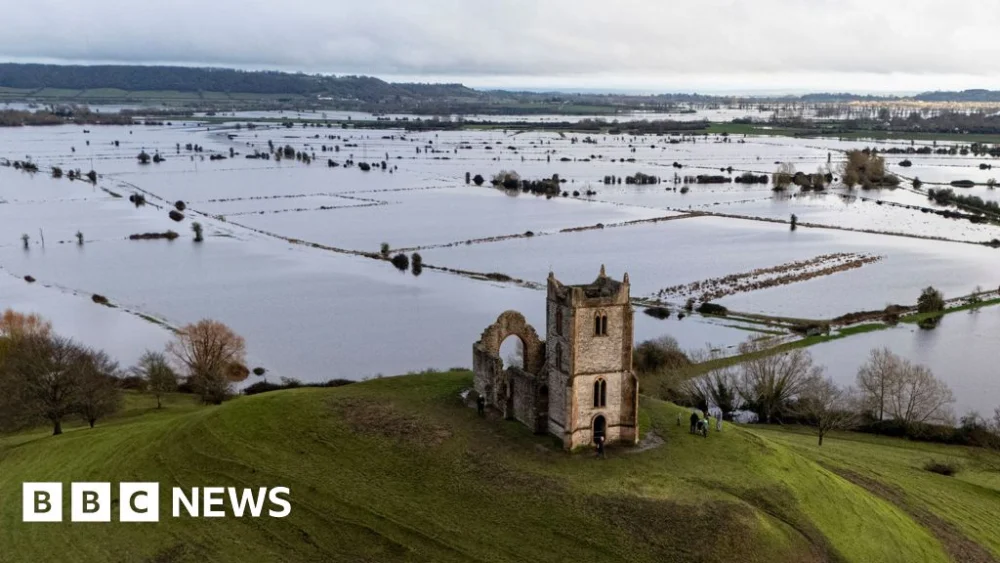
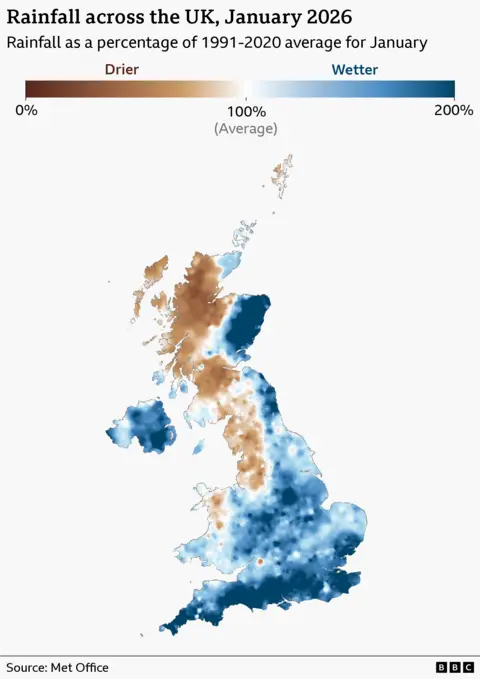
The United Kingdom is grappling with a stark reality as record-breaking rainfall continues to deluge areas from Cornwall to County Down, transforming once-rare flood events into increasingly common occurrences. This past January saw widespread areas experiencing their wettest on record, with the relentless downpours extending well into February, bringing significant disruption and raising urgent questions about the nation’s climate future. The immediate cause of the recent deluge has been identified as a persistent blocked weather pattern: a high-pressure system anchored over Scandinavia has effectively acted as a barrier, preventing the wet, Atlantic-driven weather systems from moving away, trapping moisture-laden air over the UK for extended periods.
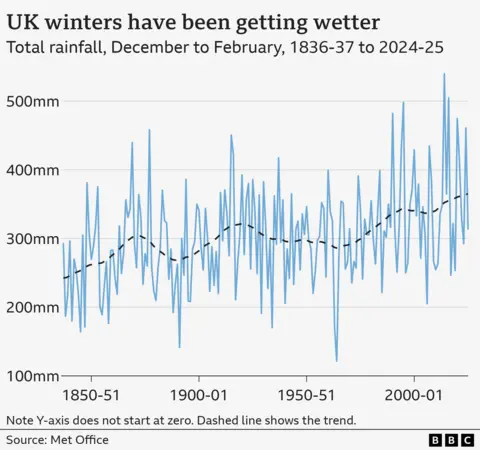
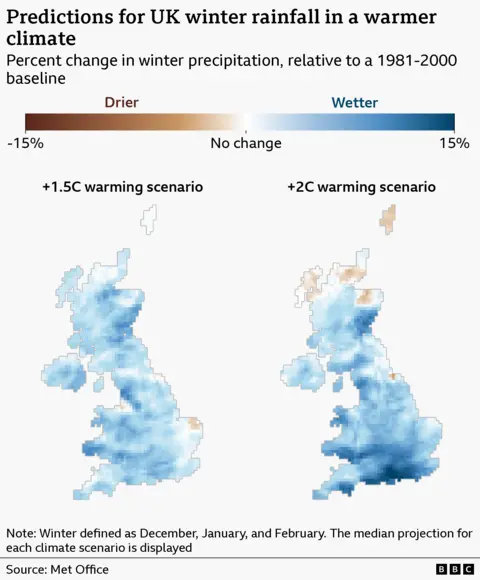
This pattern, however, is not merely a transient meteorological anomaly but a symptom of a deeper, long-term trend exacerbated by global warming. The Met Office’s analysis paints a concerning picture: at current levels of global warming, winters as wet as 2023/24, which were once considered "once in 80-year" events, have now become "once in 20-year" events. With further anticipated warming, this frequency is projected to escalate even more dramatically, posing profound and multifaceted impacts on the nation’s housing, transport networks, and critical food supply chains. The immediate human cost is palpable, as exemplified by a farmer in Somerset who recently shared his precarious situation with the BBC, living on a "knife edge" as his vital crops teetered days away from rotting in the pervasive floodwater.
The increasing frequency of such severe winter rainfall events is not a matter of chance. On a single Tuesday recently, over 100 locations across the UK were under active flood warnings, and the Environment Agency (EA) reported that more than 300 homes had already succumbed to the rising waters. This heavy and continuous rainfall echoes a discernible pattern observed over the last few years. According to the Met Office, an alarming six of the ten wettest winters since records began nearly 250 years ago have occurred within this century alone, signalling a significant climatic shift. While the UK’s rainfall patterns are naturally influenced by inherent variability, the undeniable trend towards wetter winters aligns precisely with the predictions from the country’s leading meteorological organisation.
The scientific consensus attributes this escalation to anthropogenic climate change. The sustained burning of fossil fuels like coal and oil over the past two centuries has released vast quantities of greenhouse gases, primarily CO2, into the atmosphere, leading to a measurable warming of our planet. The physics behind this phenomenon is straightforward yet impactful: for every 1°C increase in temperature, the atmosphere gains the capacity to hold approximately 7% more moisture. This increased moisture content directly translates into heavier, more intense rainfall events when weather systems pass over, contributing significantly to the observed deluges. Concurrently, sea level rise around the UK is also accelerating, a dual consequence of warmer oceans expanding thermally and melting glaciers and ice sheets adding volume to the seas. Since 1901, UK sea levels have risen by approximately 20cm. While this might seem incremental, when combined with extreme storm events and tidal surges, it critically exacerbates the risk and severity of coastal flooding, pushing inland waters further.
Looking ahead, the projections for future UK winters are even more stark. Currently, the UK typically experiences around seven days a year where rainfall exceeds 80mm – a threshold considered a heavy rainfall event. If 30mm of this falls within a single hour, it commonly triggers an immediate flash flooding warning. However, Met Office modelling indicates that if global temperatures surpass a 2°C increase above pre-industrial levels, this frequency of extreme rainfall days would rise to nine days annually. Critically, even with current global policies aimed at reducing emissions, the United Nations projects that global temperatures are still expected to increase by at least 2.5°C by the end of the century. This suggests that the UK is already locked into a future with more frequent and intense rainfall. As Professor Lizzie Kendon, head of climate projections at the Met Office, highlights, it’s not just the intensity but also the clustering of rainfall events that poses a significant threat. "That is really important," she explains, "because that can lead to successive rainfall events, [which] can lead to very saturated soils, and as we’re seeing currently in the UK, that can lead to exacerbated flooding as well." Saturated soils lose their capacity to absorb further water, leading to faster runoff and overwhelming rivers and drainage systems.
The tangible damage stemming from these increasingly wetter winters is immense, affecting foundational aspects of national life. Homes are at the forefront of the impact. The Environment Agency estimated in December that by 2050, a staggering one in four properties in the UK would be at risk from flooding. This was the first time the EA explicitly incorporated climate change impacts into its long-term flood risk assessments, underscoring the escalating nature of the threat. Regions such as the East Midlands, Yorkshire and The Humber, and south-east England are identified as particularly vulnerable hotspots. Compounding this risk, the UK government’s ambition to build 1.5 million new homes within this Parliament faces scrutiny, as reports indicate that in some parts of the country, more than 10% of these new residences are being constructed in designated flood-prone zones. This controversial practice places future homeowners at direct risk, often leading to uninsurable properties and immense personal hardship.
The transport infrastructure fares no better. A substantial third of the UK’s railway network is currently deemed at risk of flooding, leading to frequent cancellations, significant delays, and extensive damage to tracks, signalling systems, and bridges. Road networks are similarly affected, with key arterial routes often rendered impassable, disrupting commuters, supply chains, and emergency services. The economic cost of these disruptions, from lost productivity to repair bills, runs into billions of pounds annually.
Agriculture, a cornerstone of the nation’s food security, is under severe duress. The National Farmers Union (NFU) issued a stark warning to MPs in November last year, detailing the severe risks confronting the farming sector. Their communication underscored that farmers and growers are now experiencing both extreme droughts and devastating floods on an annual basis, with both phenomena severely impacting their ability to produce food. The wet winter of 2024, now recognized as the second wettest on record, inflicted an estimated £1 billion in losses on the sector from damaged crops alone. James Winslade, a third-generation beef and arable farmer from Somerset, vividly illustrates this plight. With over 90% of his farm submerged by recent rains, he faces the imminent loss of his crops to rot. "We can’t protect everywhere. There isn’t insurance for crop damage. We don’t get compensation," he lamented, adding that his father and grandfather never witnessed such sustained levels and recurrence of flooding in their lifetimes. The long-term impacts extend beyond immediate crop loss, encompassing soil degradation, delayed planting seasons, and increased disease risk for livestock.
While the UK boasts an extensive network of flood defences, their management is fragmented, involving a patchwork of organisations including farmers, water companies, and various charities, alongside the Environment Agency. The EA is directly responsible for maintaining approximately 100,000 flood defences, representing about half of the total. Worryingly, 9% of these are currently below their target condition, meaning they may not provide the intended level of protection. Each defence is assigned a critical score out of five based on its importance, highlighting the need for consistent maintenance. Further analysis by the BBC Shared Data Unit revealed an even more concerning trend: flood defences not maintained by the EA were found to be 45% more likely to be below their target condition, underscoring a systemic vulnerability in the national flood protection strategy.
The drive for increased development further exacerbates the flooding challenge. Concreting over natural surfaces for new housing estates or car parks prevents rainwater from being absorbed into the ground, instead channelling it rapidly into drains and rivers. These systems, often designed for historical rainfall patterns, become quickly overwhelmed, leading to breaches and widespread flooding. Implementing sustainable drainage systems (SuDS) and prioritising nature-based solutions, such as restoring floodplains and planting trees, are crucial steps towards mitigating these impacts by allowing water to be stored and released naturally.
An Environment Agency spokesperson, acknowledging the gravity of the situation, told the BBC: "As a result of climate change, we are seeing more flooding and extreme weather. Whilst it is sadly not possible to stop all flooding, the Environment Agency is committed to helping communities to adapt." The spokesperson highlighted the government’s flood programme, which plans a further £10.5 billion investment aimed at protecting 900,000 more properties by 2036. However, critics argue that while essential, this investment may still be insufficient given the accelerating pace of climate change and the continued development in high-risk areas. The question is no longer if wetter winters and frequent flooding will occur, but how comprehensively and urgently the UK adapts to this undeniable new climatic reality.


 George Anjay
 Ramos Leo