Nana Banana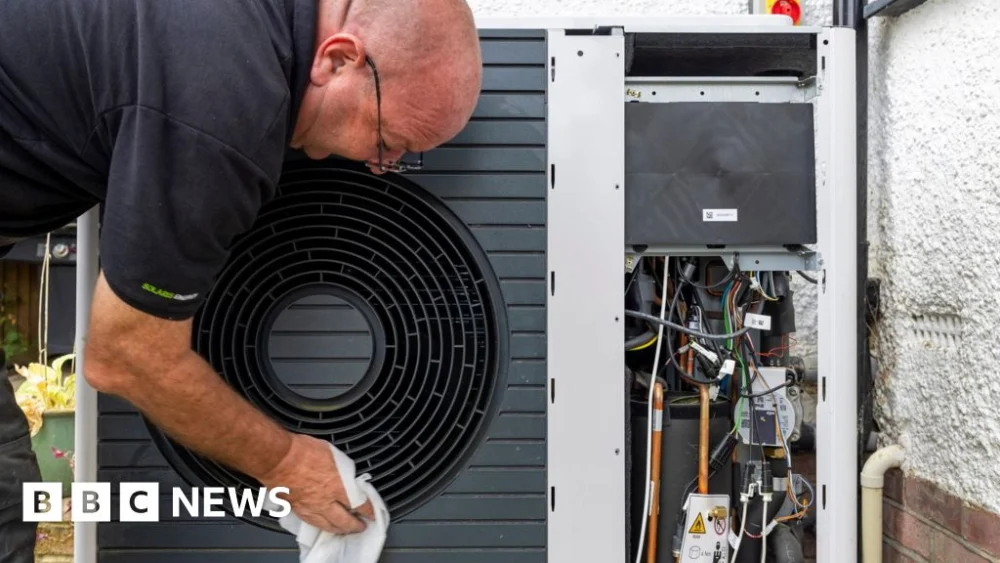
At their core, heat pumps are highly efficient electrical devices designed to warm buildings by absorbing and amplifying heat from natural sources: the air, the ground, or even water bodies. Unlike conventional boilers that generate heat through combustion, heat pumps simply move existing heat from one place to another, a process that is significantly more energy-efficient. This fundamental difference means they do not burn fossil fuels, making them crucial for achieving net-zero emissions goals, especially as the electricity grid increasingly relies on clean, renewable sources like wind and solar power.
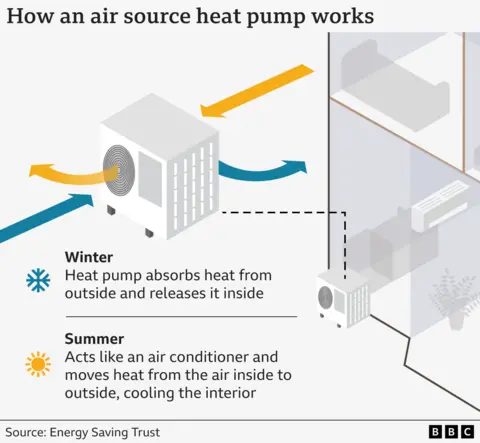
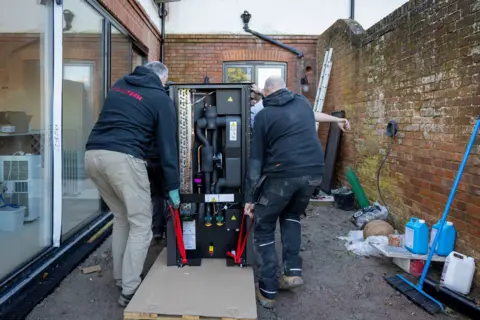
The most prevalent type, air source heat pumps (ASHPs), operate on a principle similar to a refrigerator, but in reverse. An outdoor unit, typically measuring around 1m x 1m x 0.4m, draws in ambient air. This air passes over an evaporator coil containing a refrigerant fluid. Even in cold temperatures, the refrigerant absorbs enough heat from the outside air to evaporate and turn into a low-pressure gas. This gas then flows into a compressor, where its pressure dramatically increases, causing its temperature to rise significantly. The hot, high-pressure gas then circulates to an indoor unit, where it condenses back into a liquid, releasing its amplified heat into the home’s heating system (radiators or underfloor heating) and hot water cylinder. The cooled refrigerant then passes through an expansion valve, reducing its pressure and temperature, ready to repeat the cycle. This thermodynamic process allows ASHPs to deliver multiple units of heat energy for every unit of electrical energy consumed, often achieving a Coefficient of Performance (COP) of 3-4 or higher.
While air source models are increasingly popular, ground source heat pumps (GSHPs) offer even greater efficiency due to the stable temperature of the earth beneath our feet. These systems require either a deep bore hole or a network of horizontal pipes buried in trenches across a larger area of land. A fluid circulating through these underground loops absorbs geothermal heat, which is then transferred to the heat pump unit inside the property. Although more expensive and complex to install due to the excavation work required, GSHPs typically provide higher, more consistent efficiencies throughout the year, as ground temperatures fluctuate less than air temperatures. The indoor components for both ASHPs and GSHPs include a heat pump unit, roughly the size of a gas boiler, and a hot water cylinder, with its size dependent on the household’s hot water demand.
Understanding the upfront investment is crucial for prospective owners. While exact figures vary widely based on property size, existing heating infrastructure, and specific heat pump type, a typical air source heat pump installation can range from £8,000 to £18,000 before any grants. Ground source systems are generally more expensive, often costing between £18,000 and £30,000 due to the significant groundwork involved. However, the UK government has implemented robust financial incentives to mitigate these initial costs. The flagship Boiler Upgrade Scheme (BUS) provides a substantial grant of £7,500 towards the installation of an air source or ground source heat pump for eligible homeowners in England and Wales. This grant is applicable to both existing homes and non-domestic buildings, provided the property has an eligible Energy Performance Certificate (EPC) issued within the last 10 years. Crucially, the government has extended the BUS until 2029/30, signalling a long-term commitment to its success.
A significant recent change to the BUS rules has removed the prior requirement for homes to have existing loft or cavity wall insulation to qualify for the grant. This move is designed to reduce upfront barriers to adoption, potentially saving homeowners around £2,500 in immediate costs. While this relaxation aims to accelerate installations, it’s important to note that a well-insulated home remains paramount for a heat pump to perform optimally and maximize energy savings. For low-income households and those residing in social housing, the government is extending £5 billion in funding through the Social Housing Fund and the Warm Homes Local Grant. Eligibility for these schemes typically requires the property to be privately owned or rented in England and possess an EPC rating between D and G. Scotland and Northern Ireland operate their own distinct schemes to enhance home energy efficiency, and the Warm Homes Plan will allocate additional funds to these devolved programmes, ensuring a UK-wide approach to green heating. Furthermore, the Warm Homes Plan also includes the Warm Homes Fund, which aims to provide low-interest and zero-interest loans for solar panels and domestic storage batteries for all households, with further details on access expected later this year. Those on low incomes will see these technologies covered as part of the existing Social Housing Fund and Local Grant.
The question of whether a heat pump can save money is complex, hinging on energy prices, household energy consumption, and the system’s efficiency. While electricity typically costs more per unit than gas, heat pumps use significantly less energy overall due to their high efficiency (COP). The Climate Change Committee (CCC), which advises the UK government on emissions reduction, projects that heat pumps could become cheaper to run than gas boilers in the long term. This potential for savings is further amplified by "heat pump friendly" energy deals, which often offer cheaper off-peak electricity tariffs, allowing homeowners to run their systems when electricity is less expensive. The synergy with renewable energy sources like solar panels and domestic battery storage is also a game-changer. By generating their own electricity, homeowners can drastically reduce their reliance on the grid, enhancing energy independence and cutting running costs. Nesta, a social charity, estimates that a combination of solar panels and a heat pump could lead to annual energy bill savings of nearly £1,000 for the average home.
Noise has historically been a concern for potential heat pump adopters. However, advancements in technology have significantly mitigated this issue. Older models could sometimes be noticeable, leading to planning permission requirements for units installed within one metre of a neighbour’s property. This rule has since been dropped by the government to accelerate the uptake of heat pumps. Modern devices are engineered for much quieter operation, with units now required to stay below a certain volume level, typically set at 42 decibels (dB). To put this into perspective, 42dB is comparable to the hum of a modern refrigerator or a quiet conversation, making them generally unobtrusive. Factors such as the unit’s placement, its specific design, and ambient background noise can influence perceived sound levels, but overall, noise is far less of an issue than it once was. Alongside noise regulations, rules regarding the size and number of heat pumps households can install have also been relaxed, further easing the path to adoption.
Despite these advancements and governmental support, the rate of heat pump installation in the UK lags considerably behind that of gas boilers and other major European countries such as France, Germany, and Italy. To meet the UK’s ambitious climate targets, the CCC asserts that installation rates need to surge to nearly 450,000 annually by 2030 and a staggering 1.5 million by 2035. The provided data illustrates a growth in government-supported installations across UK nations and regions between 2018 and 2024, with 2024 showing the highest numbers, reflecting the increasing momentum. However, this growth needs to be dramatically accelerated to meet the challenging targets. Scaling up requires addressing various challenges, including increasing public awareness, expanding the skilled installer base, and continuously driving down upfront costs.
In conclusion, heat pumps represent a critical technology in the UK’s strategy to achieve net-zero emissions and create more sustainable, energy-efficient homes. With robust government grants, technological improvements addressing concerns like noise, and the potential for significant long-term savings, these systems are poised to transform domestic heating. The ongoing commitment through the Warm Homes Plan and schemes like the Boiler Upgrade Scheme signals a clear direction towards a future where homes are heated cleanly and efficiently, contributing directly to a healthier planet and more affordable energy bills for households.



 George Anjay
 Ramos Leo