Nana Banana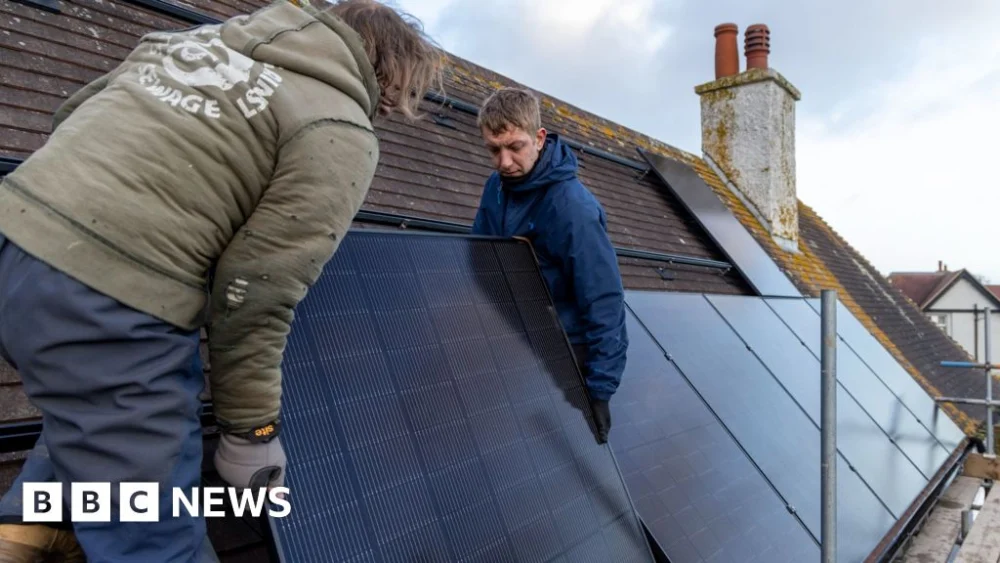
First mooted back in 2024 amidst a burgeoning "national emergency" of rising energy costs, the full details of the Warm Homes Plan have now been published, two years later. The government, led by the Labour Party, has articulated a vision for a "rooftop revolution," aiming to triple the number of homes equipped with solar panels and lift an estimated one million people out of fuel poverty. The core focus of the £15 billion investment, published on Wednesday, will be on funding the installation of solar panels, modern heat pumps, and crucial battery storage systems in homes across the country.
For homeowners, the plan outlines a combination of grants and accessible low-interest loans designed to mitigate the upfront expense of these green technologies. While the subsidies are substantial, the government acknowledges that able-to-pay households will likely still face additional costs. For instance, after receiving a government grant, the average homeowner might still pay around £5,000 for a heat pump. However, these investments are projected to yield considerable long-term savings. The government estimates that for an average three-bedroom semi-detached home, installing all three technologies – solar panels, a heat pump, and a battery – could result in annual energy bill savings of approximately £500. Independent analyses from social charity Nesta and green energy charity MCS Foundation suggest these savings could be even more significant, potentially exceeding £1,000 per year.
Energy Secretary Ed Miliband emphasised the plan’s role in addressing the broader cost of living crisis, describing it as "the biggest issue the country faces." He highlighted that "upgrading homes is a crucial part of getting bills down" and articulated the government’s desire to democratise access to these technologies. Speaking to BBC Breakfast, Miliband stated the move was aimed at "expanding the choices that people have, so something like a heat pump or a solar panel isn’t just in the reach of the wealthiest."
The Warm Homes Plan has garnered strong support from various sectors. The energy industry, workers’ unions, and the finance sector have largely welcomed the long-term financial commitment, viewing it as essential for instilling confidence and driving private investment into the green technology market. Dhara Vyas, chief executive of trade body Energy UK, affirmed, "£15 billion is a substantial commitment; it provides certainty to investors and businesses in the energy market." Camilla Born, CEO of Electrify Britain, a joint campaign by Octopus and EDF to promote electric heating, also expressed approval, acknowledging the plan’s potential for long-term bill reduction but cautioned that "the bad side is that it is a plan, and we need delivery." While some schemes are already operational and distributing grants, the specifics of how and when new funding will reach households are still being finalised, with "further engagement with the finance sector" slated for the current year.
However, the plan has not been without its critics. Reform deputy leader Richard Tice vehemently criticised the initiative, labelling it "a scandalous waste of up to £15bn of taxpayers’ cash primarily buying Chinese made solar panels, batteries and heat pumps, that is bad for British industry." This concern is underpinned by data from HMRC, which shows that two-thirds (68%) of the solar panels imported by the UK in 2024 originated from China. In response to such criticisms, Ed Miliband stated that the government was actively working to "diversify" supply chains and "unwind that concentration" through strategic investments within the UK.
Claire Coutinho, the Conservative Shadow Energy Secretary, raised concerns about the ongoing financial burden on households. She argued, "Unless the Government gets serious about cutting electricity bills now, many of these taxpayer-funded schemes will saddle households with high ongoing running costs every single year." Similarly, the Liberal Democrats criticised the plan for not going far enough, claiming it meant "no effective fuel poverty programme in place this winter."
A notable shift in the Warm Homes Plan is the downgrading of insulation funding. The original plan had placed a stronger emphasis on insulation as a cost-effective method to reduce heat loss from the UK’s notoriously leaky housing stock. However, a history of controversy surrounding government-funded insulation schemes, particularly the ECO program, which faced issues with botched installations, has led to this scheme not being extended. Aadil Qureshi, CEO of Heat Geek, a company that retrains heating engineers for heat pump installation, supported this decision, arguing that refocusing on green tech offered better value for government money. Unlike insulation, which is a mature technology, heat pumps are still in their relative infancy and require government support to catalyse industry growth. Qureshi explained, "[The plan] allows the industry to commit, to double down – it allows investors, manufacturers to say let’s keep investing to get to a certain point where it is equal with the hydrocarbon alternative."
The government’s overarching goal is to transition households away from traditional oil heaters and gas boilers towards electrical heat pumps, powered increasingly by renewable energy. This transition is crucial for cutting the country’s planet-warming emissions, with home heating currently accounting for approximately 18% of these emissions. Ed Miliband has consistently highlighted the UK’s "Achilles heel" – its dependence on fossil fuels – especially in the wake of significant price fluctuations following Russia’s invasion of Ukraine. He stressed that clean power is the only sustainable way to lower energy bills, telling Radio 4’s Today programme that the mission for clean power is vital because "we are swapping reliance on imported gas… for homegrown clean power where we control the price."
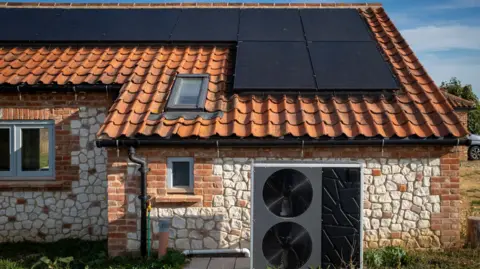
However, the UK currently grapples with some of the highest electricity bills in Europe, a consequence of network upgrades, government taxes, and the impact of wholesale gas prices on the electricity market. This explains why, despite being three to four times more efficient than gas boilers, heat pumps can sometimes be equally or more expensive to run without supplementary measures. This challenge was echoed by Chris and Penny Harcourt, a retired couple from Stowmarket who installed a heat pump two years ago. While they described it as the "best update we have done in our house for 20 years," they noted that it was expensive to run until they also installed solar panels, which significantly reduced their costs. This real-world experience underscores the government’s strategy of encouraging the "trio" of low-carbon technologies: heat pumps, solar panels, and batteries. By combining these, more of the heat pump’s electricity demand can be met by home-generated solar energy, reducing reliance on the grid and driving down overall running costs.
Not all voices within the green energy sector are in complete agreement with every aspect of the plan. Dale Vince, CEO of energy company Ecotricity, lauded the new funding for solar power but expressed reservations about the high level of subsidy for heat pumps. While acknowledging their role, Vince questioned their efficacy as a national solution for lowering heating costs and greenhouse gas emissions, arguing, "Solar panels give us the biggest bang for buck there is no doubt about that – cheapest to install and most productive in terms of bringing down energy bills. Heat pumps sit at the other end of that scale. We could put solar panels on 10 million rooftops or heat pumps in one million homes."
Beyond homeowners, the Warm Homes Plan also addresses the rights of renters. While the installation of low-carbon technology will primarily be available to homeowners and social housing tenants, the plan incorporates recent reforms to renters’ rights. From 2030, landlords will be mandated to ensure their rental properties achieve a minimum Energy Performance Certificate (EPC) score of C, an upgrade from the current requirement of E. Acknowledging existing issues where heat pump installations can paradoxically downgrade an EPC score due to the assessment being based on estimated running costs rather than true energy efficiency, the government has committed to announcing changes to the assessment process later this year.
The industry had also eagerly awaited updated efficiency requirements for new builds, known as the Future Homes Standard. Although these will be published in the coming months, the plan explicitly confirmed that "under these standards, new homes will have low-carbon heating, high levels of energy efficiency and solar panels by default," quashing earlier concerns among environmentalists that the solar panel requirement might be dropped. Jess Ralston, Energy Analyst at the Energy and Climate Intelligence Unit (ECIU), remarked that these decisions have been a long time coming. "That timelines are being pushed back is likely to be frustrating for those who are still colder and poorer in shoddy rental homes, but the public overwhelmingly back better standards for new builds so should be encouraged to see new requirements on the house builders at long last," she said. With additional reporting by Miho Tanaka, this comprehensive plan represents a significant stride towards a greener, more energy-secure future for UK households, though its successful implementation and the balancing of various interests will be key to its ultimate impact.



 George Anjay
 Ramos Leo