Nana Banana
A fierce global scramble is underway as nations race to secure the critical minerals and rare earth elements essential for everything from the smartphones in our pockets to the electric vehicles powering the green energy transition. These vital raw materials are the bedrock of modern technology and future economic growth, making their reliable supply a paramount concern for governments worldwide. The urgency of this quest has been underscored by leaders like former US President Donald Trump, who prioritized access to these minerals, even exploring potential mining deals in regions like Greenland and Ukraine as part of a broader strategy to bolster American resource independence. However, despite a global distribution of reserves, it is China that largely dominates the complex processing stages, making the world heavily reliant on Beijing for usable supplies of many of these indispensable resources.
Critical minerals are defined by governments as those raw materials deemed vital for their economy or national security, but which face a significant risk of supply disruption. This dual criteria – economic importance and supply vulnerability – determines their "critical" status. Their criticality stems from their unique physical and chemical properties that make them indispensable for a vast array of high-tech applications, often with no viable substitutes. The demand for many of these minerals is projected to soar in the coming decades, driven by the global shift towards renewable energy, advanced manufacturing, and digitalization.
Some of the common critical minerals expected to see the biggest growth in demand include:
- Lithium: A lightweight metal crucial for rechargeable batteries in electric vehicles (EVs), laptops, and mobile phones.
- Cobalt: Essential for cathodes in lithium-ion batteries, as well as in superalloys for jet engines and medical implants.
- Nickel: Used in EV batteries, stainless steel, and various alloys for its strength and corrosion resistance.
- Graphite: A key component in battery anodes and a material for advanced lubricants and fuel cells.
- Copper: Fundamental to electrification, used extensively in wiring, power generation, and EV motors due to its excellent conductivity.
- Manganese: Primarily used in steel production, but also increasingly important for battery chemistries.
- Platinum Group Metals (PGMs): Such as platinum, palladium, and rhodium, which are vital as catalysts in automotive emissions control and various industrial processes.
The specific list of critical minerals can vary significantly between nations, reflecting their individual geological endowments, industrial strengths, and strategic priorities. For example, a country with a robust automotive sector might prioritize battery metals, while one focused on aerospace might emphasize high-performance alloys.
Rare earth elements (REEs) frequently appear on the critical minerals lists of many countries due to their unique properties and widespread high-tech applications. This group consists of 17 elements: the 15 lanthanides (lanthanum to lutetium) on the periodic table, plus scandium and yttrium. Despite their name, rare earth elements are not geologically rare; for instance, neodymium is found at approximately 20 parts per million in the Earth’s crust, making it more abundant than silver and comparable to copper, which is found at 27 parts per million. The "rarity" comes from their challenging and often environmentally intensive extraction and processing, as they are rarely found in high concentrations that are economically viable to mine.
These elements possess distinctive electrical, magnetic, and optical qualities that make them irreplaceable in various advanced technologies. They are vital for microchips, which are the brains of almost every modern electronic device, from defence systems and healthcare equipment to consumer electronics and renewable energy infrastructure.
- Neodymium and Dysprosium: Crucial for creating powerful, lightweight permanent magnets used in electric vehicle motors, wind turbine generators, and precision-guided munitions.
- Europium and Terbium: Used in phosphors for flat-screen displays, energy-efficient lighting, and medical imaging.
- Cerium and Lanthanum: Act as catalysts in petroleum refining, automotive catalytic converters, and as polishing agents for glass.
- Yttrium: Used in lasers, superconductors, and as a component in certain alloys.
The unique properties of rare earths, such as their ability to withstand extreme temperatures, conduct electricity efficiently, or emit specific wavelengths of light, make them indispensable for miniaturization and performance enhancement in critical technologies.
While critical minerals are distributed globally, some countries possess particularly large reserves, and even fewer have the infrastructure to process them. For rare earth elements, China is estimated to hold 44 million tonnes of reserves, significantly more than Brazil with 21 million tonnes and Australia with about six million tonnes. Beyond rare earths, Australia is a leading global producer of iron ore, gold, zinc, nickel, cobalt, and lithium. Indonesia accounts for half of the global production of nickel, while Chile and Argentina form part of the "lithium triangle" alongside Bolivia, holding vast brine reserves. The Democratic Republic of Congo (DRC) is the dominant source of cobalt, supplying over 70% of the world’s needs. This geographical concentration of reserves creates inherent vulnerabilities in global supply chains.
However, the mere presence of minerals beneath the Earth’s surface is only one piece of the puzzle; ease of access and, critically, the capacity to process them into usable forms are equally, if not more, important. Many countries lack the sophisticated and often environmentally intensive infrastructure required to refine raw ores into high-purity metals and chemical compounds. For example, while silicon metal is mined in over 30 countries, a UK critical minerals assessment highlighted that only three nations possess the capability to process it into the polysilicon used in microchips, underscoring a significant bottleneck.
It is in this crucial processing stage that China has established a near-monopoly. Beijing dominates the refining of many critical minerals, including rare earths, lithium, and cobalt. For some rare earth elements, China is responsible for more than 95% of the global processing capacity. This dominance is not accidental but the result of decades of strategic foresight and state-backed investment. As Bob Ward, from The London School of Economics (LSE) Grantham Research Institute on Climate Change and the Environment, observed, China recognized the immense growth potential in green energy technologies over a decade ago and "strategically pursued" the development of processing capabilities.
This calculated strategy has left the United States, Europe, and other industrialized nations highly reliant on China, exposing them to significant economic and national security vulnerabilities. A 2023 report by a US Government Select Committee warned that failure to shore up its critical minerals supply chains could cause "defense production to grind to a halt and choke off manufacturing of other advanced technologies." Similarly, in 2025, the European Central Bank noted China’s "pivotal" role in the rare earth supply chain, highlighting "vulnerabilities to geopolitical disruptions."
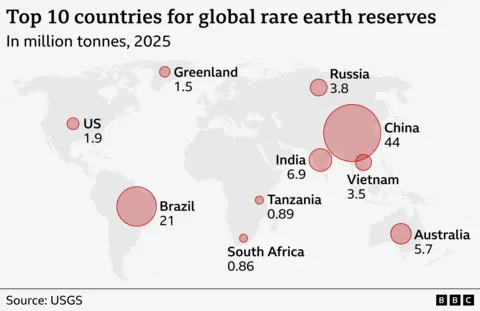
In response, countries are actively seeking to reduce this dependency. President Trump’s administration made bolstering US mineral production a priority, culminating in a critical minerals deal with Australia in October 2025. At the time, Trump declared, "In about a year from now, we’ll have so much critical mineral and rare earths that you won’t know what to do with them," reflecting the ambition to rapidly expand domestic capabilities. However, even with significant rare earth mineral reserves (just over 2% of the global supply, according to the US Geological Survey), establishing comprehensive processing facilities takes years, demanding massive capital investment, skilled labor, and stringent environmental compliance.
Gracelin Baskaran, director at the Centre for Strategic and International Studies think tank, aptly summarized the challenge: "No single country currently possesses the financial resources or technical capabilities to independently outpace China’s dominance." China’s competitive advantage has also been bolstered by historically lower environmental standards around its mining and processing activities, which have allowed it to keep production costs significantly lower than competitors. BBC News has recently documented the severe environmental toll of these practices, uncovering toxic waste ponds, widespread deforestation, and soil erosion at rare earth mines in Northern China. These environmental and social costs, which often include human rights concerns in other regions, such as artisanal cobalt mining in the DRC, are externalized and contribute to China’s cost advantage.
The global response now involves a multi-pronged approach: investing in domestic mining and processing where feasible, diversifying supply chains through "friend-shoring" with allied nations (like Australia, Canada, and Vietnam), promoting recycling and circular economy initiatives, and funding research into alternative materials and substitution technologies. The race for critical minerals is not just an economic competition; it is a strategic imperative shaping geopolitical alliances and the future of global technology and energy security.



 Roy Suryo
 George Anjay
 Ramos Leo