Nana Banana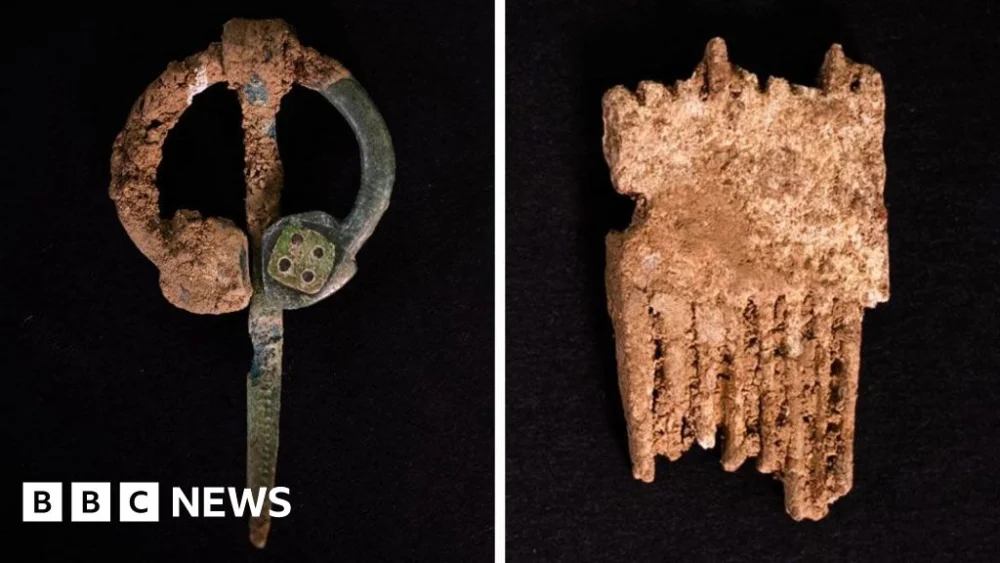
For four years, archaeologists have been meticulously excavating the site within the historic grounds of Fonmon Castle, nestled near the bustling Cardiff airport runway in the Vale of Glamorgan. This strategic location, overlooking the Bristol Channel, was likely significant for trade and communication during the 6th and 7th centuries, a period often referred to as the Early Medieval or ‘Dark Ages’ in Britain. So far, the team has unearthed 58 human skeletons, remarkably well-preserved due to the limestone bedrock into which their shallow graves were cut. The most striking feature of this discovery is the overwhelming demographic: nearly all of the individuals identified thus far are women. This unusual gender imbalance has been a central puzzle for researchers, hinting at a specialized community rather than a typical village or family burial ground.
While osteological analysis of the bones and teeth reveals that these individuals endured challenging lives, marked by physical exertion and dietary limitations common for the era, the objects buried alongside them tell a contrasting story of unexpected wealth and luxury. The juxtaposition of hard living and refined possessions has further deepened the mystery surrounding the identity and purpose of these women.
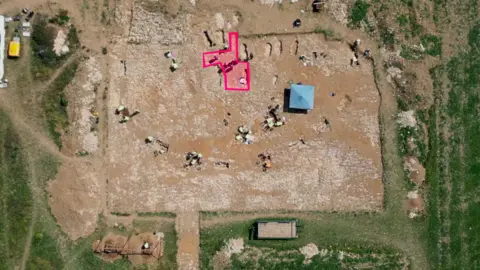
The latest excavation season has yielded a significant breakthrough: the faint but distinct outline of what appears to be a small, stone-built structure at the heart of the cemetery. Dr. Andy Seaman, an archaeologist from Cardiff University and the lead researcher on the dig, suggests this could be a crucial piece of the puzzle. "It’s producing fragments of building stone, so it might be structural. We might be thinking of a small shrine or a chapel," he explains, adding, "I do think that we have a site which may be an early religious community." Such a structure would have served as a focal point for spiritual life, reinforcing the emerging hypothesis.

The placement of this potential building within the cemetery is particularly telling. Graves are clustered densely around its inferred perimeter, indicating a strong desire among the deceased, or their community, to be interred as close as possible to this sacred feature. So intense was this desire, according to Cardiff University archaeologist Tudur Davies, that some graves contain multiple individuals. "It’s a highly desired location for people to be buried in," he notes. "Sometimes two, three, four individuals have been buried on the same spot, again and again. There doesn’t appear to be as much of a taboo over putting bodies in the same place and just moving those still there to one side." This practice suggests a community bound by strong collective identity and spiritual devotion, prioritizing proximity to the sacred over individual grave space.
The artifacts recovered from the site provide a rich tapestry of information about the daily lives and social standing of these women. Among the most exquisite finds are several small, coloured glass beads, each measuring approximately 3mm across. These miniature delights display a vibrant spectrum of hues – dark red, orange, light blue, yellow, and green – testament to sophisticated craftsmanship and access to diverse materials. Such beads could have been intricately stitched onto clothing, perhaps as decorative embellishments on tunics or cloaks, or strung together to form necklaces or bracelets. Their presence suggests a penchant for personal adornment and possibly an indicator of status or religious symbolism. Given the difficulty of producing such finely worked glass in early medieval Wales, these beads might also point to trade connections, perhaps with Anglo-Saxon kingdoms or even continental Europe, signifying the community’s integration into wider networks of exchange.

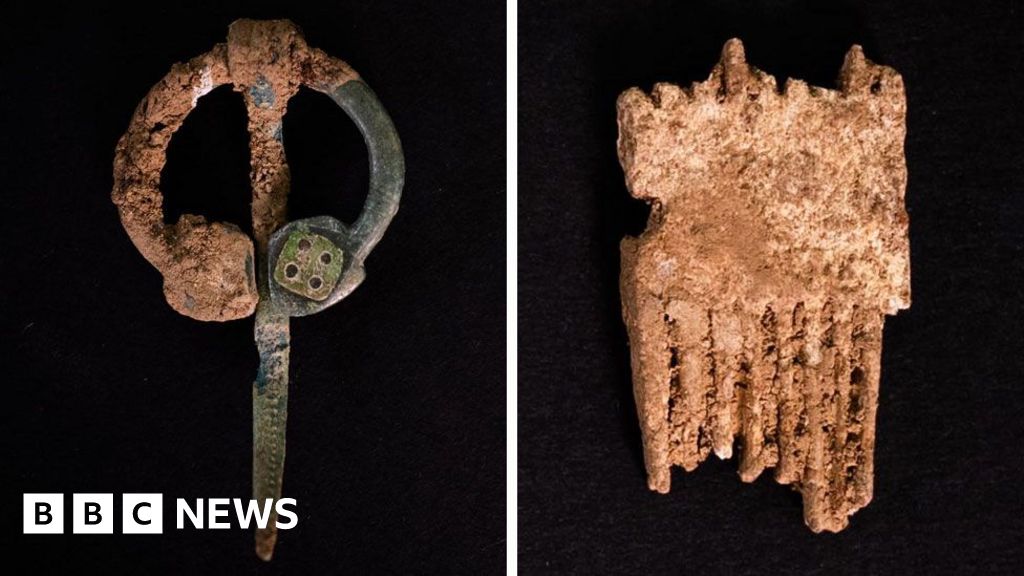
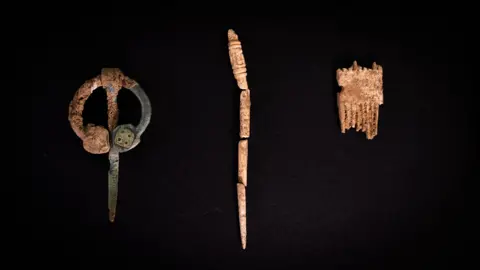
Further showcasing the community’s refined taste and connections is an ornate copper brooch, currently undergoing meticulous conservation at Cardiff University’s lab. Conservator Nicola Emmerson, painstakingly removing centuries of accumulated dirt, speculates on its original grandeur. "We’d have to do some more analysis, but it’s probably bronze," she states. "Also, we think it was possibly gilded, which would be a coating of gold over the top." The brooch’s terminals, she explains, were adorned with green enamel, creating a striking contrast with the metallic base. "This would have been a very decorative brooch. I think it’s a very special find for the site," Emmerson concludes, highlighting its significance as a status symbol or a prized personal possession, perhaps even a votive offering.
Alongside these glittering items, the archaeologists have also unearthed objects reflecting daily life, yet crafted with considerable skill. A bone pin, intricately decorated with a detailed pattern, and a comb carved from antler speak to both practical needs and an appreciation for aesthetics. These items, while functional, reveal the care and artistry invested in personal effects, even in what might have been an ascetic environment. Fragments of glassware, distinct from the beads, have also been found, suggesting the use of glass vessels for eating or drinking, another indicator of relative prosperity or connections to trading routes.
Crucially, the presence of domestic items alongside the burials paints a picture of a living, breathing community, not merely a graveyard. Dr. Seaman emphasizes this point: "We have a quern stone for grinding flour for bread. We’ve got pottery and glass for eating and drinking." These everyday tools strongly suggest that the individuals buried here were part of a self-sustaining settlement, rather than simply being brought from elsewhere for burial. "It’s clearly not just a place for the dead. There’s a living community here as well," he asserts. This living community, Seaman theorizes, was likely enclosed, deliberately separating itself from the wider secular society, a characteristic often associated with early monastic or religious settlements. This enclosure would have provided a sanctuary for spiritual practice, communal living, and perhaps a degree of protection in a turbulent era.
Despite these significant advancements, the medieval puzzle still holds several unanswered questions. While the vast majority of skeletons are female, the remains of a few men and children have also been identified. Who were these individuals? Were the men clergy, benefactors, or perhaps family members of the women? Were the children related to the women, perhaps orphans cared for by the community, or children of those who served the community? Their presence, while minor, adds complexity to the "female religious community" hypothesis, suggesting a nuanced social structure within the enclosure.
Perhaps the most chilling and perplexing discovery involves two women found buried in a ditch, one with her hands and feet tied. This stark contrast to the careful, often multi-person burials surrounding the central building raises profound questions about social hierarchy, punishment, and deviance within the community. What transgressions could have led to such a dishonorable interment? Was it a form of punitive justice, or did these individuals fall outside the community’s accepted norms for other reasons? This grim detail serves as a powerful reminder that even in a seemingly pious community, the complexities of human society, conflict, and justice were ever-present.
The team’s ongoing research aims to understand if this site represents an early example of Christianity in Wales. "It’s a period where the history is not yet written," Dr. Seaman notes, underscoring the scarcity of archaeological evidence for early Christian sites in the region. "We don’t really understand early church sites… how they functioned, what they looked like, how they were organised." The discovery at Fonmon Castle offers an unparalleled "exciting opportunity" to shed light on this formative period of Welsh history, particularly concerning the roles of women in the nascent church. Early Christian communities, often referred to as ‘Celtic Christianity’ in this context, operated differently from later monastic orders, and this site could provide crucial insights into their unique structure and daily life. The excavations are slated to continue later this year, promising further revelations that could rewrite our understanding of medieval Wales and the enduring mystery of its pioneering women.

 Ramos Leo
 atisusanti
 Roy Suryo
 George Anjay