Nana Banana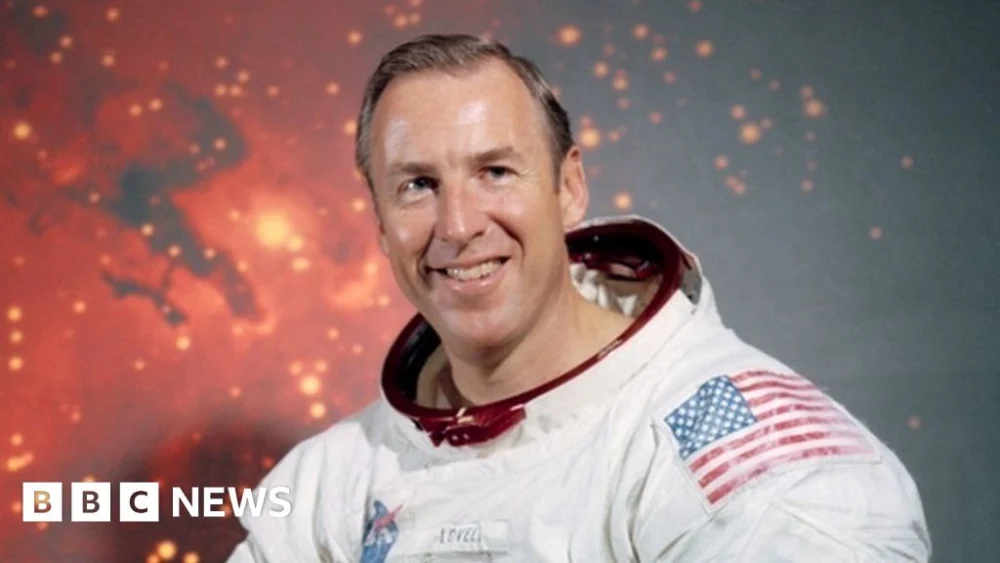
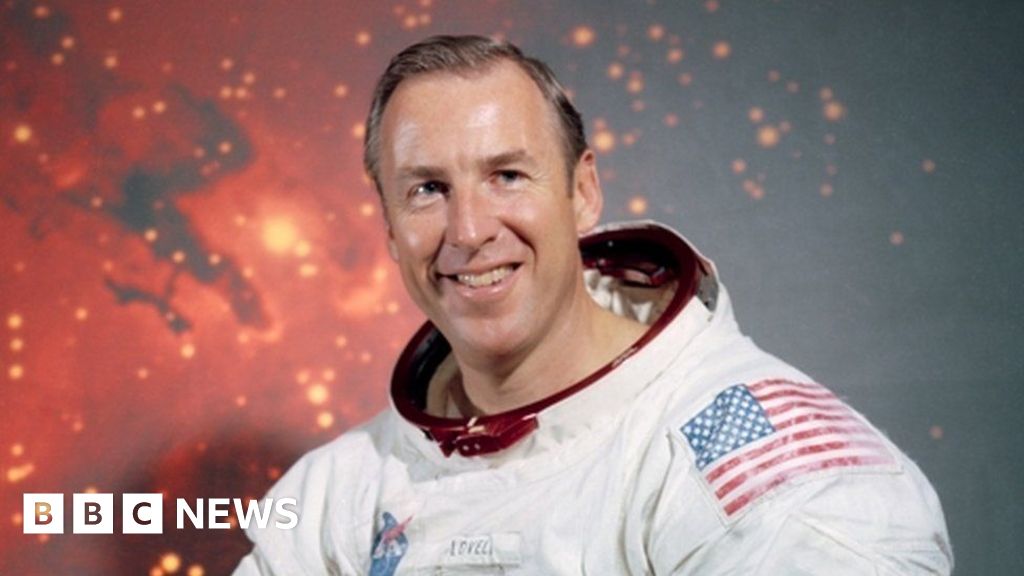
Astronaut Jim Lovell, a towering figure in the annals of space exploration who famously guided the imperiled Apollo 13 mission safely back to Earth in 1970, has passed away at the age of 97. His death marks the end of an era, leaving behind a legacy of unparalleled courage, ingenuity, and unwavering leadership in the face of cosmic peril. NASA, in a statement acknowledging his profound impact, highlighted how Lovell and his crew "turned a potential tragedy into a success," transforming a near-catastrophe into one of humanity’s most compelling tales of survival.
The Apollo 13 mission, an audacious attempt to land on the Moon, was aborted after an explosion onboard the spacecraft, Odyssey, while it was hundreds of thousands of miles from Earth. The world watched with bated breath as Lovell and his two fellow astronauts, Jack Swigert and Fred Haise, battled impossible odds. Their eventual splashdown into the Pacific Ocean became an indelible image, etched into the collective memory as one of the most iconic moments in the history of space travel and a testament to human resilience.
Lovell’s career was marked by groundbreaking achievements even before the Apollo 13 crisis. He was also a pivotal member of the Apollo 8 mission, the first human flight to orbit the Moon. This made him the first man to journey to the Moon twice, a remarkable feat, though fate dictated he would never actually land on its surface. Acting NASA head Sean Duffy lauded Lovell’s contributions, stating that he had helped the US space program to "forge a historic path," inspiring generations with his pioneering spirit.
His family, in a poignant statement, reflected on his enduring character: "We will miss his unshakeable optimism, his sense of humor, and the way he made each of us feel we could do the impossible. He was truly one of a kind." The man who portrayed Lovell in the acclaimed 1995 movie Apollo 13, Academy Award-winner Tom Hanks, also paid tribute. Hanks called Lovell one of those extraordinary individuals "who dare, who dream, and who lead others to the places we would not go on our own." In an Instagram statement, Hanks emphasized that Lovell’s many voyages "were not made for riches or celebrity, but because such challenges as those are what fuels the course of being alive."
Teenage Rocket Maker
The seeds of Jim Lovell’s extraordinary destiny were sown in a Wisconsin field one Saturday when he was just 16. With the surreptitious help of his science teacher, he had meticulously crafted a makeshift rocket from a heavy, three-foot tube. Having somehow acquired the volatile ingredients for gunpowder – potassium nitrate, sulphur, and charcoal – he donned a welder’s helmet for protection. He packed the crude device with powder, struck a match, and ran for his life. The rocket ascended 80 feet into the air before detonating in a fiery burst. A slight miscalculation in the chemical mixture, and young Jim could have been blown to pieces. For James Arthur Lovell Jr., born on March 25, 1928, this was far more than a childish lark; it was the audacious first step in a lifelong quest to conquer the skies and beyond, a dream that would eventually see him become an American hero.
His early life was shaped by challenge. When he was five, his father died in a car accident, leaving his mother, Blanche, to work tirelessly to provide for them. University seemed an impossible dream due to financial constraints. The US Navy, hungry for new pilots in the post-World War Two era, offered a path. Though not directly involved in rocketry, it promised flight, a passion that burned bright within him. Lovell enrolled in a program that funded his college education while training him as a fighter pilot. Two years into his studies, he made a calculated gamble, transferring to the Navy Academy at Annapolis, on Chesapeake Bay, hoping to align his career more closely with his burgeoning interest in rockets. This decision proved fortuitous; months later, the Korean War erupted, sending many of his former fellow apprentice pilots to Southeast Asia, where many never completed their education.
Despite strict rules against marriage and discouraging girlfriends at Annapolis, Lovell nurtured a clandestine romance with Marilyn Gerlach, his high school sweetheart whom he had shyly asked to the prom. Their bond endured, and just hours after his graduation in 1952, the newly commissioned Ensign Lovell married her. Their partnership would last for over 70 years, a testament to their enduring love, until Marilyn’s passing in 2023.
Lovell’s devotion to rocketry was evident in every choice. His thesis at the Navy Academy delved into the then-unheard-of topic of liquid-fuel engines. He yearned to specialize in this pioneering technology, but the Navy had other plans, assigning him to fly Banshee jets off aircraft carriers at night—a perilous, high-wire occupation for the daring. Yet, for Lovell, even this wasn’t enough; his gaze remained fixed on the stars.
Kennedy’s Men
In 1958, the burgeoning space age offered a new avenue. Lovell applied to NASA’s Project Mercury, America’s ambitious endeavor to place a man in Earth orbit. He was one of 110 elite test pilots considered, but a temporary liver condition unfortunately disqualified him. Undeterred, he tried again four years later. After enduring a battery of grueling medical and psychological tests, NASA announced its "New Nine" in June 1962. This cadre of exceptional individuals was tasked with fulfilling President Kennedy’s monumental pledge to land American boots on the Moon. It was the most elite group of flying men ever assembled, including future legends like Neil Armstrong, John Young, and, finally realizing his childhood dream, Jim Lovell.
Three years later, Lovell was ready for his first voyage into the cosmos. Aboard the two-man Gemini 7, with fellow astronaut Frank Borman, he embarked on a mission critical for future lunar aspirations: to determine if humans could endure two weeks in space. Their successful completion of this endurance record paved the way for longer missions. Lovell’s next flight, Gemini 12, saw him in command alongside space rookie Buzz Aldrin. This mission proved that astronauts could effectively work outside a spacecraft, with Aldrin performing crucial extravehicular activities (EVAs), spending five hours photographing star fields and demonstrating the dexterity needed for lunar exploration.
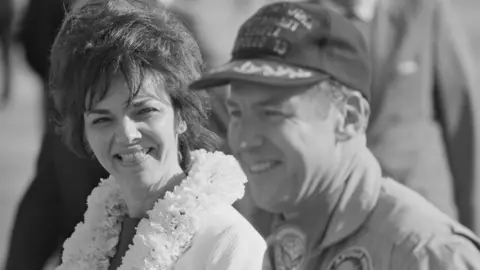
Then came Apollo 8. The crew, comprising Lovell, Borman, and William Anders, would be the first to travel beyond low Earth orbit and enter the gravitational pull of another celestial body. It was, by far, NASA’s most dangerous mission yet, pushing the boundaries of human endurance and technological capability.
‘Get the Camera’
The colossal Saturn V rocket, a marvel of engineering, propelled Lovell, Borman, and Anders out of Earth’s atmosphere at a staggering 25,000 mph (40,233 km/h). As navigator, Lovell carried a sextant, a celestial navigation tool, as a critical backup—a prudent measure in case the advanced onboard computers failed and they needed to plot their own course home. Sixty-eight hours after a thunderous launch, they achieved their objective. The engines fired, and Apollo 8 gracefully slid silently behind the Moon. A crackle in their headsets signaled the fading radio signal to Mission Control, then complete silence.
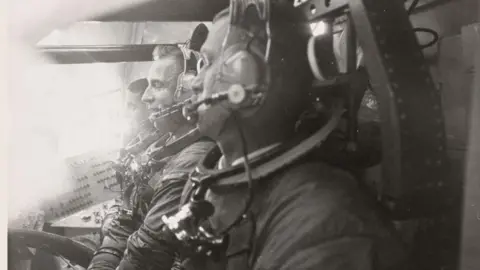
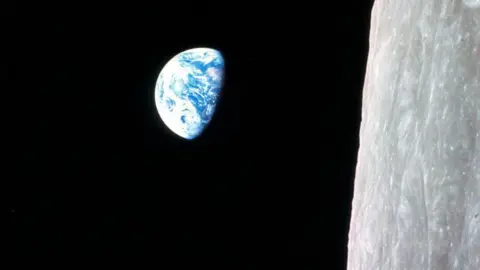
The spellbound astronauts pressed themselves against the windows, the first humans to gaze upon the far side of our nearest celestial neighbor. And then, from over the advancing horizon, an incredible, awe-inspiring sight emerged. "Earthrise," Borman gasped, a moment of profound beauty and existential realization. "Get the camera, quick," Lovell urged, capturing what would become one of the most iconic photographs in history.
It was Christmas Eve 1968. America was embroiled in the Vietnam War abroad and grappling with civil unrest at home. Yet, in that singular moment, it seemed humanity was united. People across the globe saw their planet through the astronauts’ eyes—a fragile, vibrant blue marble shining in the desolate blackness of space. Lovell, deeply moved, read from the Book of Genesis, a sacred text foundational to many of the world’s great religions, broadcasting his words to the anxious population of Earth: "And God called the light Day, and the darkness he called Night. And the evening and the morning were the first day." For him, it was an image that changed our world forever. He famously put his thumb against the window, and the entire Earth disappeared behind it, an experience he described as the most moving of his life. As the spacecraft re-emerged from the darkness, Lovell was the first to announce their safe passage, his voice cutting through the radio static: "Please be advised," he said, "there is a Santa Claus."
At that very moment, 239,000 miles away, a man in a blue Rolls-Royce pulled up outside Lovell’s Houston home. He walked past the throng of reporters camped outside and handed a box to Marilyn. She opened the star-patterned tissue paper to reveal a mink jacket. The card inside read: "Happy Christmas, and love from the Man in the Moon." The Apollo 8 crew returned as celebrities, their every move followed by millions on television. They received ticker-tape parades, congressional honors, and graced the cover of Time Magazine. And they hadn’t even set foot on the Moon. That honor, of course, went to Neil Armstrong and Buzz Aldrin a year later, fulfilling Kennedy’s dream. The New Nine had done their job.
‘Houston, We’ve Had a Problem’
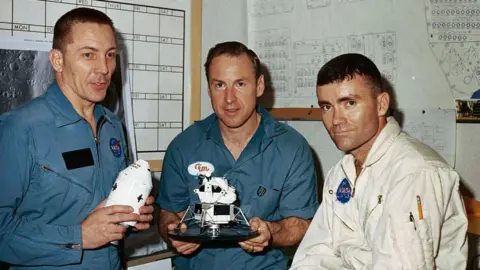
In April 1970, it was Jim Lovell’s turn to command his own lunar landing mission. The crew of Apollo 13—Lovell, Jack Swigert, and Fred Haise—were men of science, highly trained and determined to follow Armstrong and Aldrin to the lunar surface. Fortunately, they did not believe in unlucky numbers. But things went catastrophically wrong. They were approximately 200,000 miles above Earth, closing in on their lunar target, when a routine procedure called for stirring tanks containing vital oxygen and hydrogen. Swigert flicked the switch. Instead of a smooth operation, the command module, Odyssey, shuddered violently. Oxygen pressure plummeted, and critical power systems shut down. "I believe we’ve had a problem here," Swigert calmly reported. Lovell, surveying the rapidly deteriorating situation, repeated the chilling message to a stunned Mission Control: "Houston, we’ve had a problem." It was one of the greatest understatements of all time. A dramatic explosion had crippled their spacecraft, endangering the lives of all three astronauts.
The gravity of their situation was immense. An oxygen tank in the service module had ruptured, severely damaging the craft’s life support and propulsion systems. Haise and Lovell worked frantically, following instructions from ground control, to boot up the lunar module, Aquarius. This module, designed solely for lunar landing and ascent, was never intended for prolonged use as a lifeboat in deep space, nor did it possess a heat shield for Earth re-entry. Yet, it became their only hope for survival, capable of sustaining them until they could somehow limp back towards Earth.
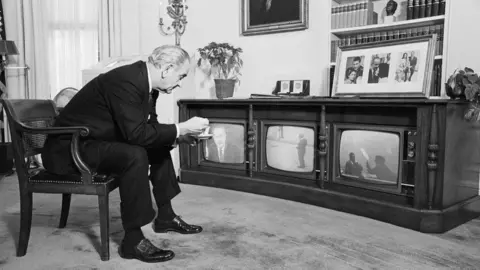
The world stopped breathing and watched. For a second time, Jim Lovell had inadvertently united the world—first, for the breathtaking beauty of Earthrise, and now, to witness his desperate fight for survival. Marilyn Lovell famously encapsulated the agonizing suspense, stating: "For four days, I didn’t know if I was a wife or a widow." Inside the cramped lunar module, temperatures plunged to near freezing, food and water were severely rationed, and carbon dioxide levels began to rise dangerously. Mission Control, in an incredible display of teamwork and ingenuity, scrambled to devise solutions, including the famous improvisation of using square CO2 scrubbers from the command module to fit the round openings in the lunar module.
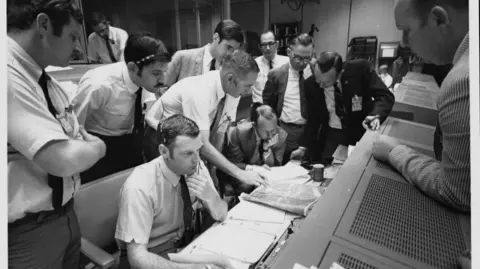
Days later, the crippled spacecraft finally limped back to the fringes of Earth’s atmosphere. The astronauts climbed back aboard the damaged Odyssey, praying its heat shield had not been compromised by the explosion. The radio silence that typically accompanies re-entry stretched on, agonizingly longer than normal. Millions watched on television, many convinced that all was lost. After six unbearable minutes, Jack Swigert’s voice, faint but clear, cut through the silence. The team on the ground erupted in cheers, holding its breath until the parachutes deployed and the command module, with its heroic crew, safely splashed down. The Apollo 13 mission, though a failure in its primary objective of a Moon landing, became NASA’s greatest triumph of survival, and without question, its finest hour.
Lovell retired from the Navy in 1973, choosing a quieter life in the private sector, working for the Bay-Houston Towing Company. He continued to inspire, giving speeches and serving as president of the National Eagle Scout Association. His harrowing experience was chronicled in his compelling book, Lost Moon: The Perilous Voyage of Apollo 13, which later became the critically acclaimed 1995 movie, Apollo 13, starring Tom Hanks as Jim Lovell.
For a cameo scene in the film, where the rescued crew shakes hands with naval officers, the director asked Lovell to dress as an admiral. But the old American hero, ever true to himself and his distinguished career, was not having it. Jim Lovell had orbited the Moon twice, witnessed the profound beauty of Earthrise, and narrowly escaped a cold death in the vacuum of space. He saw no reason to falsely burnish his résumé. He meticulously retrieved his old Navy uniform, dusted it down, and proudly wore it for his cameo appearance. "I retired as a captain," he insisted, with characteristic humility and resolve, "and a captain I will be."




 Roy Suryo
 George Anjay
 Ramos Leo
 atisusanti