
 Ramos Leo
Initially, Local Government Secretary Steve Reed had sanctioned delays for elections in 30 English councils, pushing them back until 2027. This controversial move was justified by ministers who argued that certain councils, slated for abolition or significant restructuring as part of Labour’s ambitious overhaul of local government in England, would find it financially imprudent and administratively burdensome to conduct elections for what he termed "short-lived zombie councils." Reed, writing in The Times last month, had articulated that running elections for these transitional entities would "divert scarce resources away from front-line services like fixing potholes and social care," implying a pragmatic, cost-saving measure.
However, this rationale quickly unravelled. The government’s plan to postpone ballots faced immediate and widespread criticism, not only from opposition parties but also from the UK’s independent elections watchdog, the Electoral Commission. The Commission had unequivocally stated its belief that "capacity constraints" did not constitute a "legitimate reason" for delaying democratic processes. The decisive blow came with a legal challenge mounted by Reform UK, which argued the postponements were unlawful. Following this challenge, the government was forced into a dramatic U-turn, abandoning its plans after receiving updated legal advice suggesting the delays could indeed be illegal.
Defending the sudden reversal on Tuesday, Care Minister Stephen Kinnock explained that ministers had been compelled to change course due to this shift in legal counsel. Speaking on BBC Radio 4’s Today programme, Kinnock stated, "We had a process that we went through, and then that changed. Sometimes circumstances change, and that’s the nature of the beast." Yet, the government has remained notably tight-lipped about the specifics of how the legal situation evolved, refusing to detail the updated advice. This lack of transparency has intensified pressure from opposition parties, who are now vociferously demanding the full publication of the legal advice that prompted the climbdown.
For the dedicated teams responsible for orchestrating local elections, this governmental indecision has created a logistical nightmare. A collective voice from groups representing electoral officials across the UK has highlighted the loss of crucial months of preparation time, deeming it almost impossible to be fully ready. The Association of Electoral Administrators (AEA), the primary body representing electoral officials and providing essential training, expressed its profound disappointment. Laura Lock, the AEA’s deputy chief executive, lamented that "months of essential planning time" had been squandered. She underscored the severe impact on returning officers, electoral registration officers, and the broader electoral administration teams, stating plainly, "These teams now face an uphill struggle to catch up to where they should be."
The implications of this lost time are far-reaching. Election administration is a complex, multi-faceted operation requiring meticulous planning over many months. Tasks include updating voter registers, identifying and securing suitable polling stations, recruiting and extensively training thousands of temporary staff, printing millions of ballot papers, managing the postal vote application and dispatch process, ensuring compliance with new voter ID requirements, and launching public awareness campaigns. Each of these steps demands significant lead time, coordination, and financial resources. The sudden reinstatement of elections means these teams must now compress what would typically be a six-to-nine-month planning cycle into a matter of weeks, potentially leading to increased costs for expedited services, overtime pay for staff, and a higher risk of administrative errors.
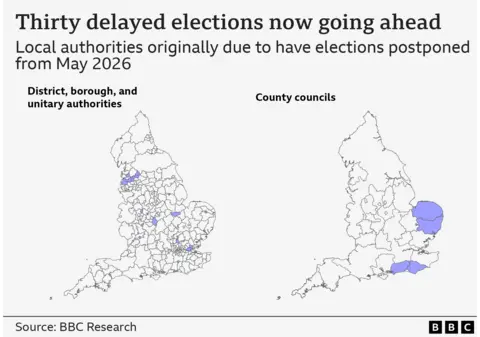
As a direct consequence of the U-turn, local elections in at least 30 areas across England, including high-profile councils in Norfolk, Suffolk, Blackburn, Lincoln, and Thurrock, will now proceed as scheduled on 7 May. Interestingly, some local organisers had prudently continued their preparations regardless, anticipating the legal challenge to the government’s initial postponement decision, which was scheduled to be heard in the High Court on Thursday. Their foresight, though perhaps a gamble at the time, has now proven invaluable.
Beyond the immediate administrative challenges, experts warn of deeper consequences for the democratic process. Jonathan Carr-West, chief executive of the Local Government Information Unit, speaking on BBC Breakfast, highlighted the immense pressure this situation places on "hard-working council officers." He predicted that while the elections would undoubtedly "be done," it would be "as always, by hard-working council officers just going the extra mile, working harder, doing the extra hours, giving up their weekends. They can do it, but I don’t think it’s fair to ask them to." Carr-West further argued that this eleventh-hour policy shift "damages our democratic process" and conveys a dangerous message that "these elections are optional," potentially eroding public trust in local governance and democratic institutions.
The political fallout from the U-turn has been swift and sharp, exposing divisions and drawing condemnation from across the political spectrum. Matthew Hicks, the leader of the Conservative-run Suffolk County Council, expressed palpable frustration, stating that "Local councils across the country are experiencing whiplash as major government decisions shift repeatedly and without warning." He emphasized how such uncertainty severely impacts the ability "to plan effectively" and "deliver stability for residents," highlighting the practical challenges for local leadership. Similarly, Lynn Worrall, the leader of the Labour-run Thurrock Council, voiced her disappointment, noting it was "disappointing that this decision has been reversed so late in the day," reflecting the widespread administrative disruption.
Reform UK, the party instrumental in forcing the U-turn, wasted no time in claiming victory. Nigel Farage, a prominent figure in the party, took to X (formerly Twitter) to declare triumphantly: "We took this Labour government to court and won." The government, having capitulated, has also agreed to cover Reform UK’s legal costs relating to the proceedings, a sum a party source estimated would be at least £100,000, adding a significant financial dimension to the political embarrassment.
The Conservative Party, the main opposition, seized upon the opportunity to lambast the government’s handling of the situation. Kemi Badenoch, a senior Conservative MP and prominent voice, criticised the government for "predictable chaos from a useless government that cannot make basic decisions." Meanwhile, Liberal Democrat leader Sir Ed Davey also weighed in, stating that his party had "fought tooth and nail to stop this stitch-up and the government has been forced into a humiliating U-turn." These strong reactions underscore the severe damage to the government’s credibility and competence following this latest in a "string of climbdowns."
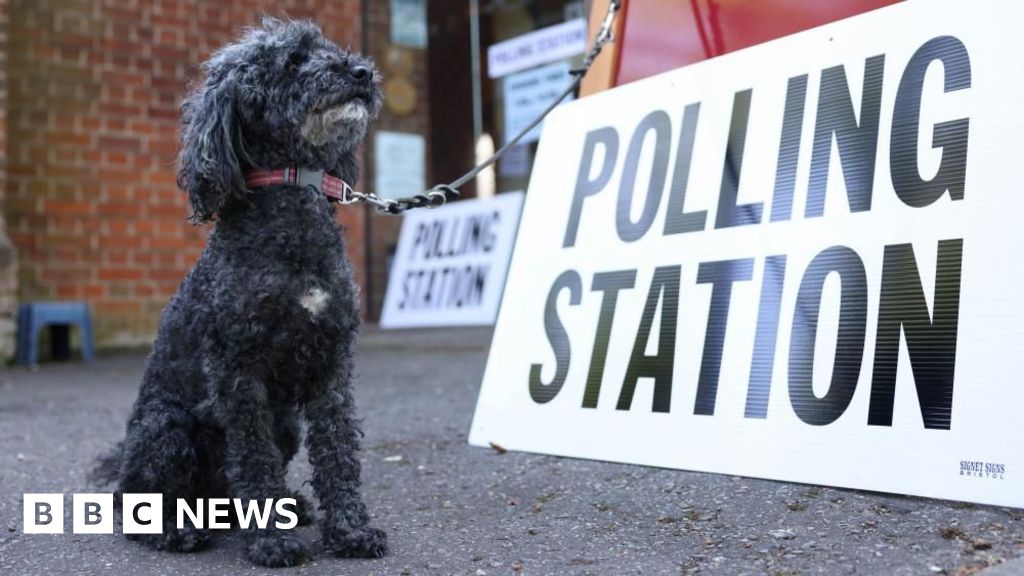
The timing of the announcement, made during Parliament’s mid-February recess, meant that ministers avoided immediate parliamentary scrutiny. However, MPs are now expected to press for answers and accountability when Parliament reconvenes next week, ensuring a heated debate on the government’s conduct and the implications for future electoral processes. The episode serves as a stark reminder of the intricate balance between administrative efficiency, legal propriety, and democratic accountability, and the significant consequences when that balance is disturbed. The images accompanying this report, including a miniature black poodle at a polling station and maps detailing the affected district, borough, unitary, and county councils, serve as visual anchors to the very real, tangible impact of these political decisions on local communities and their democratic rights.



 Roy Suryo

 Nakalama John
 atisusanti
