Nana Banana
The United Kingdom is poised for a significant expansion of its clean energy infrastructure, with a record number of solar projects set to be developed across England, Scotland, and Wales following the government’s latest competitive auction. This landmark decision marks a crucial step towards the nation’s ambitious climate goals, aiming to drastically reduce reliance on fossil fuels, but it also anticipates strong resistance from local communities concerned about the impact on their landscapes. The Contracts for Difference (CfD) allocation round, a cornerstone of the UK’s renewable energy strategy, has awarded contracts to an unprecedented supply of renewable energy developments, solidifying solar power’s role as a cost-effective and vital component of the future energy mix.
A total of 157 solar developments, collectively offering an impressive 4.9 gigawatts (GW) of capacity, secured government backing in this round. This represents a substantial increase from the previous auction in 2024, which saw 93 projects awarded, contributing 3.3 GW. Beyond solar, the auction also saw contracts granted to approximately 1.3 GW of onshore wind projects, predominantly located in Scotland, alongside a smaller but strategically important number of tidal power developments. This diverse portfolio underscores a multifaceted approach to decarbonising the national grid.
The results have been enthusiastically received by climate advocacy groups and clean energy organisations, who champion solar power as a relatively inexpensive and readily deployable solution to bolster the UK’s energy security, particularly during the sunnier summer months. Its ability to complement wind power, which often performs better in other seasons, creates a more resilient and balanced renewable energy system. The government has set a target for at least 95% of Great Britain’s electricity to originate from "clean" sources, including renewables and nuclear energy, by 2030. Achieving this target requires a rapid scaling up of renewable capacity, and this auction provides a substantial push in that direction.
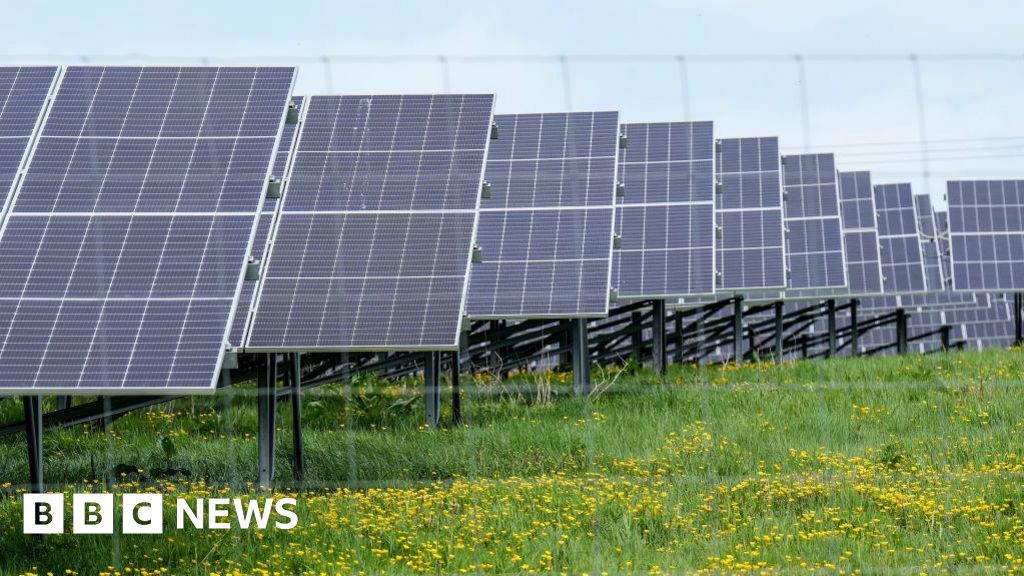
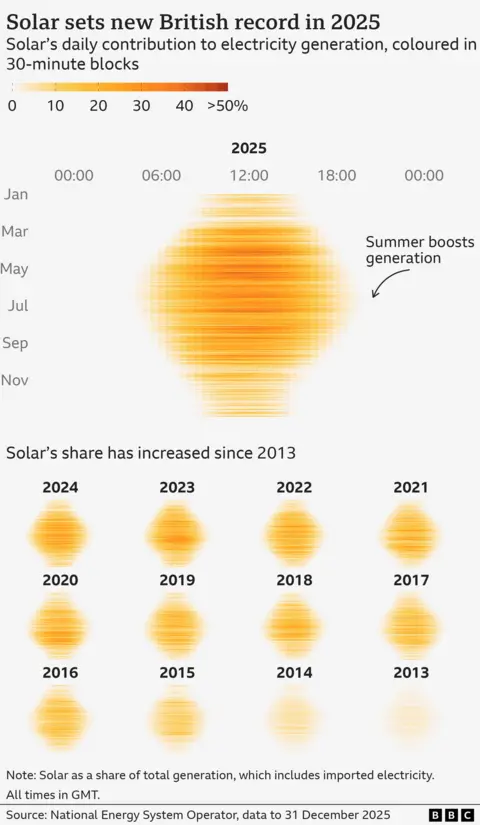
Currently, the UK’s operational solar capacity stands at approximately 21 GW according to government figures, though the solar industry itself estimates it closer to 24 GW. The government’s aspiration is to reach 45-47 GW of solar power capacity by 2030, with the potential to rise to 54-57 GW if rooftop solar installations are maximised. To ensure the reliability of this intermittent energy source, there is a parallel emphasis on developing more sophisticated battery storage and other grid-scale storage systems, enabling the grid to store excess solar energy generated during peak sunlight hours for use outside of sunny periods.
Despite the broad welcome from environmental and industry sectors, the expansion of large-scale solar farms is not without its detractors. Local communities frequently voice strong opposition to these extensive developments, fearing the "mass industrialisation" of rural areas and the loss of traditional landscapes. A prominent example is the planned West Burton solar farm on the Lincolnshire and Nottinghamshire border, which has emerged as the largest single project to secure a government contract in this round. While all awarded solar projects had already navigated and successfully obtained planning permission, the local concerns highlight the ongoing tension between national energy imperatives and local environmental and aesthetic considerations. These objections often revolve around the visual impact, potential disruption to agricultural land, and the strain on local infrastructure.
The Contracts for Difference (CfD) scheme, under which these contracts were awarded, is a critical mechanism designed to incentivise investment in low-carbon electricity generation. It offers developers a guaranteed price for the electricity they generate over a fixed period, typically 15 to 20 years, indexed to inflation. This price certainty de-risks significant upfront investments in renewable projects, making them more attractive to investors. For solar projects in this auction, the fixed price was set at £65 per megawatt-hour (MWh) in 2024 prices, a decrease from the £70/MWh awarded in the 2024 auction, reflecting the declining cost of solar technology. Onshore wind projects, conversely, saw a slight increase in their guaranteed price, rising to £72/MWh from £71/MWh in the previous round (also in 2024 prices).
The financial implications of these contracts on household bills are complex and depend on a variety of factors, including future wholesale electricity market prices – which are currently heavily influenced by gas prices – the cost of necessary grid upgrades, and fluctuations in electricity demand. However, the government argues that the guaranteed prices for solar and wind are significantly more competitive than the cost of constructing and operating new fossil fuel power plants, particularly gas-fired ones, offering a long-term pathway to more stable and affordable energy.
The political reaction to the auction results underscores the divisive nature of energy policy. Claire Coutinho, the Secretary of State for Energy Security and Net Zero, praised the outcome, stating, "By backing solar and onshore wind at scale, we’re driving bills down for good and protecting families, businesses, and our country from the fossil fuel rollercoaster controlled by petrostates and dictators." This statement aligns with the government’s narrative of securing energy independence and combating climate change through renewable deployment.
However, the Shadow Secretary of State for Energy Security and Net Zero, Ed Miliband, voiced concerns from the opposition. He argued that the government’s strategy risked "loading more and more wind and solar on to the grid before the grid can handle it." Miliband contended that "the true cost of this power, once you add in network charges and back up, is far higher, so all this will do is make our electricity even more expensive," implying a potential strain on the existing grid infrastructure and a hidden cost burden for consumers.
Other political parties also weigh in on the national energy debate. Reform UK has consistently questioned the costs and necessity of net zero policies, advocating for alternative approaches. Meanwhile, the Liberal Democrats and the Green Party generally champion a rapid expansion of renewables to address climate change and foster green job creation, though they too acknowledge the importance of addressing local objections raised by some councillors regarding specific projects. The Scottish National Party (SNP) supports renewables and frequently advocates for greater control over Scotland’s abundant energy resources. Plaid Cymru in Wales recognises the need for diverse renewable technologies but has expressed reservations about large solar farms encroaching on valuable agricultural land.
Beyond solar and wind, the auction also provided contracts for a small number of tidal power projects. While currently more expensive than other renewable technologies, the government views these as strategic investments in a nascent sector with significant long-term potential for cost reduction and job creation, particularly in coastal regions.
In a related announcement, the government has unveiled its "Local Power Plan," an initiative designed to empower communities across the UK to "own and control their own energy." This plan commits up to £1 billion in funding, drawn from the allocation for the state-owned Great British Energy company, to support local energy projects. These could include community-owned solar panels on public buildings like leisure centres, fostering a sense of local ownership and direct benefit from the energy transition.
Despite the positive momentum from this record auction, many analysts maintain serious doubts about the government’s ability to fully meet its ambitious 2030 clean power targets. The sheer volume of renewable projects still required, coupled with the ongoing challenges of grid connection and infrastructure upgrades, presents a formidable hurdle. This auction, while significant, highlights the complex balancing act between accelerating the transition to clean energy, managing public sentiment and local impacts, and ensuring the robust and reliable operation of the national grid.



 Roy Suryo
 George Anjay
 Ramos Leo
 atisusanti