Nana Banana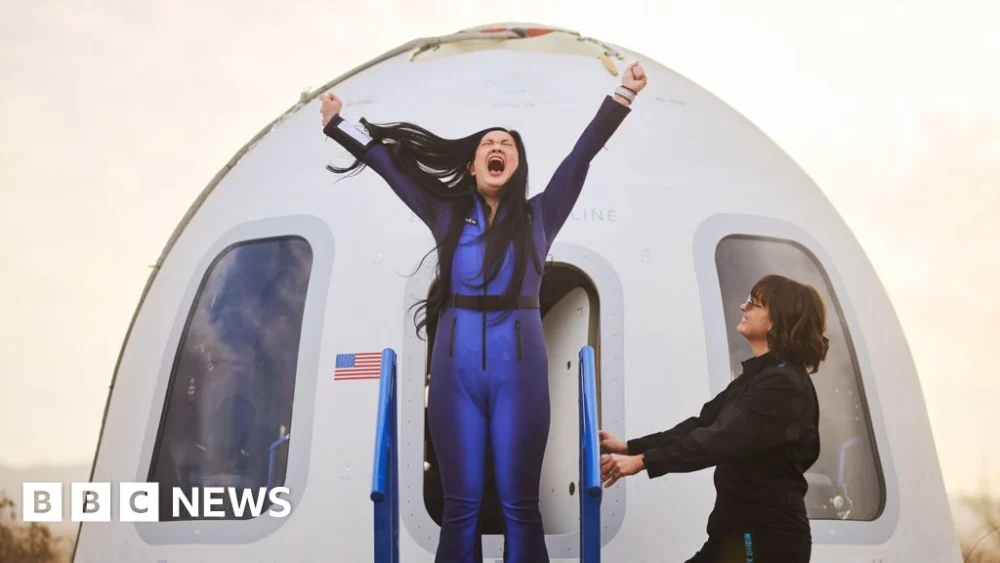
Speaking with raw honesty about the aftermath of the experience, Ms. Nguyen, who made history as the first Vietnamese woman to journey into space, articulated that the overwhelming backlash effectively buried her lifelong dreams under what she described as "an avalanche of misogyny." This deeply personal revelation underscores the often-unseen emotional toll faced by public figures, particularly those venturing into highly scrutinized domains like private space travel. The public narrative surrounding the flight quickly shifted from one of pioneering spirit to a contentious debate, leaving Nguyen to contend with the vitriolic fallout.
The Blue Origin flight, launched in April from its Texas site, propelled the six-woman crew beyond the Kármán line, the internationally recognized boundary of space, offering them a fleeting but unforgettable glimpse of Earth from orbit. The New Shepard rocket system, known for its fully automated operation, is designed for suborbital tourism and research, carrying its passengers to the edge of space before returning them safely to Earth. Alongside Nguyen, Perry, and Sánchez, the crew also included aerospace engineer Aisha Bowe, news anchor Gayle King, and film producer Kerianne Flynn, making for a diverse ensemble of women from various professional backgrounds.
In a poignant statement shared on her Instagram account, Ms. Nguyen recounted the harrowing days and weeks that followed her return to Earth. When fellow crew member Gayle King, the renowned US news anchor, reached out to check on her well-being, Nguyen admitted, "I told her my depression might last for years." This conversation highlights the immediate and profound psychological impact of the negative public reception. She further characterized the relentless barrage of news coverage and social media reactions as an "onslaught no human brain has evolved to endure," suggesting a level of digital aggression that overwhelmed her capacity to cope.
The initial period post-flight was marked by severe withdrawal and emotional distress. "I did not leave Texas for a week, unable to get out of bed," she revealed, painting a vivid picture of her incapacitation. The lingering trauma persisted, manifesting weeks later. "A month later, when a senior staff at Blue [Origin] called me, I had to hang up on him because I could not speak through my tears." These details offer a stark insight into the depth of her despair, demonstrating how external criticism can deeply wound and paralyze an individual, even one as resilient as Nguyen.
Ms. Nguyen’s professional life and personal identity are deeply intertwined with her scientific pursuits and advocacy. She had dedicated years to researching women’s health, conducting numerous experiments during the Blue Origin flight itself. Her journey to space was not merely a personal achievement but a culmination of her scientific ambition and a symbolic moment for her community. She noted that everything she "had worked for – as a scientist, my women’s health research, the years I had trained for this moment, the experiments I operated in space, the history that was being made as the first Vietnamese woman astronaut, on the 50th anniversary of the US-Vietnam war, as the child of boat refugees, the promise I kept to my survivor self […] were buried under an avalanche of misogyny." This powerful statement conveys a profound sense of loss, as the very achievements she hoped to celebrate were overshadowed and undermined by the public’s negativity, particularly the gendered nature of the attacks.
Beyond her spaceflight, Amanda Nguyen is internationally recognized for her groundbreaking work in protecting the civil rights of sexual assault survivors. Her advocacy led to the drafting and passing of the Sexual Assault Survivors’ Bill of Rights, a federal law that has revolutionized how survivors are treated within the justice system across the United States. This personal mission stemmed from her own experience of being raped while at university, an event that compelled her to put her ambition to become an astronaut on hold to pursue a years-long campaign for justice, a journey she shared in an interview with The Guardian in March. Her dedication to this cause underscores her commitment to social justice and her capacity for turning personal trauma into powerful advocacy. The "avalanche of misogyny" she faced post-flight would undoubtedly have resonated deeply with her past experiences, making the backlash particularly painful and personal.
Eight months on from realizing her lifelong dream of space travel, Ms. Nguyen now reports a glimmer of hope. She stated that the "fog of grief has started to lift," signaling a gradual return to emotional stability. She expressed immense gratitude to her followers and supporters, whose kind wishes and encouragement provided a lifeline during her darkest moments. "You all saved me," she declared, highlighting the vital role of community and empathy in navigating profound emotional crises.
Despite the severe backlash and personal suffering, Nguyen maintains a perspective of resilience and hope. She acknowledged that "there has been overwhelming good that has come out of [the flight]." This positive impact includes the significant media attention her women’s health research has garnered, providing a platform to discuss critical issues that might otherwise remain in the shadows. Furthermore, the flight has opened doors to new opportunities for her advocacy work, allowing her to meet with world leaders and advance her mission for civil rights and justice on a global stage. This ability to find light amidst darkness speaks volumes about her unwavering commitment to her causes.
The Blue Origin flight itself represents a segment of the burgeoning private space industry, spearheaded by billionaire entrepreneurs like Jeff Bezos, who founded Blue Origin in 2000, and Elon Musk with SpaceX, and Richard Branson with Virgin Galactic. These companies aim to make space accessible not just for government-funded astronauts but also for private citizens, ushering in an era of space tourism and commercial space ventures. However, this new frontier has not been without its critics. Arguments against such ventures often revolve around the immense wealth expended on what some perceive as a vanity project for the ultra-rich, especially when pressing global issues like climate change and poverty demand urgent attention. The environmental impact of rocket launches, even suborbital ones, is also a point of contention, with concerns raised about carbon emissions and resource consumption. These broader societal debates formed the turbulent backdrop against which Amanda Nguyen’s personal journey unfolded, inadvertently making her a focal point for these complex discussions.
Ultimately, Amanda Nguyen’s courageous revelation serves as a powerful reminder of the human cost of online harassment and the complex interplay between personal achievement, public perception, and mental well-being. Her story is not just about a journey to space, but about the resilience required to navigate the terrestrial challenges that follow, and her unwavering commitment to her identity as a scientist, an activist, and a survivor.


 Roy Suryo