Nana Banana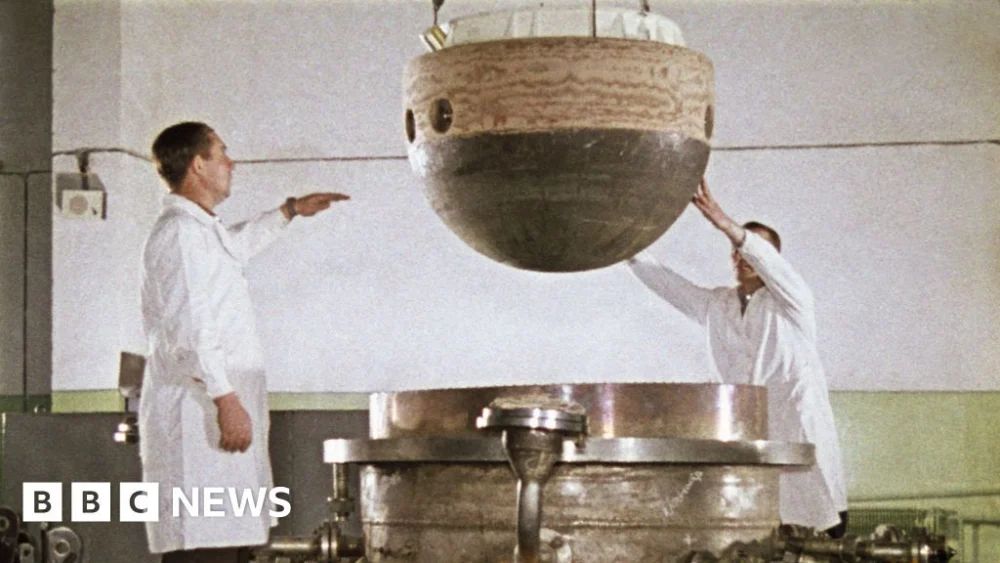
Authored by Maddie Molloy, Climate & science reporter, a part of a Soviet-era spacecraft is likely to have re-entered the Earth’s atmosphere after being stuck in orbit for more than half a century, the European Space Agency (ESA) confirmed. The event marks the probable fiery end for a relic of the Cold War space race, which has orbited our planet as a piece of uncontrolled space debris since 1972.
Kosmos 482, launched on March 31, 1972, was an ambitious Soviet mission intended to explore Venus. While officially designated "Kosmos" – a generic classification often used by the Soviet Union for classified or failed planetary probes – its true purpose was to send a lander to the scorching surface of Venus, following the successful Venera 7 and 8 missions. The spacecraft was designed to be a twin of Venera 8, which had successfully landed on Venus earlier that year. However, Kosmos 482’s journey took an unexpected turn shortly after liftoff. Its Block D upper stage, responsible for propelling the probe out of Earth’s orbit and onto a trajectory towards Venus, suffered a critical malfunction. Instead of achieving its trans-Venus injection burn, the upper stage failed to ignite properly, leaving the spacecraft stranded in an elliptical Earth orbit.
The stranded probe soon broke into four distinct pieces, a fragmentation likely caused by internal pressure or thermal stresses from its initial failed burn. These four fragments have since been circling the planet for more than five decades, silently bearing witness to the passage of time and the advancements in space exploration. For years, space tracking agencies around the globe, including the U.S. Space Command and the European Space Agency, have monitored these pieces, anticipating their eventual, uncontrolled re-entry.
The EU Space Surveillance and Tracking centre (SST), a collaborative effort of European nations to monitor space objects, reported that one of these fragments – widely believed to be the descent module or lander – "most likely" re-entered the atmosphere at approximately 06:16 GMT (07:16 BST) on Saturday. This marked the culmination of 52 years of orbital decay, where the subtle drag of Earth’s tenuous upper atmosphere gradually pulled the object lower and lower.
A critical uncertainty remains regarding the event: it is currently unclear whether the object completely burned up during its fiery descent or if any substantial pieces managed to survive the extreme temperatures and pressures to reach the ground. Furthermore, the precise geographical location of the re-entry is not definitively known. Predicting the exact re-entry point for uncontrolled objects is notoriously difficult due to variables like atmospheric density fluctuations, solar activity affecting atmospheric drag, and the object’s tumbling characteristics. These factors make pinpointing the final trajectory a complex probabilistic exercise rather than an exact science.
Despite these uncertainties, experts emphasize that the risk to human life or property remains incredibly low. With approximately 70% of Earth’s surface covered by oceans, the overwhelming probability is that any surviving debris would splash down harmlessly into the sea. Stijn Lemmens, a senior analyst at the European Space Agency, succinctly put this into perspective, stating, "It’s much more likely that you win the lottery than that you get impacted by this piece of space debris." This statement underscores the vastness of our planet and the relatively small size of even robust space debris.
The reason experts believe the Kosmos 482 lander might have partially survived its atmospheric re-entry lies in its original design. The lander capsule was engineered to endure the incredibly harsh conditions of Venus’s atmosphere. Venus boasts an atmospheric pressure over 90 times that of Earth’s at sea level and surface temperatures averaging 462 degrees Celsius (864 degrees Fahrenheit), hot enough to melt lead. To withstand this inferno, the Kosmos 482 lander was equipped with an exceptionally robust heat shield, made of ablative materials designed to dissipate intense heat, and a durable, pressure-resistant structural shell. This extreme resilience, intended for a different planetary environment, ironically made it more likely to survive the less severe, though still formidable, heat and friction of Earth’s atmospheric re-entry compared to a typical satellite.
However, the lander’s parachute system, which was originally intended to slow its descent through the dense Venusian atmosphere, is highly likely to have degraded significantly over more than five decades in the harsh vacuum and radiation of space. Materials exposed to such prolonged conditions can become brittle or compromised, rendering the parachute ineffective. This degradation means that if the lander did survive, it would have impacted the Earth’s surface at a high velocity, rather than a controlled, slowed descent.
Mr. Lemmens further explained that the "re-entry of human-made objects into Earth’s atmosphere occurs quite frequently." He noted that re-entries of bigger spacecraft happen weekly, while smaller fragments or defunct satellites re-enter on a daily basis. The vast majority of these objects, particularly smaller ones or those not built with extreme heat resistance, typically burn up completely in the Earth’s atmosphere, disintegrating into tiny particles or vaporizing before they can reach the ground. The dazzling streaks of "shooting stars" are often not natural meteoroids but rather small pieces of space debris meeting their end.
The re-entry of Kosmos 482’s lander highlights the growing issue of space debris, a problem that has become increasingly pressing as humanity launches more and more objects into orbit. International space agencies, including ESA, NASA, and national space commands, closely track hundreds of thousands of pieces of space junk, from defunct satellites and spent rocket stages to tiny fragments created by collisions. The increasing density of objects in certain orbital bands raises concerns about the "Kessler Syndrome," a theoretical scenario where the density of objects in low Earth orbit becomes so high that collisions generate enough new debris to create a cascade of further collisions, rendering space unusable for generations.
In response to this escalating challenge, there is a strong international push for more responsible space practices. Mr. Lemmens emphasized that future spacecraft "should be designed in such a way that they can take themselves out of orbit safely, preferably by doing controlled re-entries." Controlled re-entries involve using a spacecraft’s remaining fuel to execute a precise burn that guides it to a specific, unpopulated "graveyard" zone, typically over the vast expanse of the South Pacific Ocean. This method allows for accurate predictions of landing locations, significantly reducing the risk of any debris impacting populated areas and thereby protecting people and property. Moreover, it represents a crucial step in "managing the environmental impact of space debris" by ensuring that large objects do not contribute to uncontrolled clutter in Earth’s orbital environment.
Efforts are underway globally to implement these principles. The Inter-Agency Space Debris Coordination Committee (IADC), comprising space agencies from 13 countries, develops guidelines for space debris mitigation, including recommendations for post-mission disposal. These guidelines encourage operators to de-orbit satellites within 25 years of the end of their mission, either through controlled re-entry or by boosting them into a higher "graveyard orbit." Additionally, concepts like "design for demise" are gaining traction, where spacecraft components are intentionally designed to burn up completely upon re-entry.
The fiery descent of the Kosmos 482 lander serves as a potent reminder of the enduring legacy of early space exploration and the long-term consequences of orbital debris. While the immediate risk was minimal, its re-entry underscores the critical need for continued vigilance, international cooperation, and proactive measures in spacecraft design and mission planning to ensure the sustainability and safety of Earth’s orbital environment for future generations. The era of simply abandoning spacecraft in orbit is drawing to a close, replaced by a growing imperative for responsible stewardship of our cosmic backyard.



 George Anjay
 Nakalama John
 atisusanti
 Ramos Leo