
 Nana Banana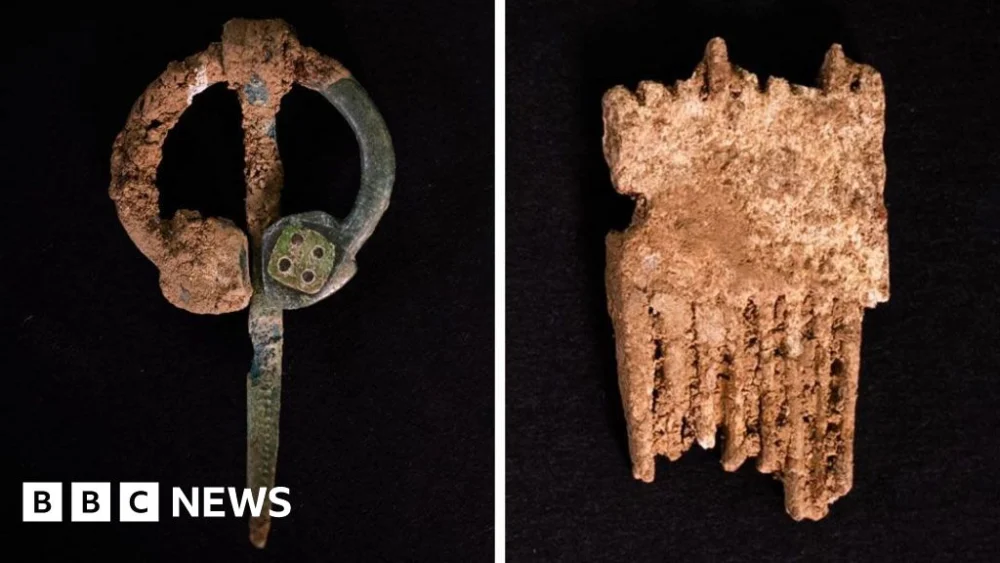
For the past four years, archaeological teams have been diligently excavating this enigmatic site, situated within the sprawling grounds of Fonmon Castle in the Vale of Glamorgan, remarkably close to the bustling end of the runway at Cardiff Airport. This juxtaposition of ancient history and modern infrastructure provides a striking backdrop to the unfolding story. The 1,500-year-old skeletons themselves offer a wealth of information, buried carefully in shallow graves painstakingly cut directly into the underlying limestone bedrock. While initial osteological analysis of their bones and teeth indicates that these women, and indeed the few men and children found, lived lives that were often physically demanding, the objects discovered among their graves tell a different, more nuanced story, hinting at a community that was not devoid of wealth or even a touch of luxury.
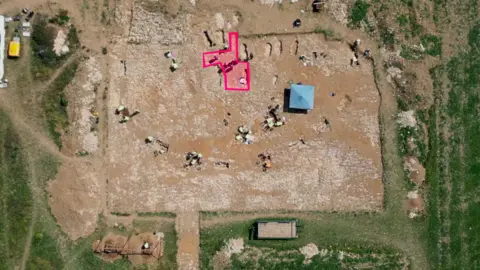
The archaeological team, led by Dr. Andy Seaman from Cardiff University, has been wrestling with the perplexing question of the identities of these women. Who were they? What brought them to this secluded spot? The latest season of digging, however, has yielded a pivotal clue: the discernible outline of what could very possibly be a small, but central, building. "It’s producing fragments of dressed building stone, so it definitely looks structural. We might be thinking of a small shrine or perhaps even a chapel," Dr. Seaman explains, his voice betraying a hint of excitement at the potential implications. "This is a really strong indicator. I increasingly believe that what we have here is a site which functioned as an early religious community."
The potential building’s location is highly significant, positioned centrally within the cemetery, with graves noticeably clustered around its perimeter. This arrangement suggests a profound desire among the community members to be interred as close as possible to this focal feature, whatever its precise function. So strong was this impulse, according to Cardiff University archaeologist Tudur Davies, that some of these graves contain not just one, but multiple individuals. "It’s clearly a highly desired location for people to be buried in," he observes. "Sometimes two, three, or even four individuals have been buried on the same spot, again and again. There doesn’t appear to be as much of a taboo over putting bodies in the same place and just moving those already there to one side to make room for a new burial." This practice of repeated interment points to a strong communal bond and the sanctity attributed to the central feature.

The artefacts painstakingly recovered from the site are providing crucial insights into the daily lives, beliefs, and even the status of the people buried here. These objects have been carefully transported to Cardiff University’s specialized laboratory for conservation and detailed analysis. Conservator Clare Emerson is meticulously engaged in the delicate task of removing centuries of accumulated dirt from an ornate copper brooch, revealing its intricate details. "We’d have to do some more detailed analysis, but it’s probably bronze," she states, her focus unwavering. "Also, we think it was possibly gilded, which would be a coating of gold over the top, indicating significant value and craftsmanship." The ends of the brooch, she further explains, were adorned with vibrant green enamel. "This would have been a very decorative and striking brooch, certainly a statement piece. I think it’s a very special find for the site, suggesting a level of sophistication and access to fine goods."
Beyond this piece of early medieval ‘bling,’ the team has also unearthed a finely crafted pin made from bone, featuring a detailed, perhaps symbolic, pattern, and an intricately carved comb fashioned from antler. These items speak to personal adornment, hygiene, and the presence of skilled craftspeople within or connected to the community. Perhaps most captivating are the exquisite, multicoloured glass beads. Measuring a mere 3mm across, each one is a miniature testament to ancient artistry and trade. These tiny treasures were possibly stitched onto clothing as embellishments, adding a splash of colour and luxury to garments, or perhaps attached to a piece of jewellery, forming a necklace or bracelet. Their presence hints at trade networks that brought such materials to this relatively remote Welsh site, or perhaps even local glassworking skills.

Crucially, the domestic items unearthed at the site provide equally significant clues about the community’s self-sufficiency and daily routines. "We have discovered a quern stone for grinding flour, essential for making bread," Dr. Andy Seaman notes, highlighting a fundamental aspect of daily life. "We’ve also found fragments of pottery and glass, used for eating and drinking." These everyday objects paint a vivid picture of a functioning settlement, not merely a graveyard. "It’s clearly not just a place for the dead. There’s undeniable evidence of a living community here as well," he asserts. The presence of these domestic tools and wares strongly supports the hypothesis that the community was likely enclosed, living in close proximity to the cemetery itself, purposefully separated from the wider secular society. This enclosure would have fostered a distinct way of life, perhaps monastic or semi-monastic, dedicated to spiritual pursuits.
The various pieces of this intriguing medieval puzzle are steadily beginning to coalesce, forming a clearer picture of this unique settlement. However, several compelling questions continue to challenge the archaeologists. The presence of a small number of male remains alongside the predominantly female burials raises questions: who were these men? Were they spiritual leaders, brothers, or perhaps support staff for the community? Similarly, the discovery of child remains prompts further inquiry: were they related to any of the women, perhaps daughters or younger members of a wider family unit residing within the community’s orbit?
One of the most perplexing and stark discoveries concerns the burials of two women who were found not in carefully prepared graves, but unceremoniously "tossed in a ditch"—one of whom had her hands and feet tied. This raises unsettling questions about social justice, punishment, or perhaps even ritualistic practices of the era. What transgression could have led to such a dishonourable burial? Were they outcasts, victims of crime, or did their manner of death hold some symbolic meaning for the community? Such burials stand in stark contrast to the careful interments of the majority, offering a glimpse into the darker, more complex facets of early medieval society and its moral code.
The team’s ongoing research is now heavily focused on determining if this site represents an exceptionally early example of organised Christianity in Wales. "It’s a period where the history is not yet fully written, or at least, is incredibly sparse," Dr. Seaman emphasizes. "We don’t really understand early church sites in this region—how they functioned, what they looked like structurally, how they were organised socially and spiritually." While later periods of Christian history are well-documented, this "very formative period of history" remains largely opaque, making the Fonmon Castle site an unparalleled opportunity. "So, it’s a really exciting opportunity to shed light on a poorly understood but pivotal era," he concludes. The archaeologists are scheduled to continue their crucial excavations at the site later this year, hoping to unearth more clues that will ultimately complete this remarkable historical narrative and reshape our understanding of early medieval Welsh society and the significant role women played within it.


 Roy Suryo

 Nakalama John
 atisusanti
 Ramos Leo
