Nana Banana
Scientists are embarking on a groundbreaking mission to monitor the health of the Southern Ocean’s most vital species: Antarctic krill. Utilising cutting-edge satellite technology, researchers aim to overcome the immense challenges of surveying these diminutive, yet critically important, marine crustaceans across the vast, harsh Antarctic environment. This innovative approach promises to provide unprecedented insights into krill populations, offering a crucial tool in the fight against climate change and unsustainable fishing practices that threaten these oceanic "superheroes."
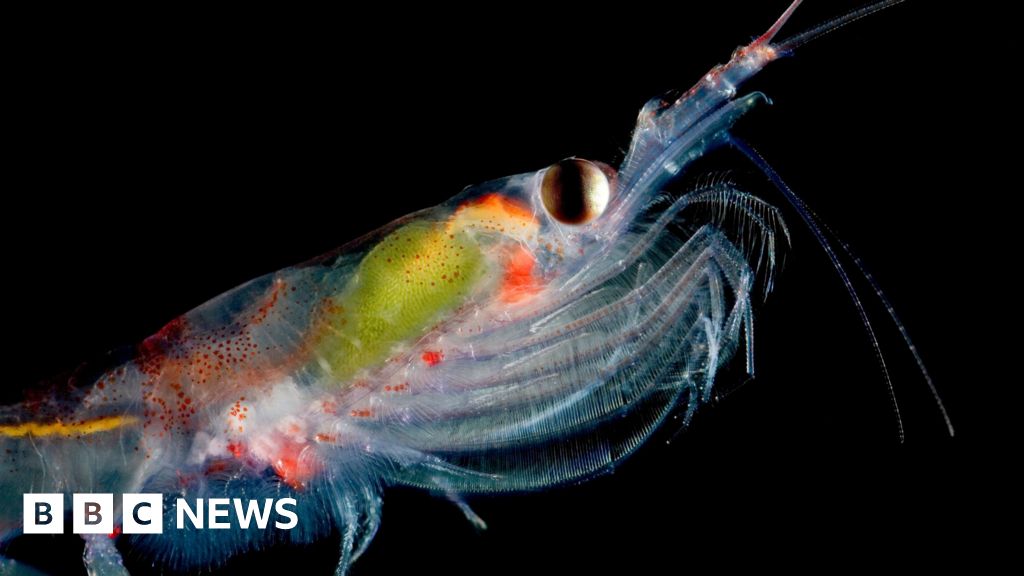
Antarctic krill (Euphausia superba) are more than just small crustaceans; they are the cornerstone of one of the planet’s most productive and sensitive ecosystems. Measuring just a couple of inches long when fully grown, their sheer abundance makes them one of the most successful animal species on Earth. These tiny creatures form a massive biomass, estimated to be hundreds of millions of tonnes, making them the primary food source for an extraordinary array of marine wildlife. Whales, penguins, seals, seabirds, and numerous fish species depend almost entirely on krill for their survival, undertaking vast migrations and complex foraging strategies to feast on these protein-rich organisms. Without krill, the vibrant Antarctic ecosystem, as we know it, would simply collapse.
Beyond their direct role in the food web, krill are integral to a vital global process: carbon sequestration. They participate in a "virtuous cycle" that helps regulate the Earth’s climate. Krill feed voraciously on microscopic marine plants, known as phytoplankton, which thrive in the nutrient-rich waters of the Southern Ocean. These phytoplankton are prodigious absorbers of atmospheric carbon dioxide, converting it into organic matter through photosynthesis. When krill consume phytoplankton, they transfer this carbon up the food chain. Crucially, when whales, in turn, consume vast quantities of krill, they fertilise the ocean through their enormous faecal plumes. This nutrient-rich "whale poop" acts as a powerful fertiliser for phytoplankton, stimulating further growth and, consequently, further absorption of planet-warming carbon. Disruption to this delicate cycle, particularly a decline in krill populations, could therefore have far-reaching consequences, exacerbating global warming and destabilising the entire Antarctic ecosystem.
Conservation scientists are increasingly alarmed by the pressures facing Antarctic krill. Two primary threats loom large: climate change and commercial fishing. Rising ocean temperatures are a direct consequence of global warming, impacting krill’s metabolic rates, reproductive success, and larval development. Krill are particularly vulnerable to changes in sea ice, which serves as a critical habitat and food source, especially during the harsh Antarctic winter. Juvenile krill graze on the algae that grow on the underside of sea ice, using it as a sheltered nursery. As sea ice extent and thickness diminish due to warming, this vital habitat and food source are lost, directly threatening krill survival. Ocean acidification, another consequence of increased CO2 absorption by seawater, also poses a long-term threat, potentially affecting krill’s exoskeletons and overall physiological health.
The commercial krill fishery, though regulated, adds another layer of pressure. Krill are harvested primarily for aquaculture feed, especially for farmed fish, and for human consumption in the form of omega-3 supplements and krill oil. While the fishery is managed by the Commission for the Conservation of Antarctic Marine Living Resources (CCAMLR), concerns persist about localised overfishing in critical foraging areas for predators like penguins and seals. Monitoring krill populations traditionally involves costly and logistically complex expeditions using research vessels, nets, and sonar. These methods offer only snapshots of krill distribution and abundance, covering limited areas and timeframes. The vastness of the Southern Ocean and its notoriously challenging weather conditions make comprehensive, continuous monitoring incredibly difficult and expensive, highlighting the urgent need for new, scalable solutions.
This is where the innovative "from Space" approach comes in. Researchers from the University of Strathclyde, in collaboration with the wildlife charity WWF and the British Antarctic Survey (BAS), are pioneering a method to monitor krill populations using satellite data. The core of their strategy relies on detecting subtle differences in the colour and light absorption properties of seawater that are indicative of krill presence and density. Just as phytoplankton blooms alter ocean colour, dense aggregations of krill, with their reddish-brown digestive tracts and the impact they have on the water’s optical properties, are believed to leave a detectable signature.
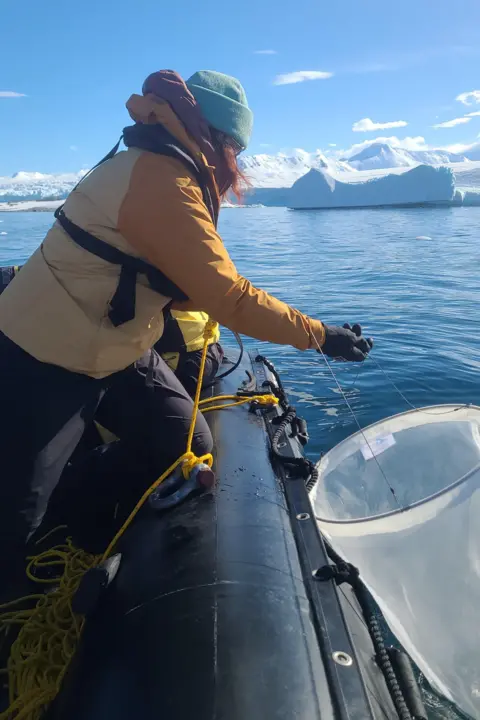
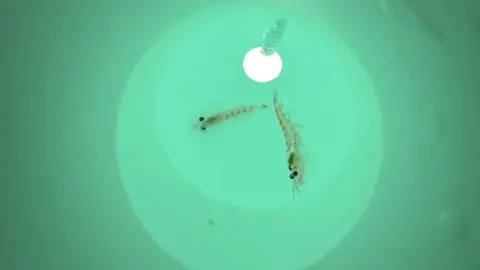
Dr. Cait McCarry, a researcher from the University of Strathclyde, has been at the forefront of this groundbreaking fieldwork. She recently returned from an expedition to Antarctica, where she undertook the painstaking process of collecting live krill samples. Leaning over the side of a small research boat amidst the icy waters and towering icebergs, she meticulously pulled in sampling nets to capture the tiny crustaceans. Back on board, often in improvised laboratory settings, Dr. McCarry conducted crucial experiments to establish the precise relationship between krill density and the spectral properties of seawater.
"We start with seawater, then we add in a krill and take a measurement [of how much light the water absorbs]," Dr. McCarry explained. "Then we add another krill and take another measurement." This iterative, precise calibration process is fundamental. By systematically varying the number of krill in a known volume of water and measuring how light at different wavelengths is absorbed and reflected, scientists can build a robust optical model. This model will essentially create a "krill signature" – a unique spectral fingerprint that satellites can theoretically detect from orbit. The specific pigments within krill, as well as their sheer physical presence in large swarms, alter how sunlight penetrates and reflects from the ocean surface, and it is these minute changes that satellites equipped with sensitive spectrometers are designed to pick up.
The ultimate goal is to translate these ground-truthed measurements into algorithms that can be applied to data collected by existing and future ocean colour satellites. These satellites, which continuously orbit the Earth, capture vast amounts of data on the light reflected from the ocean’s surface. While traditionally used to map phytoplankton concentrations (indicated by chlorophyll), the new research aims to differentiate the unique optical signal of krill from other marine components. This will allow researchers to create "snapshots" of krill distribution and abundance across vast stretches of the Southern Ocean, something impossible with traditional ship-based surveys.
Rod Downie, chief polar adviser at WWF-UK, underscored the critical importance of this research. "Antarctic krill are the superheroes of the Southern Ocean," he said. "They are tiny, unsung heroes that sustain incredible marine life, but climate change and unsustainable fishing are putting them at risk." The ability to monitor krill populations from space would provide an unparalleled tool for conservation and management. It would enable scientists and policymakers to identify areas where krill populations are declining, track the impact of climate change in real-time, and make more informed decisions regarding fishing quotas and the establishment of marine protected areas (MPAs).
Improved data on krill distribution and abundance would allow for more dynamic and adaptive management of the krill fishery, ensuring that fishing efforts do not disproportionately impact local krill populations, particularly in areas crucial for breeding penguin colonies or whale feeding grounds. Furthermore, this satellite-based monitoring could help evaluate the effectiveness of proposed MPAs in the Southern Ocean, such as those currently under consideration in the Weddell Sea and the Antarctic Peninsula, by providing evidence of krill recovery or stability within protected zones.
The consequences of failing to protect krill extend beyond the Antarctic. The health of the Southern Ocean ecosystem directly influences global climate patterns and marine biodiversity. By providing a continuous, large-scale view of krill populations, this satellite technology offers a new frontier in marine conservation. It represents a significant leap forward from intermittent ship-based surveys, offering the potential for a truly comprehensive understanding of how krill are responding to a rapidly changing world. "We urgently need to better manage the fishery and protect krill habitats within a network of marine protected areas," Mr. Downie concluded. "[This project could] give us a new tool to help monitor and safeguard this vital species." The journey from collecting tiny krill in an Antarctic net to counting them from thousands of kilometres above Earth exemplifies humanity’s ingenuity in confronting the profound environmental challenges of our time, ensuring the survival of these magnificent, yet vulnerable, creatures and the entire ecosystem they sustain.




 George Anjay
 Nakalama John
 atisusanti
 Ramos Leo