Nana Banana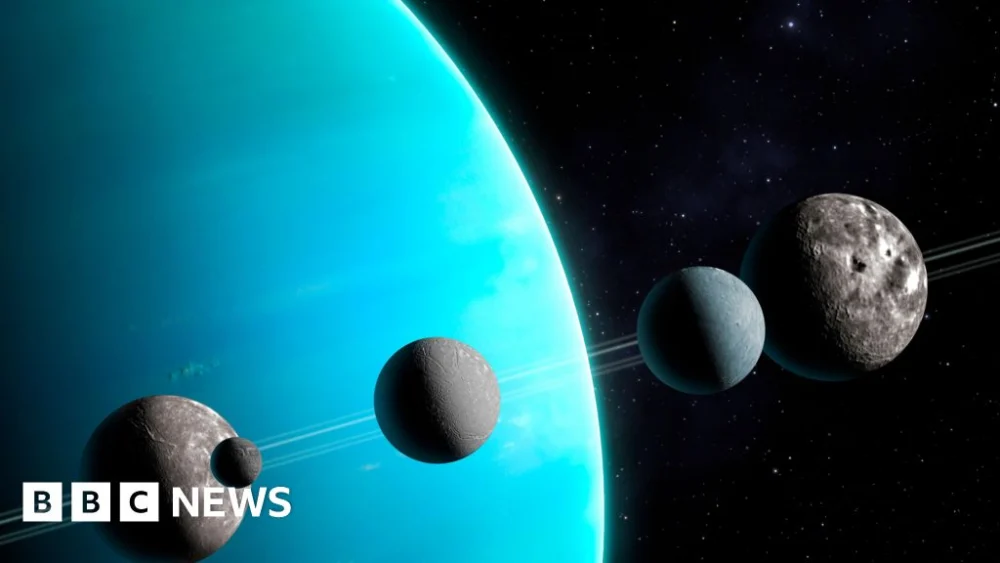
Uranus, a gas giant shrouded in an atmosphere of hydrogen, helium, and methane, resides in the outer reaches of our solar system, making it one of the coldest planets. It is also distinguished by its peculiar axial tilt, appearing to roll on its side as it orbits the Sun—a cosmic anomaly believed to be the result of a colossal ancient impact. This unique orientation, coupled with its vast distance and frigid temperatures, contributed to its image as a desolate world, unlikely to host any significant geological activity or liquid water.
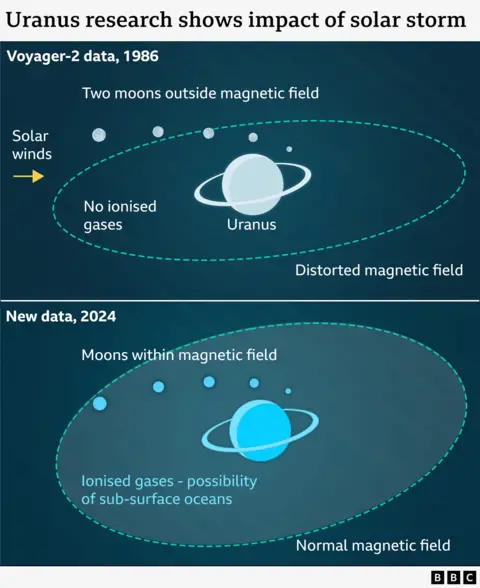
Our initial, albeit brief, close-up encounter with Uranus occurred in 1986 when Voyager 2, on its grand tour of the outer planets, swept past the gas giant and its intricate system of rings and moons. The spacecraft delivered breathtaking images and invaluable data, unveiling a complex world previously known only as a faint dot in telescopes. Yet, alongside these visual marvels, Voyager 2’s instruments also relayed puzzling information about the Uranian system’s environment. Specifically, the data suggested that Uranus and its moons were remarkably inactive, a stark contrast to other icy moons in the outer solar system, like Europa or Enceladus, which show clear signs of geological dynamism and subsurface oceans.
Furthermore, Voyager 2’s measurements indicated that Uranus’s protective magnetic field was strangely distorted, appearing squashed and pushed away from the Sun. A planet’s magnetic field acts as a shield, trapping gases and other material released from the planet itself or its moons, often indicative of geological activity or the presence of liquid water. The apparent absence of such trapped material in Uranus’s magnetosphere further reinforced the notion that the planet and its five largest satellites—Miranda, Ariel, Umbriel, Titania, and Oberon—were inert, lifeless bodies. This finding presented an enormous surprise and a decades-long mystery, as it deviated significantly from the active nature observed in the moon systems of Jupiter and Saturn.

The new analysis, recently published in the esteemed Journal Nature Astronomy, has finally provided a compelling solution to this enduring puzzle. Researchers, led by scientists at University College London, meticulously re-examined the archival data from Voyager 2. Their breakthrough revealed that the spacecraft’s flyby of Uranus coincided with an extraordinary event: a powerful solar storm. This intense burst of solar wind, a stream of charged particles emanating from the Sun, would have temporarily overwhelmed and distorted Uranus’s magnetic field, effectively blowing away any gases or other materials that might have been escaping from the planet or its moons.
Consequently, for nearly 40 years, the scientific community has held an incomplete, and ultimately misleading, view of the Uranian system’s true nature. Dr. William Dunn of University College London, a key figure in this new research, expressed the profound implications of these findings. "These results suggest that the Uranian system could be much more exciting than previously thought," Dr. Dunn stated, his enthusiasm palpable. "There could be moons there that could have the conditions that are necessary for life; they might have oceans below the surface that could be teeming with fish!" While the prospect of "fish" in such extreme environments is a vivid, perhaps hyperbolic, expression of excitement, the underlying scientific possibility of subsurface liquid water oceans, a fundamental prerequisite for life as we know it, is now significantly elevated.
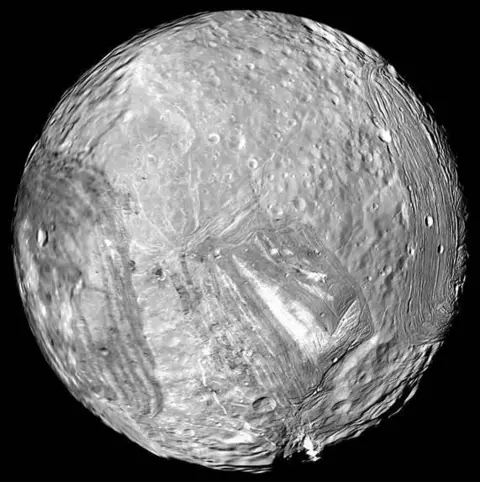
The re-evaluation of Voyager 2’s data suggests that, under normal conditions, Uranus’s magnetic field would likely be filled with gases and other signatures of activity, much like those observed around other gas giants. This implies that the Uranian moons, far from being frozen, inert rocks, could possess subsurface oceans. Such oceans, hidden beneath thick icy shells, are now considered prime candidates for hosting extraterrestrial life in our solar system, as evidenced by discoveries at Jupiter’s moon Europa and Saturn’s moon Enceladus. These distant ocean worlds are thought to be warmed by tidal forces from their parent planets or by radiogenic heating from their cores, preventing the water from freezing solid and providing potential energy sources through hydrothermal vents. The new research posits that the Uranian moons, including the dramatically fractured Miranda, could similarly harbor these hidden, potentially life-sustaining environments.
Linda Spilker, a veteran scientist who was part of the Voyager program when the original Uranus data arrived and who now serves as the project scientist for the Voyager missions, shared her delight at the new revelations. "The results are fascinating, and I am really excited to see that there is potential for life in the Uranian system," she told BBC News. Spilker also emphasized the enduring value of historic space exploration data. "I’m also so pleased that so much is being done with the Voyager data. It’s amazing that scientists are looking back at the data we collected in 1986 and finding new results and new discoveries." Her comments underscore the importance of long-term data archival and the continuous re-evaluation of scientific observations with new analytical techniques and evolving theoretical frameworks.
Dr. Affelia Wibisono of the Dublin Institute for Advanced Studies, an independent expert not involved in the research team, echoed this sentiment, describing the results as "very exciting." She highlighted the broader lesson: "It shows how important it is to look back at old data, because sometimes, hiding behind them is something new to be discovered, which can help us design the next generation of space exploration missions." This perspective is particularly pertinent given NASA’s ambitious plans for future deep-space exploration.
Indeed, partly as a direct result of this new research, NASA is actively developing a new mission, the Uranus Orbiter and Probe. After nearly four decades since Voyager 2’s singular visit, this dedicated mission aims to return to the icy world and its intriguing moons for an extended, in-depth study. The current timeline projects a launch within the next decade, with arrival at Uranus expected by 2045.
According to NASA’s Dr. Jamie Jasinski, whose initial idea sparked the re-examination of the Voyager 2 data, these findings are not just exciting scientific discoveries but also critical for the practical planning of the upcoming mission. "Some of the instruments for the future spacecraft are very much being designed with ideas from what we learned from Voyager 2 when it flew past the system when it was experiencing an abnormal event," Dr. Jasinski explained. "So we need to rethink how exactly we are going to design the instruments on the new mission so that we can best capture the science we need to make discoveries." This means the new orbiter will be equipped with instruments specifically designed to penetrate the magnetosphere during various solar conditions, seeking out the very signatures of activity and material outflow that Voyager 2 inadvertently missed. The scientific survey will also be tailored to investigate the subsurface ocean hypothesis, perhaps through gravimetric measurements or observations of surface features that could indicate cryovolcanism.
The journey to Uranus is long and challenging, but the potential rewards are immense. By the mid-21st century, when NASA’s Uranus Orbiter and Probe is expected to finally reach its destination, scientists hope to unravel the mysteries of these far-flung icy moons. What were once considered dormant, sterile worlds could very well prove to be vibrant ocean worlds, harboring the fundamental ingredients for life, thereby dramatically expanding the scope of potentially habitable environments within our own solar system and reigniting the profound question: are we truly alone?



 Roy Suryo